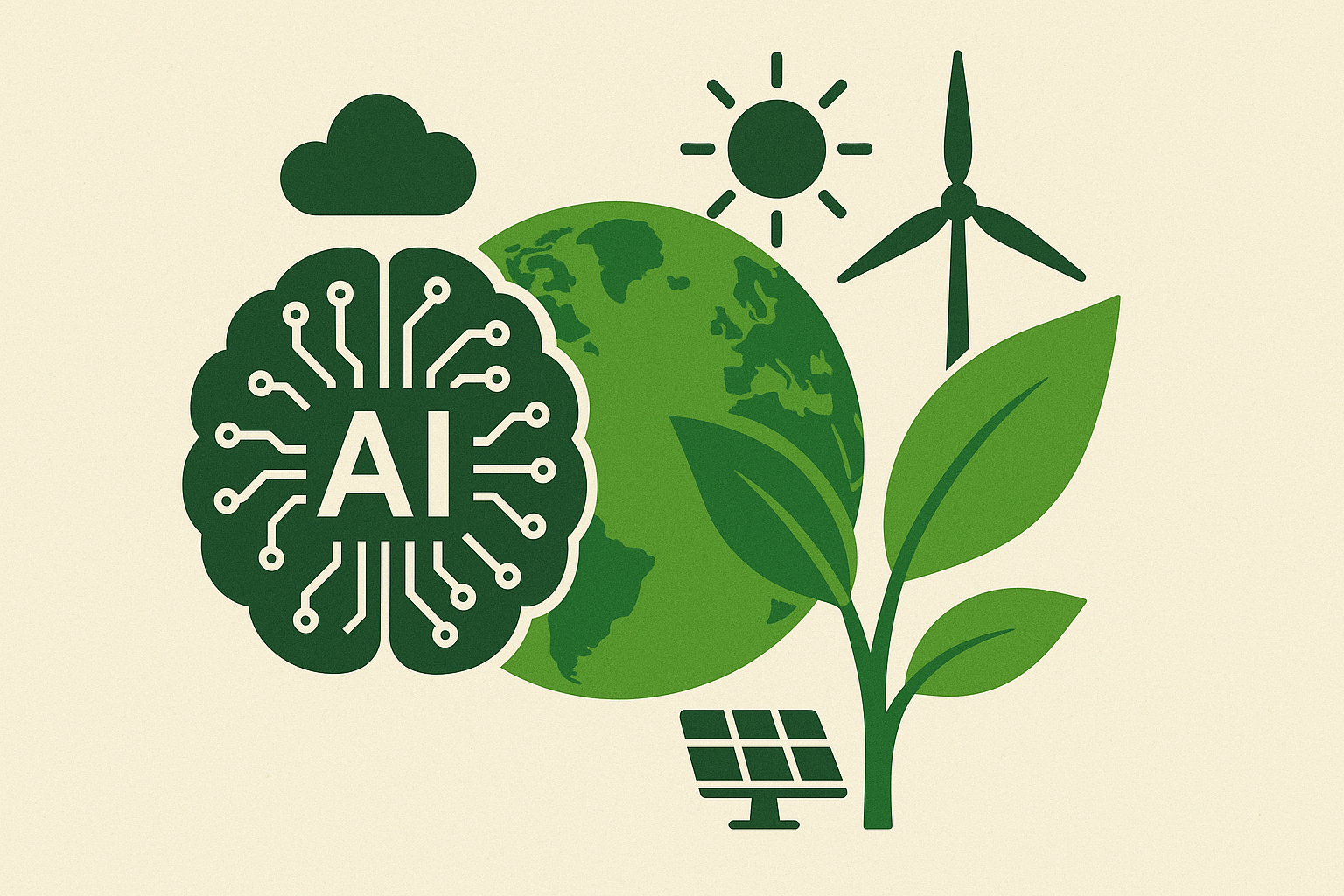
AI is increasingly recognised for its transformative potential and growing environmental footprint across industries. The development and deployment of large-scale AI models require vast computational resources, significant amounts of electricity, and extensive cooling infrastructure.
For instance, studies have shown that training a single large language model can consume as much electricity as several hundred households use in a year, while data centres operated by companies like Google and Microsoft require millions of litres of water annually to keep servers cool.
That has sparked an emerging debate around what is now often called ‘Green AI’, the effort to balance technological progress with sustainability concerns. On one side, critics warn that the rapid expansion of AI comes at a steep ecological cost, from high carbon emissions to intensive water and energy consumption.
On the other hand, proponents argue that AI can be a powerful tool for achieving sustainability goals, helping optimise energy use, supporting climate research, and enabling greener industrial practices. The tension between sustainability and progress is becoming central to discussions on digital policy, raising key questions.
Should governments and companies prioritise environmental responsibility, even if it slows down innovation? Or should innovation come first, with sustainability challenges addressed through technological solutions as they emerge?
Sustainability challenges
In the following paragraphs, we present the main sustainability challenges associated with the rapid expansion of AI technologies.
Energy consumption
The training of large-scale AI models requires massive computational power. Estimates suggest that developing state-of-the-art language models can demand thousands of GPUs running continuously for weeks or even months.
According to a 2019 study from the University of Massachusetts Amherst, training a single natural language processing model consumed roughly 284 tons of CO₂, equivalent to the lifetime emissions of five cars. As AI systems grow larger, their energy appetite only increases, raising concerns about the long-term sustainability of this trajectory.
Carbon emissions
Carbon emissions are closely tied to energy use. Unless powered by renewable sources, data centres rely heavily on electricity grids dominated by fossil fuels. Research indicates that the carbon footprint of training advanced models like GPT-3 and beyond is several orders of magnitude higher than that of earlier generations. That research highlights the environmental trade-offs of pursuing ever more powerful AI systems in a world struggling to meet climate targets.
Water usage and cooling needs
Beyond electricity, AI infrastructure consumes vast amounts of water for cooling. For example, Google reported that in 2021 its data centre in The Dalles, Oregon, used over 1.2 billion litres of water to keep servers cool. Similarly, Microsoft faced criticism in Arizona for operating data centres in drought-prone areas while local communities dealt with water restrictions. Such cases highlight the growing tension between AI infrastructure needs and local environmental realities.
Resource extraction and hardware demands
The production of AI hardware also has ecological costs. High-performance chips and GPUs depend on rare earth minerals and other raw materials, the extraction of which often involves environmentally damaging mining practices. That adds a hidden, but significant footprint to AI development, extending beyond data centres to global supply chains.
Inequality in resource distribution
Finally, the environmental footprint of AI amplifies global inequalities. Wealthier countries and major corporations can afford the infrastructure and energy needed to sustain AI research, while developing countries face barriers to entry.
At the same time, the environmental consequences, whether in the form of emissions or resource shortages, are shared globally. That creates a digital divide where the benefits of AI are unevenly distributed, while the costs are widely externalised.
Progress & solutions
While AI consumes vast amounts of energy, it is also being deployed to reduce energy use in other domains. Google’s DeepMind, for example, developed an AI system that optimised cooling in its data centres, cutting energy consumption for cooling by up to 40%. Similarly, IBM has used AI to optimise building energy management, reducing operational costs and emissions. These cases show how the same technology that drives consumption can also be leveraged to reduce it.
AI has also become crucial in climate modelling, weather prediction, and renewable energy management. For example, Microsoft’s AI for Earth program supports projects worldwide that use AI to address biodiversity loss, climate resilience, and water scarcity.
Artificial intelligence also plays a role in integrating renewable energy into smart grids, such as in Denmark, where AI systems balance fluctuations in wind power supply with real-time demand.
There is growing momentum toward making AI itself more sustainable. OpenAI and other research groups have increasingly focused on techniques like model distillation (compressing large models into smaller versions) and low-rank adaptation (LoRA) methods, which allow for fine-tuning large models without retraining the entire system.
Meanwhile, startups like Hugging Face promote open-source, lightweight models (like DistilBERT) that drastically cut training and inference costs while remaining highly effective.
Hardware manufacturers are also moving toward greener solutions. NVIDIA and Intel are working on chips with lower energy requirements per computation. On the infrastructure side, major providers are pledging ambitious climate goals.
Microsoft has committed to becoming carbon negative by 2030, while Google aims to operate on 24/7 carbon-free energy by 2030. Amazon Web Services is also investing heavily in renewable-powered data centres to offset the footprint of its rapidly growing cloud services.
Governments and international organisations are beginning to address the sustainability dimension of AI. The European Union’s AI Act introduces transparency and reporting requirements that could extend to environmental considerations in the future.
In addition, initiatives such as the OECD’s AI Principles highlight sustainability as a core value for responsible AI. Beyond regulation, some governments fund research into ‘green AI’ practices, including Canada’s support for climate-oriented AI startups and the European Commission’s Horizon Europe program, which allocates resources to environmentally conscious AI projects.
Balancing the two sides
The debate around Green AI ultimately comes down to finding the right balance between environmental responsibility and technological progress. On one side, the race to build ever larger and more powerful models has accelerated innovation, driving breakthroughs in natural language processing, robotics, and healthcare. In contrast, the ‘bigger is better’ approach comes with significant sustainability costs that are increasingly difficult to ignore.
Some argue that scaling up is essential for global competitiveness. If one region imposes strict environmental constraints on AI development, while another prioritises innovation at any cost, the former risks falling behind in technological leadership. The following dilemma raises a geopolitical question that sustainability standards may be desirable, but they must also account for the competitive dynamics of global AI development.
At the same time, advocates of smaller and more efficient models suggest that technological progress does not necessarily require exponential growth in size and energy demand. Innovations in model efficiency, greener hardware, and renewable-powered infrastructure demonstrate that sustainability and progress are not mutually exclusive.
Instead, they can be pursued in tandem if the right incentives, investments, and policies are in place. That type of development leaves governments, companies, and researchers facing a complex but urgent question. Should the future of AI prioritise scale and speed, or should it embrace efficiency and sustainability as guiding principles?
Conclusion
The discussion on Green AI highlights one of the central dilemmas of our digital age. How to pursue technological progress without undermining environmental sustainability. On the one hand, the growth of large-scale AI systems brings undeniable costs in terms of energy, water, and resource consumption. At the same time, the very same technology holds the potential to accelerate solutions to global challenges, from optimising renewable energy to advancing climate research.
Rather than framing sustainability and innovation as opposing forces, the debate increasingly suggests the need for integration. Policies, corporate strategies, and research initiatives will play a decisive role in shaping this balance. Whether through regulations that encourage transparency, investments in renewable infrastructure, or innovations in model efficiency, the path forward will depend on aligning technological ambition with ecological responsibility.
In the end, the future of AI may not rest on choosing between sustainability and progress, but on finding ways to ensure that progress itself becomes sustainable.
Would you like to learn more about AI, tech, and digital diplomacy? If so, ask our Diplo chatbot!