Crypto builders face growing pressure to design systems that protect fundamental human rights from the outset. As concerns mount over surveillance, state-backed ID systems, and AI impersonation, experts warn that digital infrastructure must not compromise individual freedom.
Privacy-by-default, censorship resistance, and decentralised self-custody are no longer idealistic features — they are essential for any credible Web3 system. Critics argue that many current tools merely replicate traditional power structures, offering centralisation disguised as innovation.
The collapse of platforms like FTX has only strengthened calls for human-centric solutions.
New approaches are needed to ensure people can prove their personhood online without relying on governments or corporations. Digital inclusion depends on verification systems that are censorship-resistant, privacy-preserving and accessible.
Likewise, self-custody must evolve beyond fragile key backups and complex interfaces to empower everyday users.
While embedding values in code brings ethical and political risks, avoiding the issue could lead to greater harm. For the promise of Web3 to be realised, rights must be a design priority — not an afterthought.
Would you like to learn more about AI, tech and digital diplomacy? If so, ask our Diplo chatbot!
A video featuring ChatGPT Live has gone viral after it correctly guessed an object hidden in a user’s hand using only a series of questions.
The clip, shared on the social media platform X, shows the chatbot narrowing down its guesses until it lands on the correct answer — a pen — within less than a minute. The video has fascinated viewers by showing how far generative AI has come since its initial launch.
Multimodal AI like ChatGPT can now process audio, video and text together, making interactions more intuitive and lifelike.
Another user attempted the same challenge with Gemini AI by holding an AC remote. Gemini described it as a ‘control panel for controlling temperature’, which was close but not entirely accurate.
The fun experiment also highlights the growing real-world utility of generative AI. During Google’s I/O conference during the year, the company demonstrated how Gemini Live can help users troubleshoot and repair appliances at home by understanding both spoken instructions and visual input.
Beyond casual use, these AI tools are proving helpful in serious scenarios. A UPSC aspirant recently explained how uploading her Detailed Application Form to a chatbot allowed it to generate practice questions.
She used those prompts to prepare for her interview and credited the AI with helping her boost her confidence.
Would you like to learn more aboutAI, tech and digital diplomacy? If so, ask our Diplo chatbot!
A Scottish research team has developed a pioneering AI-powered tool that could transform how skin cancer is diagnosed in some of the world’s most isolated regions.
The device, created by PhD student Tess Watt at Heriot-Watt University, enables rapid diagnosis without needing internet access or direct contact with a dermatologist.
Patients use a compact camera connected to a Raspberry Pi computer to photograph suspicious skin lesions.
The system then compares the image against thousands of preloaded examples using advanced image recognition and delivers a diagnosis in real time. These results are then shared with local GP services, allowing treatment to begin without delay.
The self-contained diagnostic system is among the first designed specifically for remote medical use. Watt said that home-based healthcare is vital, especially with growing delays in GP appointments.
The device, currently 85 per cent accurate, is expected to improve further with access to more image datasets and machine learning enhancements.
The team plans to trial the tool in real-world settings after securing NHS ethical approval. The initial rollout is aimed at rural Scottish communities, but the technology could benefit global populations with poor access to dermatological care.
Heriot-Watt researchers also believe the device will aid patients who are infirm or housebound, making early diagnosis more accessible than ever.
Would you like to learn more aboutAI, tech and digital diplomacy? If so, ask our Diplo chatbot!
Perplexity AI CEO Aravind Srinivas believes that the company’s new AI-powered browser, Comet, could soon replace two key white-collar roles in most offices: recruiters and executive assistants.
Speaking on The Verge podcast, Srinivas explained that with the integration of more advanced reasoning models like GPT-5 or Claude 4.5, Comet will be able to handle tasks traditionally assigned to these positions.
He also described how a recruiter’s week-long workload could be reduced to a single AI prompt.
From sourcing candidates to scheduling interviews, tracking responses in Google Sheets, syncing calendars, and even briefing users ahead of meetings, Comet is built to manage the entire process—often without any follow-up input.
The tool remains in an invite-only phase and is currently available to premium users.
Srinivas also framed Comet as the early foundation of a broader AI operating system for knowledge workers, enabling users to issue natural language commands for complex tasks.
He emphasised the importance of adopting AI early, warning that those who fail to keep pace with the technology’s rapid growth—where breakthroughs arrive every few months—risk being left behind in the job market.
In a separate discussion, he urged younger generations to reduce time spent scrolling on Instagram and instead focus on mastering AI tools. According to him, the shift is inevitable, and those who embrace it now will hold a long-term professional advantage.
Would you like to learn more aboutAI, tech and digital diplomacy? If so, ask our Diplo chatbot!
Privacy-focused search engine DuckDuckGo has launched a new feature that allows users to filter out AI-generated images from search results.
Although the company admits the tool is not perfect and may miss some content, it claims it will significantly reduce the number of synthetic images users encounter.
The new filter uses open-source blocklists, including a more aggressive ‘nuclear’ option, sourced from tools like uBlock Origin and uBlacklist.
Users can access the setting via the Images tab after performing a search or use a dedicated link — noai.duckduckgo.com — which keeps the filter always on and also disables AI summaries and the browser’s chatbot.
The update responds to growing frustration among internet users. Platforms like X and Reddit have seen complaints about AI content flooding search results.
In one example, users searching for ‘baby peacock’ reported seeing just as many or more AI images than real ones, making it harder to distinguish between fake and authentic content.
DuckDuckGo isn’t alone in trying to tackle unwanted AI material. In 2024, Hiya launched a Chrome extension aimed at spotting deepfake audio across major platforms.
Microsoft’s Bing has also partnered with groups like StopNCII to remove explicit synthetic media from its results, showing that the fight against AI content saturation is becoming a broader industry trend.
Would you like to learn more aboutAI, tech and digital diplomacy? If so, ask our Diplo chatbot!
President Donald Trump has officially signed the GENIUS Act into law, marking a historic step in establishing a legal framework for stablecoins in the US. The act, passed with bipartisan support on 18 July, introduces the first rules for the $250 billion stablecoin market.
While Trump hailed the bill’s passage as a major achievement, backlash has emerged from both politicians and crypto insiders. Republican Representative Marjorie Taylor Greene condemned the bill, arguing it could secretly enable the rollout of a central bank digital currency (CBDC).
She warned that stablecoins under state control may function like a surveillance tool and criticised the absence of a clause banning CBDCs from the legislation.
Outside Capitol Hill, concerns were echoed by prominent Bitcoin advocate Justin Bechler, who likened the act to a covert power grab by central authorities. He claimed that fully compliant, state-enforced stablecoins effectively amount to CBDCs in practice.
Jean Rausis of SmarDex also described the bill as a ‘CBDC trojan horse’.
However, some believe the criticism is misplaced. Journalist Eleanor Terrett noted that the GENIUS Act includes language that prohibits the Federal Reserve from launching a retail CBDC.
Senator Tim Scott supported this view, stating the act does not expand the Fed’s powers in any direction resembling a digital currency for the public.
Would you like to learn more about AI, tech and digital diplomacy? If so, ask our Diplo chatbot!
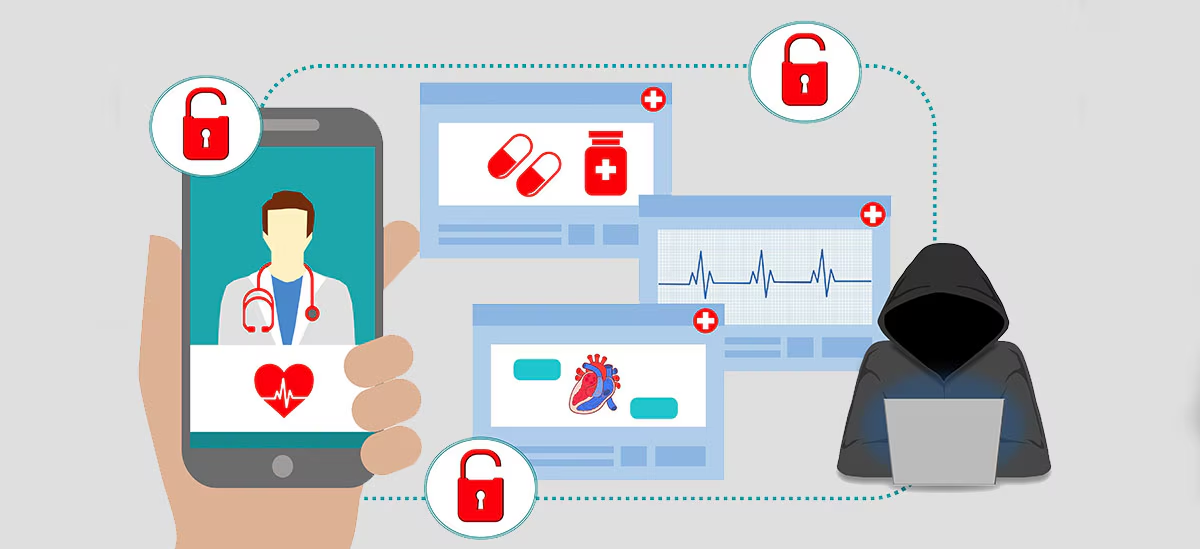
Anne Arundel Dermatology, a network of over 100 clinics across seven states, has confirmed a cyberattack that compromised patient data for nearly 1.9 million individuals.
The breach between 14 February and 13 May 2025 may have exposed sensitive personal and medical records.
The company responded swiftly by isolating affected systems, working with forensic experts and completing a full file review by 27 June.
While there is no evidence that the data was accessed or misused, patients were notified and offered 24 months of identity-theft protection.
The incident ranks among the largest reported healthcare data breaches this year, prompting mandatory notifications to state attorneys general and the HHS Office for Civil Rights.
Affected individuals are advised to monitor statements and credit reports carefully.
Would you like to learn more about AI, tech and digital diplomacy? If so, ask our Diplo chatbot!
In a massive data breach revealed in July 2025, the Texas Alcohol & Drug Testing Service (TADTS) admitted hackers gained access to sensitive information belonging to approximately 748,763 individuals.
Attackers remained inside the network for five days in July 2024 before detection, later leaking hundreds of gigabytes of data via the BianLian ransomware group.
Exposed records include a dangerous mix of personal and financial data—names, Social Security and passport numbers, driver’s licence and bank account details, biometric information, health‑insurance files and login credentials.
The breadth of this data presents a significant risk of identity theft and financial fraud.
Despite identifying the breach shortly after, TADTS delayed notifying those affected until July 2025 and provided no credit monitoring or identity theft services.
The company is now under classic action scrutiny, with law firms investigating its response and breach notification delays.
Security experts warn that the extended timeline and broad data exposure could lead to scams, account takeovers and sustained damage to victims.
Affected individuals are urged to monitor statements, access free credit reports, and remain alert for suspicious activity.
Would you like to learn more about AI, tech and digital diplomacy? If so, ask our Diplo chatbot!
Exploiting known but unpatched vulnerabilities, attackers gained persistent access to these network devices, potentially enabling further intrusions into core telecom systems.
Affected providers emphasised that only client-owned hardware was breached and confirmed no internal networks were compromised, but the campaign raises deeper concerns.
Cloud security researchers at Wiz have uncovered a critical misconfiguration in Nvidia’s Container Toolkit, used widely across managed AI services, that could allow a malicious container to break out and gain full root privileges on the host system.
The vulnerability, tracked as CVE‑2025‑23266 and nicknamed ‘NVIDIAScape’, arises from unsafe handling of OCI hooks. Exploiters can bypass container boundaries by using a simple three‑line Dockerfile, granting them access to server files, memory and GPU resources.
With Nvidia’s toolkit integral to GPU‑accelerated cloud offerings, the risk is systemic. A single compromised container could steal or corrupt sensitive data and AI models belonging to other tenants on the same infrastructure.
Nvidia has released a security advisory alongside updated toolkit versions. Users are strongly advised to apply patches immediately. Experts also recommend deploying additional isolation measures, such as virtual machines, to protect against container escape threats in multi-tenant AI environments.
Would you like to learn more about AI, tech and digital diplomacy? If so, ask our Diplo chatbot!