British Prime Minister Keir Starmer inaugurated London’s first Google-backed AI Campus in Camden on Wednesday. The facility aims to equip young people with vital skills in AI and machine learning, addressing the growing demand for expertise in these areas. Located near Google’s upcoming offices in King’s Cross, the campus has already launched a two-year pilot project for students aged 16 to 18.
The pilot cohort of 32 students will benefit from AI-focused mentoring and resources provided by Google’s DeepMind. They will engage in real-world projects that integrate AI with health, social sciences, and the arts. The campus, a collaboration between Google and local authorities, seeks to inspire students from diverse backgrounds to envision themselves as leaders in the AI-driven future.
Starmer hailed the initiative as a transformative step for young people, particularly those in challenging circumstances. He emphasised that the programme represents a significant milestone in preparing the next generation to navigate AI’s boundless potential. ‘The possibilities of AI are incredible, and projects like this will shape the future,’ he stated.
Google further announced £865,000 in funding for a national AI literacy programme. This initiative, led by the Raspberry Pi Foundation and Parent Zone, aims to train teachers and reach 250,000 students by 2026. Debbie Weinstein, Google’s UK and Ireland managing director, highlighted the programme’s role in ensuring that AI’s vast opportunities are accessible to all, potentially unlocking £400 billion in economic benefits for the UK.
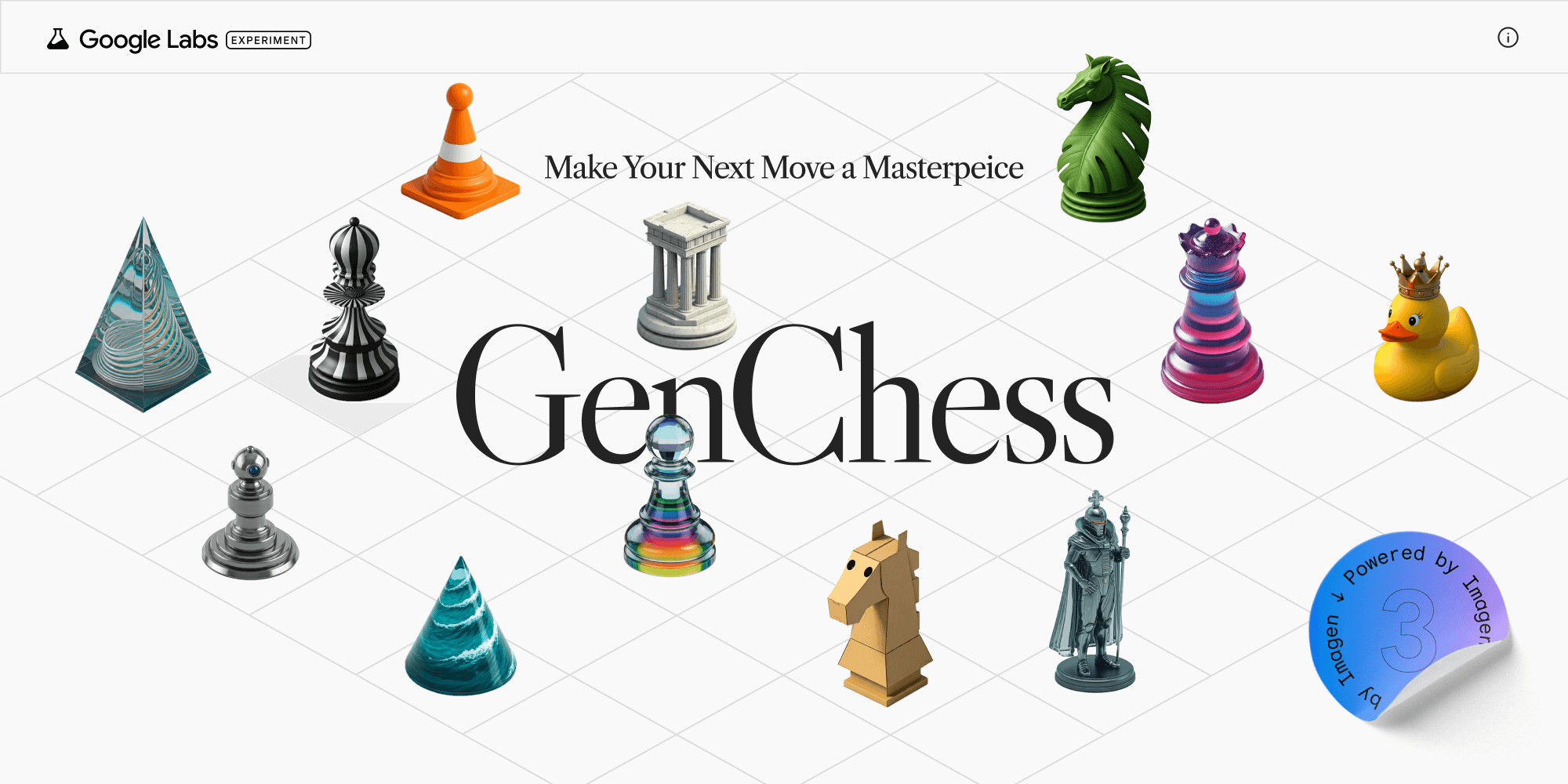
Google Labs has unveiled GenChess, a new AI-powered web project that adds a creative twist to the traditional game of chess. The experiment allows players to design their own chess pieces using Google’s Gemini Imagen 3 image-generation model. By typing text prompts, users can customise their chess sets with themes like sushi or pizza, giving each game a personalised touch. GenChess offers two styles: a classic mode that mimics traditional pieces and a creative mode for abstract designs. Players can further refine individual pieces for a truly bespoke gaming experience.
Once the custom set is complete, players can face an AI opponent with chess pieces generated on complementary themes. For instance, a sushi-themed set might compete against a taco-inspired set. Users can select from three difficulty levels—easy, medium, or hard—and two timer options to match their playstyle. The project showcases AI’s potential in creative design and user interaction, merging art and gameplay into one cohesive experience.
The launch of GenChess coincides with Google’s broader initiatives around chess during the World Chess Championship. These include a coding challenge in partnership with the International Chess Federation (FIDE) on Google-owned Kaggle, encouraging participants to create innovative AI chess engines. Additionally, Google plans to launch Chess Gem, an interactive feature in the Gemini app next month. This tool will allow Gemini Advanced subscribers to play chess against a conversational AI, blending gameplay with witty banter. The range of initiatives highlights Google’s commitment to integrating AI into diverse aspects of life, from gaming to advanced problem-solving.
Vancouver’s mayor, Ken Sim, is pushing for the city to embrace Bitcoin, positioning it as a leader in cryptocurrency adoption. During a city council meeting on 26 November, Sim proposed integrating Bitcoin into Vancouver’s investment portfolio as part of a broader effort to diversify financial assets.
The initiative aligns with a growing global trend of Bitcoin adoption by institutional investors. Major entities such as Japan’s Government Pension Investment Fund (GPIF) and the State of Wisconsin Investment Board have already included Bitcoin ETFs in their holdings. Similarly, asset management giants like Goldman Sachs are increasing their exposure to Bitcoin, showcasing its growing role in mainstream finance.
Sim’s vision highlights Bitcoin’s potential to preserve purchasing power while modernising the city’s financial strategies. If implemented, this move could place Vancouver among the world’s pioneering Bitcoin-friendly cities.
A Cambridge start-up is trialing a groundbreaking device to support independence for people living with dementia. Supersense Technologies’ SenS2 hub monitors movement, temperature, and humidity in the home without using cameras or microphones, providing real-time updates to family members. The company is seeking 100 participants for further testing as part of its push for the £4.4m Longitude Prize on Dementia.
The technology has already made a difference for families in Cambridge. Maggie, a 83-year-old, who is living with dementia, and her daughter Lucy Gardner, say the device provides vital insights into Maggie’s daily routine while preserving her independence. Lucy explained that the alerts allow her to check on her mother without intruding, reducing stress for both.
Supersense co-founders Dr. James Brown and Dr. Matt Ash emphasise that every person’s needs are unique, and data-driven customisation is key. With AI integration, the SenS2 hub can interpret activity and provide tailored updates. The device reflects the growing potential of assistive technology to alleviate the challenges of dementia care, benefiting individuals and families alike.
President-elect Donald Trump is reportedly considering appointing an ‘AI czar’ to oversee federal artificial intelligence initiatives and policy coordination. The position would centralise AI strategies across government departments, potentially reflecting growing recognition of AI’s transformative impact.
According to sources cited by Axios, Tesla CEO Elon Musk, though not a candidate for the role, is expected to contribute to discussions on AI’s future use and implications in the United States.
The move could mark a significant shift in the government’s approach to advancing AI capabilities while addressing regulatory and ethical challenges.
The United StatesCommerce Department has announced nearly $60 million in subsidies for BAE Systems and Rocket Lab to boost semiconductor production crucial for aerospace and space technologies. BAE will receive $35.5 million to quadruple the production of chips used in F-35 fighter jets and satellites, cutting its modernisation timeline significantly.
Rocket Lab’s SolAero Technologies will receive $23.9 million to expand solar cell production by 50% over three years. These space-grade semiconductors power key missions, including NASA’s Artemis programme and the James Webb Space Telescope.
The investments are part of the Biden administration’s $52.7 billion ‘Chips and Science‘ programme aimed at bolstering domestic semiconductor manufacturing.
Audio platform Pocket FM is leveraging AI to expand its vast library of over 200,000 hours of content. CEO Rohan Nayak highlighted the company’s focus on using AI tools for faster and more cost-effective content production while also exploring new genres and markets. Collaborations with AI firms like ElevenLabs have enabled the platform to produce audio content five times faster and at a fraction of the usual cost.
India-based Pocket FM is also experimenting with AI-powered tools to adapt stories for different regions. These tools not only translate but consider cultural nuances, enhancing relevance for diverse audiences. Additionally, an AI-driven writing assistant provides creators with ideas, alternative storylines, and insights based on user preferences, empowering solo writers to produce high-quality episodes consistently.
To grow its audience, Pocket FM is developing a “blockbuster engine” that analyses user engagement data to predict and create hit shows. However, the company acknowledges the challenge of maintaining content quality as AI accelerates production. Striking this balance remains critical to the platform’s success.
Since its founding, Pocket FM has raised $197M in funding and generated $127M in revenue in 2024. Competing with Audible and other audio platforms, the company aims to use AI as a cornerstone of its growth strategy.
Crypto.com is set to host a groundbreaking golf tournament in Las Vegas on 17 December, offering a prize purse paid entirely in cryptocurrency. The Crypto.com Showdown will see PGA Tour stars Rory McIlroy and Scottie Scheffler face off against LIV Golf rivals Bryson DeChambeau and Brooks Koepka.
The prize, denominated in CRO, marks the first time a major sports event has awarded winnings exclusively in cryptocurrency. Crypto.com CEO Kris Marzalek highlighted the tournament as a step towards reshaping the sports and entertainment industries through digital assets.
Organised by BZ Entertainment and EverWonder Studio, the event aims to unify professional golf while showcasing the potential of cryptocurrency. With over 100 million users and partnerships spanning Formula 1, UFC, and FIFA, Crypto.com continues solidifying its influence in global sports.
AI is transforming daily life for visually impaired individuals like Louise Plunkett, who has Stargardt disease, a condition causing progressive vision loss. Apps like “Be My AI” use ChatGPT to generate detailed descriptions of images, helping users identify everyday items, read packaging, and navigate spaces. While Plunkett praises its convenience, she notes that its descriptions can sometimes be overly detailed.
Developed by the Danish firm Be My Eyes, the app initially relied on human volunteers to describe visual elements over video calls. Now, its AI-driven features are expanding, with users increasingly turning to it for tasks such as analysing WhatsApp images. The company envisions future applications like live-streamed AI assistance to describe surroundings in real time.
Other innovations include the AI-powered WeWalk cane, which offers navigation, obstacle detection, and public transit updates through voice commands. Advocates like Robin Spinks of the Royal National Institute of Blind People emphasise AI’s potential to revolutionise accessibility, offering tools that make life easier for those with vision impairments. Despite some skepticism, many find the technology invaluable.
Biotech startup Cradle has raised $73 million to expand its labs and team, aiming to make AI-powered protein design more accessible. Founded in 2022, the company uses language models to analyse proteins, often described as “an alien programming language,” to suggest modifications that improve functionality, such as heat resistance or manufacturability.
Cradle’s software has gained traction among biotech and pharmaceutical companies by reducing the time and cost of experimental rounds, which can be both expensive and unpredictable. Its simple SaaS model eliminates concerns about royalties or intellectual property, offering a streamlined approach compared to competitors that co-develop drugs or processes.
Despite being a software provider, Cradle maintains a laboratory in Amsterdam to validate protein designs and build datasets to refine its models. The latest funding, led by IVP with participation from Index Ventures and Kindred Capital, will support lab expansion and further hiring. CEO Stef van Grieken aims to scale Cradle’s tools to reach a million scientists worldwide.