Quantum sector surges as Rigetti unveils modular machine

Quantum computing is progressing faster than expected, with Rigetti Computing achieving a major breakthrough. The company reached 99.5% median 2-qubit gate fidelity using a modular 36-qubit system—halving its error rate and moving closer to fault-tolerant computing.

The new machine, built from four 9-qubit chiplets, represents the industry’s largest multichip quantum system. Its modular design addresses the scalability challenges of single-chip models.

Rigetti’s superconducting qubits also outperform rivals by operating at significantly faster speeds.

Plans are in place to launch a 100+-qubit system before the end of 2025. Backing from DARPA, the US Air Force, and the UK government further validates Rigetti’s approach. Partnerships with Nvidia and Quanta Computer add commercial strength.

Despite modest revenue, Rigetti holds $575 million in cash with no debt and owns the sector’s first dedicated quantum chip factory. True commercial quantum advantage is expected between 2026 and 2028.

Shares of Rigetti, along with other quantum computing firms like IonQ and D-Wave, have surged in recent months, outperforming the broader market.

Rigetti offers strong potential—but remains a high-risk pick in a competitive field.

Would you like to learn more about AI, tech and digital diplomacy? If so, ask our Diplo chatbot

EU helps Vietnam prepare for cyber emergencies

The European Union and Vietnam have conducted specialised cyber‑defence training to enhance the resilience of key infrastructure sectors such as power, transportation, telecoms and finance.

Participants, including government officials, network operators and technology experts, engaged in interactive threat-hunting exercises and incident simulation drills designed to equip teams with practical cyber‑response skills.

This effort builds on existing international partnerships, including collaboration with the US Cybersecurity and Infrastructure Security Agency, to align Vietnam’s security posture with global standards.

Vietnam faces an alarming shortfall of more than 700,000 cyber professionals, with over half of organisations reporting at least one breach in recent years.

The training initiative addresses critical skills gaps and contributes to national digital security resilience.

Would you like to learn more about AI, tech and digital diplomacy? If so, ask our Diplo chatbot!

South Korea’s new Science Minister pledges AI-led national transformation

South Korea’s new Science and ICT Minister, Bae Kyung-hoon, has pledged to turn the nation into one of the world’s top three AI powerhouses.

Instead of following outdated methods, Bae outlined a bold national strategy centred on AI, science and technology, aiming to raise Korea’s potential growth rate to 3 per cent and secure a global economic leadership position.

Bae, a leading AI expert and former president of LG AI Research, officially assumed office on Thursday.

Drawing from experience developing hyperscale AI models like LG’s Exaone, he emphasised the need to build a unique competitive advantage rooted in AI transformation, talent development and technological innovation.

Rather than focusing only on industrial growth, Bae’s policy agenda targets a broad AI ecosystem, revitalised research and development, world-class talent nurturing, and addressing issues affecting daily life.

His plans include establishing AI-centred universities, enhancing digital infrastructure, promoting AI semiconductors, restoring grassroots research funding, and expanding consumer rights in telecommunications.

With these strategies, Bae aims to make AI accessible to all citizens instead of limiting it to large corporations or research institutes. His vision is for South Korea to lead in AI development while supporting social equity, cybersecurity, and nationwide innovation.

Would you like to learn more about AI, tech and digital diplomacy? If so, ask our Diplo chatbot!

EU confirms AI Act rollout and releases GPAI Code of Practice

The European Commission has confirmed it will move forward with the EU AI Act exactly as scheduled, instead of granting delays requested by tech giants and businesses.

On 10 July 2025, it published the final General-Purpose AI (GPAI) Code of Practice alongside FAQs to guide organisations aiming to comply with the new law.

Rather than opting for a more flexible timetable, the Commission is standing firm on its regulatory goals. The GPAI Code of Practice, now in its final form, sets out voluntary but strongly recommended steps for companies that want reduced administrative burdens and clearer legal certainty under the AI Act.

The document covers transparency, copyright, and safety standards for advanced AI models, including a model documentation form for providers.

Key dates have already been set. From 2 August 2025, rules covering notifications, governance, and penalties will come into force. By February 2026, official guidelines on classifying high-risk AI systems are expected.

The remaining parts of the legislation will take effect by August 2026, instead of being postponed further.

With the publication of the GPAI Code of Practice, the EU takes another step towards building a unified ethical framework for AI development and deployment across Europe, focusing on transparency, accountability, and respect for fundamental rights.

Would you like to learn more about AI, tech and digital diplomacy? If so, ask our Diplo chatbot!

US moves to block Chinese tech in undersea Internet cables

The United States is moving to strengthen the security of its digital infrastructure by proposing new regulations on undersea internet cables.

The Federal Communications Commission (FCC) plans to ban the connection of submarine cables to the US if they involve Chinese technology or equipment. It also aims to prohibit companies that are flagged as national security threats, including Huawei and ZTE.

Additionally, the FCC will seek public comments on further measures to protect undersea cable infrastructure, as part of an ongoing review of regulations overseeing the global network of submarine cables that carry 99% of international internet traffic.

These policy moves reflect US concerns over China’s role in internet infrastructure and potential espionage. Since 2020, regulators have blocked multiple cable projects linking the US to Hong Kong due to security risks.

Recent incidents, such as suspected sabotage in the Baltic Sea, Taiwan’s accusations of cable cutting by Chinese vessels, and Houthi-linked damage to cables in the Red Sea, highlight the growing vulnerability of global communications networks.

These steps guard against foreign adversary ownership, cyber threats, and physical sabotage.

Would you like to learn more about AI, tech and digital diplomacy? If so, ask our Diplo chatbot!

Salt Typhoon compromises critical US infrastructure

A US state’s Army National Guard network was thoroughly compromised by the Chinese cyberespionage group Salt Typhoon from March to December 2024. According to a confidential federal memo, hackers extracted highly sensitive information, including administrator credentials, network maps, and interstate communication data, raising alarm over data leaked across all 50 states and four US territories.

Security analysts caution that the breach goes beyond intelligence gathering. With access to National Guard systems, integral to state-level threat response and civilian support, the group is poised to exploit vulnerabilities in critical infrastructure, particularly during crises or conflict.

Salt Typhoon, linked to China’s Ministry of State Security, has a track record of penetrating telecommunications, energy grids, transport systems, and water utilities. Often leveraging known vulnerabilities in Cisco and Palo Alto equipment, the group has exfiltrated over 1,400 network configuration files from more than 70 US critical infrastructure providers.

Federal agencies, including DHS and CISA, are sounding the alarm: this deep infiltration presents a serious national security threat and indicates a strategic shift in cyber warfare. Navigating Sun Typhoon’s persistent access through local and federal networks is now a top priority in defending the critical systems on which communities rely.

Would you like to learn more about AI, tech and digital diplomacy? If so, ask our Diplo chatbot!

Broadcom challenges Nvidia with Tomahawk Ultra AI networking chip

Broadcom has introduced a new networking chip designed to boost AI data centre performance, positioning itself against Nvidia in the AI hardware race.

Called Tomahawk Ultra, the chip helps link hundreds of processors within close range, ensuring fast communication vital for large AI models.

Instead of using Nvidia’s proprietary NVLink system, Broadcom’s Tomahawk Ultra operates on an accelerated version of Ethernet and connects up to four times more chips within a server rack.

The chip acts as a traffic controller, enabling what the industry refers to as ‘scale-up’ computing — where AI models tap into combined computing power from tightly grouped chips.

According to Broadcom senior vice president Ram Velaga, it took engineers around three years to design the Tomahawk Ultra, which was originally aimed at high-performance computing but adapted for AI workloads as demand surged.

Taiwan Semiconductor Manufacturing Company (TSMC) is producing the processors using its five-nanometre process, and the chips are already shipping to customers.

Rather than requiring major hardware overhauls, the Tomahawk Ultra offers a scalable, Ethernet-based alternative for AI firms looking to build faster, more flexible data centres.

Would you like to learn more about AI, tech and digital diplomacy? If so, ask our Diplo chatbot!

Military-trained hacker brought down in telecom data theft

A former US Army Private admitted in court to a sweeping cybercrime operation targeting major telecom providers AT&T and Verizon between April 2023 and December 2024.

Operating as ‘kiberphant0m,’ he infiltrated at least ten corporate networks, stealing login credentials and sensitive call logs, including those of senior officials.

Prosecutors revealed a sophisticated scheme: the hacker used brute‑force SSH attacks, coordinated with online accomplices via Telegram, and attempted extortion valued at over US$1 million. Stolen call records were posted and sold on dark‑web platforms such as BreachForums.

Wagenius pleaded guilty to charges including wire fraud conspiracy, computer extortion, and aggravated identity theft. He faces a combined sentence of up to 27 years, with his sentencing hearing scheduled for 6 October 2025.

Security analysts note this case highlights the increasing threat of insiders exploiting privileged access and illustrates how even service‑level employees can orchestrate wide‑scale cyber intrusions and extortion campaigns.

It also underscores the strategic role of public-private coordination in dismantling online illicit economies.

Would you like to learn more about AI, tech and digital diplomacy? If so, ask our Diplo chatbot!
Europe’s quantum ambitions meet US private power and China’s state drive

Quantum computing could fundamentally reshape technology, using quantum bits (qubits) instead of classical bits. Qubits allow complex calculations beyond classical computing, transforming sectors from pharmaceuticals to defence.

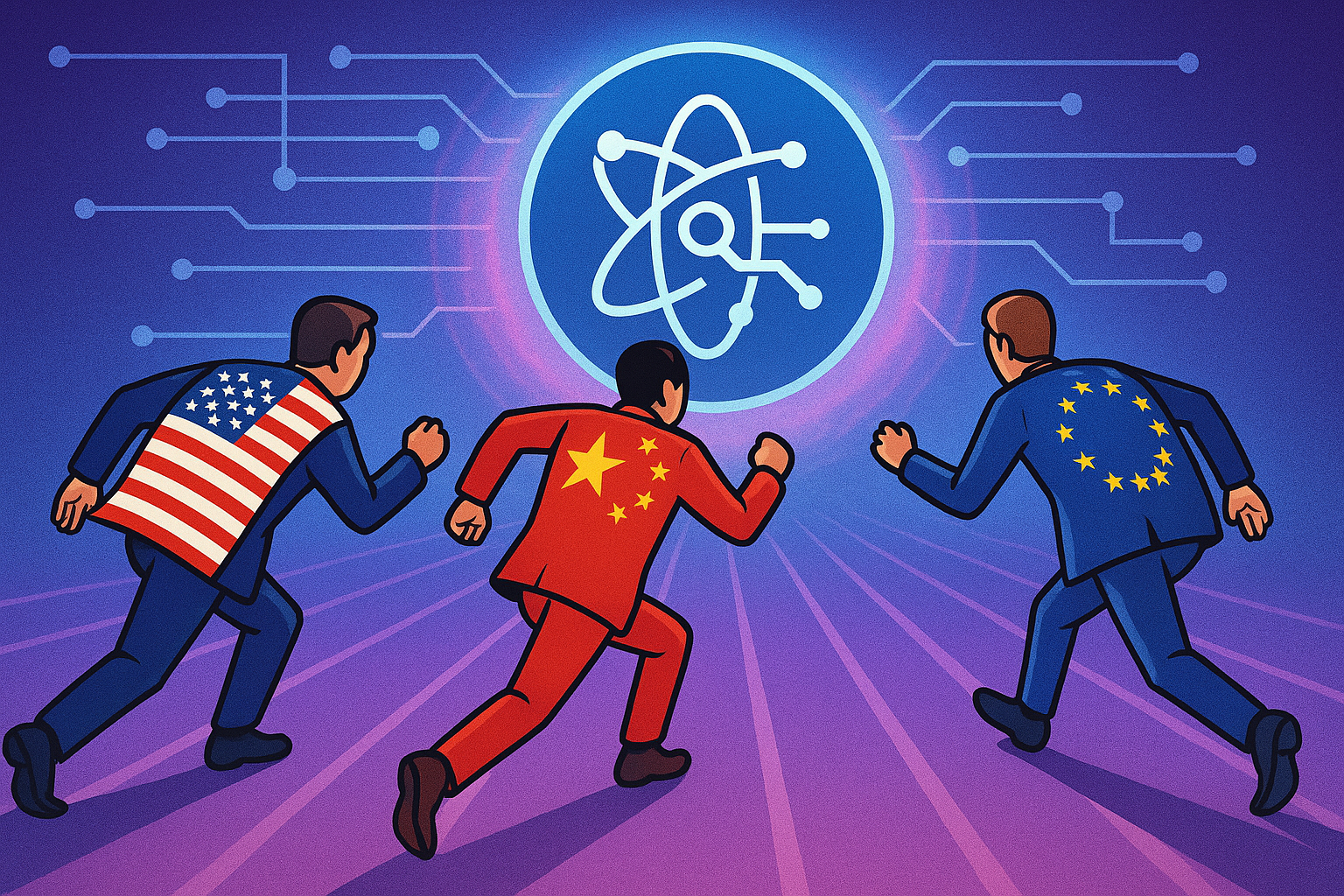
Europe is investing billions in quantum technology, emphasising technological sovereignty. Yet, it competes fiercely with the United States, which enjoys substantial private investment, and China, powered by significant state-backed funding.

The UK began quantum initiatives early, launching the National Quantum Programme 2014. It recently pledged £2.5 billion more, supporting start-ups like Orca Computing and Universal Quantum, alongside nations like Canada, Israel, and Japan.

Europe accounted for eight of the nineteen quantum start-ups established globally in 2024, including IQM Quantum Computers and Pasqal. Despite Europe’s scientific strengths, it only captured 5% of global quantum investments, versus 50% for the US.

The European Commission aims to strengthen quantum capabilities by funding six chip factories and a continent-wide Quantum Skills Academy. However, attracting sufficient private investment remains a significant challenge.

The US quantum industry thrives, driven by giants such as IBM, Google, Microsoft, IonQ, Rigetti, and D-Wave Quantum. Recent breakthroughs include Microsoft’s topological qubit and Google’s Willow quantum chip.

D-Wave Quantum has demonstrated real-world quantum advantages, solving complex optimisation problems in minutes. Its technology is now used commercially in logistics, traffic management, and supply chains.

China, meanwhile, leads in state-driven quantum funding, investing $15 billion directly and managing a $138 billion tech venture fund. By contrast, US federal investment totals about $6 billion, underscoring China’s aggressive approach.

Global investment in quantum start-ups reached $1.25 billion in Q1 2025 alone, reflecting a shift towards practical applications. By 2040, the quantum market is projected to reach $173 billion, influencing global economics and geopolitics.

Quantum computing raises geopolitical concerns, prompting democratic nations to coordinate through bodies like the OECD and G7. Interoperability, trust, and secure infrastructure have become essential strategic considerations.

Europe’s quantum ambitions require sustained investment, standard-setting leadership, and robust supply chains. Its long-term technological independence hinges on moving swiftly beyond initial funding towards genuine strategic autonomy.

Would you like to learn more about AI, tech and digital diplomacy? If so, ask our Diplo chatbot!

AI Appreciation Day highlights progress and growing concerns

AI is marking another milestone as experts worldwide reflect on its rapid rise during AI Appreciation Day. From reshaping business workflows to transforming customer experiences, AI’s presence is expanding — but so are concerns over its long-term implications.

Industry leaders point to AI’s growing role across sectors. Patrick Harrington from MetaRouter highlights how control over first-party data is now seen as key instead of just processing large datasets.

Vall Herard of Saifr adds that successful AI implementations depend on combining curated data with human oversight rather than relying purely on machine-driven systems.

Meanwhile, Paula Felstead from HBX Group believes AI could significantly enhance travel experiences, though scaling it across entire organisations remains a challenge.

Voice AI is changing industries that depend on customer interaction, according to Natalie Rutgers from Deepgram. Instead of complex interfaces, voice technology is improving communication in restaurants, hospitals, and banks.

At the same time, experts like Ivan Novikov from Wallarm stress the importance of securing AI systems and the APIs connecting them, as these form the backbone of modern AI services.

While some celebrate AI’s advances, others raise caution. SentinelOne’s Ezzeldin Hussein envisions AI becoming a trusted partner through responsible development rather than unchecked growth.

Naomi Buckwalter from Contrast Security warns that AI-generated code could open security gaps instead of fully replacing human engineering, while Geoff Burke from Object First notes that AI-powered cyberattacks are becoming inevitable for businesses unable to keep pace with evolving threats.

Would you like to learn more about AI, tech and digital diplomacy? If so, ask our Diplo chatbot!