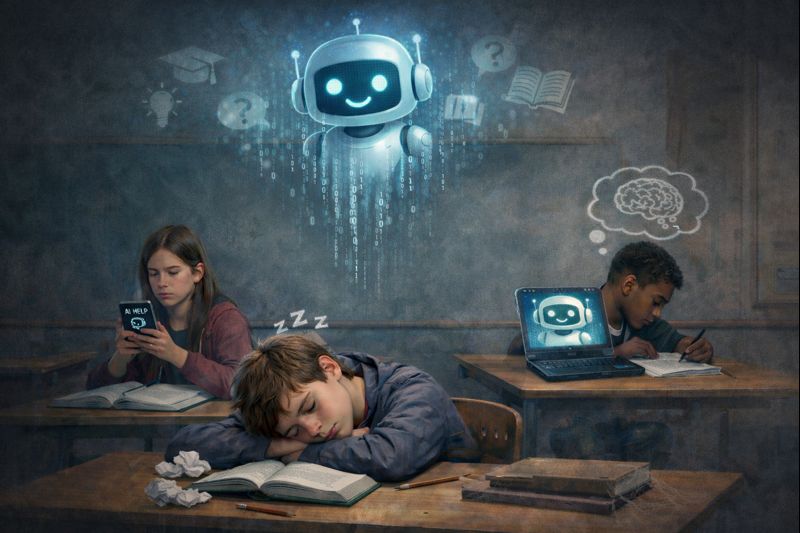
Experts say many families face a dilemma between protecting children from AI and preventing them from falling behind in an increasingly AI-driven world.
In interviews, parents expressed unease about deepfakes, blurred lines between reality and AI-generated content, and potential threats they feel unprepared to teach their children to identify.
Still, some parents are introducing AI tools to their children under supervision, viewing guided exposure as safer and more beneficial than strict prohibition. These parents emphasise helping kids learn AI responsibly rather than barring them from using it.
Experts warn that many parents delay engagement with AI out of fear or lack of knowledge, isolating themselves from opportunities to guide children.
Instead, they recommend an informed, gradual introduction, including open discussions about AI risks and benefits. Careful mediation, honesty, and education may help children develop healthy tech habits.
Would you like to learn more about AI, tech and digital diplomacy? If so, ask our Diplo chatbot!
A student from San Jose and an English teacher in Chicago co-authored a Boston Globe opinion warning that widespread use of AI in schools damages the vital student-teacher bond.
While marketed as efficiency boosters, AI tools encourage students to forgo independent thinking.
Educators report feeling increasingly marginalised as AI handles much of their workload, including grading, lesson planning, and feedback within classrooms.
The authors call for a return to supervised in-class assignments, using pen and paper, strict scrutiny of AI vendors in education, and outright bans on unsupervised AI classroom tools to help reset the learning relationship.
Would you like to learn more about AI, tech and digital diplomacy? If so, ask our Diplo chatbot!

A growing number of US teens rely on AI for daily decision‑making and emotional support, with chatbots such as ChatGPT, Character.AI and Replika. One Kansas student admits she uses AI to simplify everyday tasks, using it to choose clothes or plan events while avoiding schoolwork.
A survey by Common Sense Media reveals that over 70 per cent of teenagers have tried AI companions, with around half using them regularly. Roughly a third reported discussing serious issues with AI, sometimes finding it as or more satisfying than talking with friends.
Experts express concern that such frequent AI interactions could hinder development of creativity, critical thinking and social skills in young people. The study warns adolescents may become overly validated by AI, missing out on real‑world emotional growth.
Educators caution that while AI offers constant, non‑judgemental feedback, it is not a replacement for authentic human relationships. They recommend AI use be carefully supervised to ensure it complements rather than replaces real interaction.
Would you like to learn more about AI, tech and digital diplomacy? If so, ask our Diplo chatbot!
Children and teenagers are increasingly turning to AI not just for help with homework but as a source of companionship.
A recent study by Common Sense Media revealed that over 70% of young people have used AI as a companion. Alarmingly, nearly a third of teens reported that their conversations with AI felt as satisfying, or more so, than talking with actual friends.
Holly Humphreys, a licensed counsellor at Thriveworks in Harrisonburg, Virginia, warned that the trend is becoming a national concern.
She explained that heavy reliance on AI affects more than just social development. It can interfere with emotional wellbeing, behavioural growth and even cognitive functioning in young children and school-age youth.
As AI continues evolving, children may find it harder to build or rebuild connections with real people. Humphreys noted that interactions with AI are often shallow, lacking the depth and empathy found in human relationships.
The longer kids engage with bots, the more distant they may feel from their families and peers.
To counter the trend, she urged parents to establish firm boundaries and introduce alternative daily activities, particularly during summer months. Simple actions like playing card games, eating together or learning new hobbies can create meaningful face-to-face moments.
Encouraging children to try a sport or play an instrument helps shift their attention from artificial friends to genuine human connections within their communities.
Would you like to learn more aboutAI, tech and digital diplomacy? If so, ask our Diplo chatbot!
A new NCA survey shows 70% of Americans without crypto want more information before considering digital assets. Half of respondents said they don’t understand crypto, while others voiced concerns about scams and unknown project founders.
Despite this uncertainty, 34% of those polled said they were open to learning more. The NCA’s report summarised the mood as ‘curiosity high, confidence low,’ noting that a large number of people are interested in crypto but unsure how to take the first step.
The NCA, a nonprofit launched in March and led by Ripple Labs’ chief legal officer Stuart Alderoty, has been tasked with helping Americans better understand crypto. Backed by $50 million from Ripple, the organisation aims to build trust and boost crypto literacy through education.
Would you like to learn more about AI, tech and digital diplomacy? If so, ask our Diplo chatbot!
The MoU establishes a framework for joint research, curriculum development, and knowledge-sharing initiatives to address local priorities and global tech challenges.
This collaboration signals a strategic leap in Sri Lanka’s digital transformation journey. It emerged during Asia Tech x Singapore 2025, where officials outlined plans for AI training, policy alignment, digital infrastructure support, and e‑governance development.
The partnership builds on Sri Lanka’s broader agenda, including fintech innovation and cybersecurity, to strengthen its national AI ecosystem.
With the formalisation of this MoU, Sri Lanka hopes to elevate its regional and global AI standing. The initiative aims to empower local researchers, cultivate tech talent, and ensure that AI governance and innovation are aligned with ethical and economic goals.
Would you like to learn more about AI, tech and digital diplomacy? If so, ask our Diplo chatbot!
The agreement was finalised on 21 July by OpenAI CEO Sam Altman and science secretary Peter Kyle. It includes a commitment to expand OpenAI’s London office. Research and engineering teams will grow to support AI development and provide assistance to UK businesses and start-ups.
Under the collaboration, OpenAI will share technical insights with the UK’s AI Security Institute to help government bodies better understand risks and capabilities. Planned deployments of AI will focus on public sectors such as justice, defence, education, and national security.
According to the UK government, all applications will follow national standards and guidelines to improve taxpayer-funded services. Peter Kyle described AI as a critical tool for national transformation. ‘AI will be fundamental in driving the change we need to see across the country,’ he said.
He emphasised its potential to support the NHS, reduce barriers to opportunity, and power economic growth. The deal signals a deeper integration of OpenAI’s operations in the UK, with promises of high-skilled jobs, investment in infrastructure, and stronger domestic oversight of AI development.
Would you like to learn more about AI, tech and digital diplomacy? If so, ask our Diplo chatbot!
Perplexity AI CEO Aravind Srinivas believes that the company’s new AI-powered browser, Comet, could soon replace two key white-collar roles in most offices: recruiters and executive assistants.
Speaking on The Verge podcast, Srinivas explained that with the integration of more advanced reasoning models like GPT-5 or Claude 4.5, Comet will be able to handle tasks traditionally assigned to these positions.
He also described how a recruiter’s week-long workload could be reduced to a single AI prompt.
From sourcing candidates to scheduling interviews, tracking responses in Google Sheets, syncing calendars, and even briefing users ahead of meetings, Comet is built to manage the entire process—often without any follow-up input.
The tool remains in an invite-only phase and is currently available to premium users.
Srinivas also framed Comet as the early foundation of a broader AI operating system for knowledge workers, enabling users to issue natural language commands for complex tasks.
He emphasised the importance of adopting AI early, warning that those who fail to keep pace with the technology’s rapid growth—where breakthroughs arrive every few months—risk being left behind in the job market.
In a separate discussion, he urged younger generations to reduce time spent scrolling on Instagram and instead focus on mastering AI tools. According to him, the shift is inevitable, and those who embrace it now will hold a long-term professional advantage.
Would you like to learn more aboutAI, tech and digital diplomacy? If so, ask our Diplo chatbot!
OpenAI’s experimental language model has reached a noteworthy milestone in AI by performing at a gold medal level in the 2025 International Math Olympiad (IMO), one of the world’s most challenging competitions.
The model solved five out of six problems under the same timed and tool-free conditions as human participants, earning 35 out of 42 possible points. Three former IMO medalists evaluated each solution to ensure fairness and accuracy.
The achievement marks a leap in AI’s reasoning capabilities, with the model demonstrating the ability to tackle complex problems requiring hours of sustained creative thinking.
Researcher Alexander Wei noted the significance of this progress, tracing the model’s development through reasoning benchmarks from fundamental arithmetic problems to Olympiad-level tasks demanding far deeper cognitive effort.
Despite the breakthrough, the model is not expected to be released to the public anytime soon. OpenAI clarified that the IMO-capable model is part of an internal research track, distinct from its upcoming release of GPT-5.
According to Wei, GPT-5 will arrive soon but will not yet contain the same advanced mathematics capabilities.
In parallel, Hyperbolic Labs co-founder Yuchen Jin hinted that GPT-5 will operate as a multi-model system with dynamic routing, automatically selecting the most appropriate sub-model based on user input. Jin also noted that GPT-6 is already in training, suggesting rapid, continued progress in AI development.
Would you like to learn more about AI, tech and digital diplomacy? If so, ask our Diplo chatbot!

Massachusetts libraries face sweeping service reductions as federal funding cuts threaten critical educational and digital access programmes. Local and major libraries are bracing for the loss of key resources including summer reading initiatives, online research tools, and English language classes.
The Massachusetts Board of Library Commissioners (MBLC) said it has already lost access to 30 of 34 databases it once offered. Resources such as newspaper archives, literacy support for the blind and incarcerated, and citizenship classes have also been cancelled due to a $3.6 million shortfall.
Communities unable to replace federal grants with local funds will be disproportionately affected. With over 800 library applications for mobile internet hot spots now frozen, officials warn that students and jobseekers may lose vital lifelines to online learning, healthcare and employment.
The cuts are part of broader efforts by the Trump administration to shrink federal institutions, targeting what it deems anti-American programming. Legislators and library leaders say the result will widen the digital divide and undercut libraries’ role as essential pillars of equitable access
Would you like to learn more about AI, tech and digital diplomacy? If so, ask our Diplo chatbot!