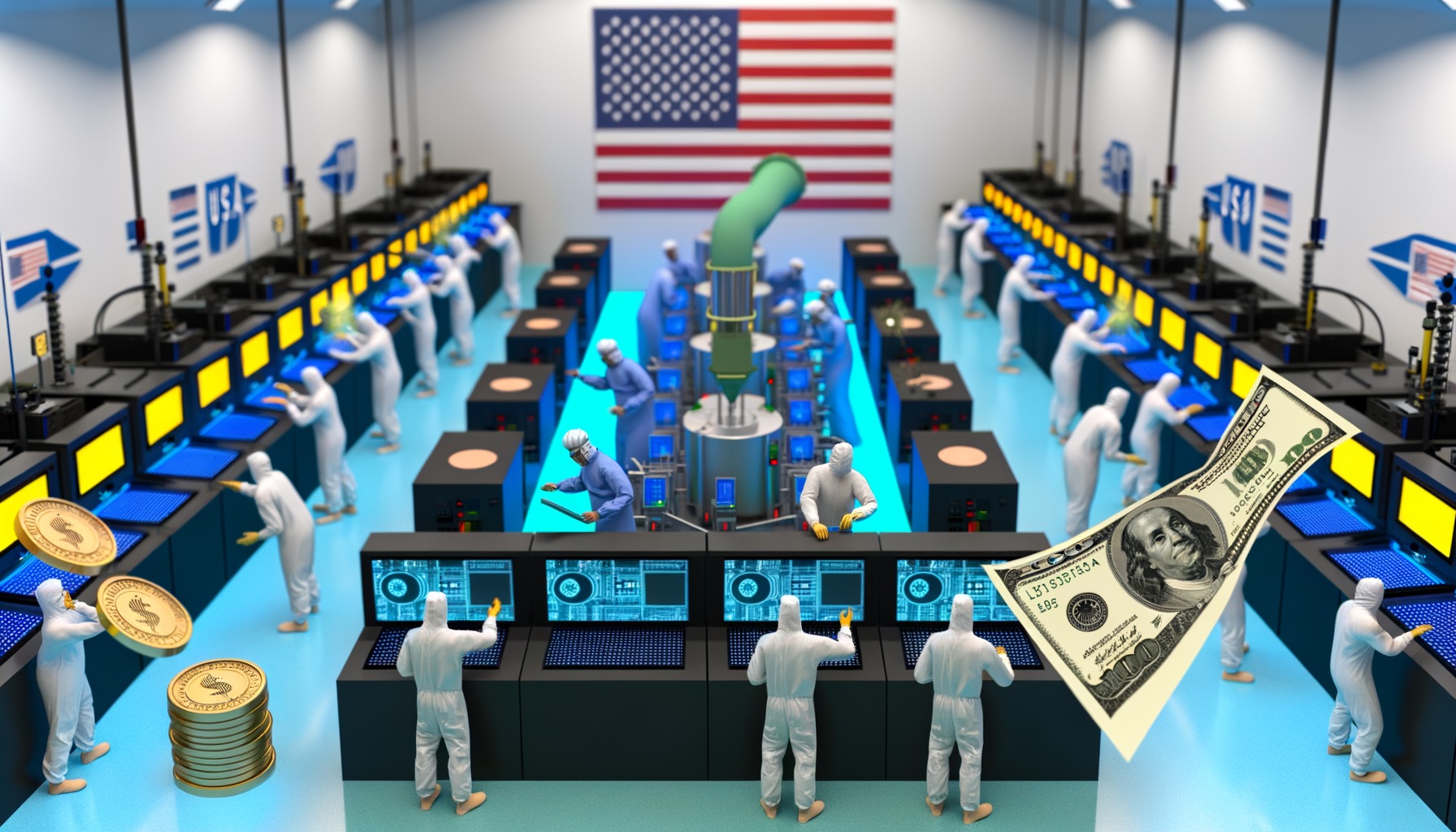
The United StatesCommerce Department has announced nearly $60 million in subsidies for BAE Systems and Rocket Lab to boost semiconductor production crucial for aerospace and space technologies. BAE will receive $35.5 million to quadruple the production of chips used in F-35 fighter jets and satellites, cutting its modernisation timeline significantly.
Rocket Lab’s SolAero Technologies will receive $23.9 million to expand solar cell production by 50% over three years. These space-grade semiconductors power key missions, including NASA’s Artemis programme and the James Webb Space Telescope.
The investments are part of the Biden administration’s $52.7 billion ‘Chips and Science‘ programme aimed at bolstering domestic semiconductor manufacturing.
The Bank of England is expediting its efforts to develop a central bank digital currency (CBDC), with Governor Andrew Bailey highlighting the urgency of creating a secure, accessible form of digital money for the UK. This move follows growing concerns that private fintech firms are outpacing traditional financial institutions in digital innovation, raising risks to financial stability, security and consumer privacy.
Bailey’s comments reflect a global challenge: central banks must modernise to keep pace with the rapid advancements in blockchain and Web3 technologies. Private sector firms, often operating with fewer regulatory constraints, are achieving breakthroughs that leave traditional systems struggling to adapt. However, their unchecked progress could deepen vulnerabilities in the global financial landscape.
The push for a digital pound is seen as essential not just for competitiveness but also for aligning with society’s shifting expectations. As consumers increasingly demand transparent, on-demand financial services, central banks face a crucial decision. They must either embrace partnerships with fintech firms and reform outdated frameworks or risk falling behind in the race for digital innovation. A CBDC, if implemented correctly, could pave the way for greater financial inclusivity and economic stability.
Audio platform Pocket FM is leveraging AI to expand its vast library of over 200,000 hours of content. CEO Rohan Nayak highlighted the company’s focus on using AI tools for faster and more cost-effective content production while also exploring new genres and markets. Collaborations with AI firms like ElevenLabs have enabled the platform to produce audio content five times faster and at a fraction of the usual cost.
India-based Pocket FM is also experimenting with AI-powered tools to adapt stories for different regions. These tools not only translate but consider cultural nuances, enhancing relevance for diverse audiences. Additionally, an AI-driven writing assistant provides creators with ideas, alternative storylines, and insights based on user preferences, empowering solo writers to produce high-quality episodes consistently.
To grow its audience, Pocket FM is developing a “blockbuster engine” that analyses user engagement data to predict and create hit shows. However, the company acknowledges the challenge of maintaining content quality as AI accelerates production. Striking this balance remains critical to the platform’s success.
Since its founding, Pocket FM has raised $197M in funding and generated $127M in revenue in 2024. Competing with Audible and other audio platforms, the company aims to use AI as a cornerstone of its growth strategy.
Chinese robotaxi firm Pony AI secured $260 million in a US IPO, valuing the startup at $4.55 billion. This marks a resurgence in US investor confidence for Chinese tech companies, with the IPO reflecting renewed interest in autonomous driving technologies despite ongoing geopolitical tensions.
The company’s move follows a period of uncertainty for Chinese firms in US markets, notably after Didi Global’s delisting. Regulatory disputes between China and the US have eased, bolstering opportunities for companies like Pony AI. However, the robotaxi sector faces challenges, including public concerns about autonomous vehicles’ safety, data privacy, and stiff competition from rivals such as Tesla, which plans to launch similar services in the US next year.
Pony AI sold 20 million American depositary shares at $13 each and raised an additional $153.4 million through private placements. Backed by Toyota, the company’s valuation has declined from $8.5 billion two years ago, highlighting the competitive and uncertain nature of the market. Analysts note widespread robotaxi adoption may take years due to safety and reliability hurdles.
The IPO follows a trend of other Chinese firms, including Zeekr and WeRide, also going public in the US. While Pony AI’s operations in the US remain limited, its public listing underscores growing investor interest in technology startups despite profitability challenges and intense market competition.
South Korea announced plans to provide 14 trillion won ($10 billion) in low-interest loans next year to support its chip sector amid growing competition from China and uncertainty over US trade policies under President-elect Donald Trump. The funds, managed by state-run banks, will include 1.8 trillion won for infrastructure like power lines at a new high-tech chip complex in Yongin and Pyeongtaek, designed to attract advanced chipmakers.
The government highlighted challenges posed by rapid advancements in China’s semiconductor industry and potential changes to US policies like the Inflation Reduction Act and Chips Act, which could alter global trade incentives. Trump has also pledged new tariffs on goods from China, Mexico, and Canada, raising additional concerns for South Korean exporters.
While South Korea leads in memory chip manufacturing through giants like Samsung Electronics and SK Hynix, it faces setbacks in chip design and contract manufacturing, where rivals are gaining ground. The government vowed to use all available resources to help the industry overcome its current challenges and maintain global competitiveness.
Vietnam’s Prime Minister Pham Minh Chinh called on the United States to remove export restrictions on certain technologies during an event in Hanoi hosted by the American Chamber of Commerce. Chinh emphasised Vietnam’s interest in satellite communications development and revealed ongoing talks with SpaceX to boost aerospace cooperation. He also urged the US to recognise Vietnam as a market economy, a step that could lower trade tariffs.
The US currently restricts Vietnam’s access to technologies deemed critical to national security, though Vietnam is allowed to import conventional weapons and some advanced technologies. Chinh questioned the necessity of the embargo, stating, “We are not fighting anyone, so why do you keep the embargo?”
Despite potential US tariffs of up to 20% on imports under the next Trump administration, Chinh avoided addressing the issue directly. He instead highlighted Vietnam’s $25 billion in expected foreign investment this year and stressed the importance of maintaining strong US-Vietnam relations to tackle global challenges.
Samsung Electronics made significant leadership changes on Wednesday, aiming to strengthen its position in the competitive AI chip market. Semiconductor chief Jun Young-hyun was named co-CEO, gaining direct control of the struggling memory chip business, while US chip head Han Jin-man was promoted to lead the foundry division. The moves reflect Samsung’s strategy to address declining profits and regain its edge against rivals SK Hynix and Taiwan’s TSMC.
The reshuffle comes amid growing investor concerns over Samsung’s lagging performance in AI chip supply, particularly to key client Nvidia. Samsung’s semiconductor profits dropped sharply in the third quarter, attributed to delays with a major customer. Despite some progress since, analysts remain sceptical about the leadership structure, with Chung Hyun-ho retaining his influential role in the Business Support Task Force.
Chairman Jay Y. Lee acknowledged public and investor concerns during a hearing this week, emphasising the need to navigate business uncertainty and intensifying competition, particularly from Chinese chipmakers. Samsung hopes the leadership overhaul will drive innovation and stabilise its chip business in a rapidly evolving market.
OpenAI is allowing employees to sell up to $1.5 billion worth of shares to Japan’s SoftBank Group in a new tender offer, according to sources familiar with the deal. This follows SoftBank’s $500 million investment in OpenAI during an October funding round that valued the Microsoft-backed AI startup at $157 billion. Employees have until 24 December to decide whether to sell their shares, with the offer price matching the last funding round.
SoftBank’s Vision Fund 2 will finance the purchase, reflecting CEO Masayoshi Son’s strategy to increase his stake in AI ventures. Son has aggressively expanded his AI portfolio, including investments in OpenAI and chip startup Graphcore, as he positions the conglomerate to ride the AI boom.
OpenAI continues to attract global attention with its flagship product ChatGPT, which now boasts 250 million weekly active users. The company’s rapid growth and high valuation highlight its central role in shaping the AI revolution.
Australia is set to link its Indian Ocean territory of Christmas Island to the mainland through a subsea cable project backed by Alphabet’s Google. The Bosun cable will connect Darwin to Christmas Island, significantly enhancing digital resilience and creating additional pathways to Asia. Christmas Island, strategically located 350 km from Jakarta, is home to a small population of 1,250 but plays a vital role in regional defence and communications, aligning with ongoing US-Australia military upgrades in northern Australia.
The project, supported by Australian firms NextDC, Vocus, and Subco, forms part of a larger strategy to diversify subsea cable networks. These connections will complement Australia’s links across the Pacific and Indian Oceans, integrating into global networks connecting the United States, Asia, and the Pacific Islands. The cables also support Australia’s defence strategy, including its surveillance operations as China‘s submarine activity increases in the Indian Ocean.
In addition to its strategic importance, the cable will provide the residents of Christmas Island with faster and more reliable internet services, significantly improving local connectivity. This development highlights Australia’s commitment to secure, resilient digital infrastructure while strengthening ties with its remote territories and global partners.
Huawei has announced plans to expand its Harmony operating system with a target of 100,000 apps in the next 6–12 months. Chairman Xu Zhijun emphasised the need for personalised applications to strengthen the ecosystem and meet consumer demands. Currently, Harmony has over 15,000 apps catering to basic needs.
The push comes amid United Statessanctions, which have restricted Huawei’s access to Google’s Android. Xu called on developers, government agencies, and organisations to support Harmony, stressing its maturity will depend on widespread adoption and user patience.
HarmonyOS was unveiled in 2019 after the US imposed trade restrictions upon China, citing security concerns. Huawei remains committed to investing in its development to achieve technological self-reliance, with Xu describing the initiative as essential for the company’s future success.