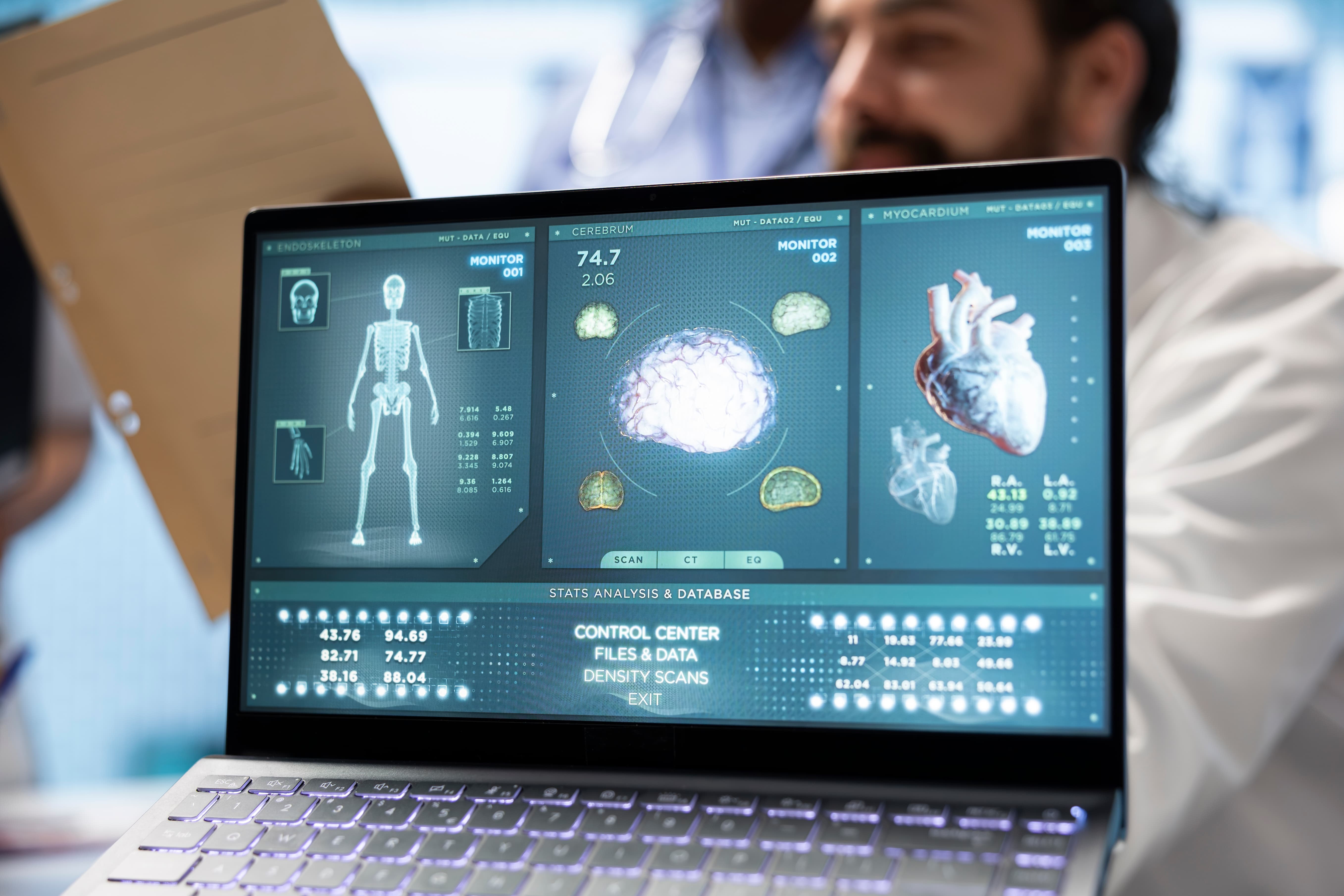
Scientists have unveiled an AI tool capable of predicting the risk of developing over 1,000 medical conditions. Published in Nature, the model can forecast certain cancers, heart attacks, and other diseases more than a decade in advance.
Developed by the German Cancer Research Centre (DKFZ), the European Molecular Biology Laboratory (EMBL), and the University of Copenhagen, the model utilises anonymised health data from the UK and Denmark. It tracks the order and timing of medical events to spot patterns that lead to serious illness.
Researchers said the tool is exceptionally accurate for diseases with consistent progression, including some cancers, diabetes, heart attacks, and septicaemia. Its predictions work like a weather forecast, indicating higher risk rather than certainty.
The model is less reliable for unpredictable conditions such as mental health disorders, infectious diseases, or pregnancy complications. It is more accurate for near-term forecasts than for those decades ahead.
Though not yet ready for clinical use, the system could help doctors identify high-risk patients earlier and enable more personalised, preventive healthcare strategies. Researchers say more work is needed to ensure the tool works for diverse populations.
Would you like to learn more about AI, tech, and digital diplomacy? If so, ask our Diplo chatbot!
NVIDIA and the UK are accelerating plans to build the nation’s AI infrastructure, positioning the country as a hub for AI innovation, jobs and research.
The partnership, announced by Prime Minister Keir Starmer and NVIDIA CEO Jensen Huang earlier in the year, has already resulted in commitments worth up to £11 billion.
A rollout that includes AI factories equipped with 120,000 NVIDIA Blackwell GPUs across UK data centres, supporting projects such as OpenAI’s Stargate UK.
NVIDIA partner Nscale will host 60,000 of these GPUs domestically while expanding its global capacity to 300,000. Microsoft, CoreWeave and other partners are also investing in advanced supercomputing facilities, with new projects announced in England and Scotland.
NVIDIA is working with Oxford Quantum Circuits and other research institutions to integrate AI and quantum technologies in a collaboration that extends to quantum computing.
Universities in Edinburgh and Oxford are advancing GPU-driven quantum error correction and AI-controlled quantum hardware, highlighting the UK’s growing role in cutting-edge science.
To prepare the workforce, NVIDIA has joined forces with techUK and QA to provide training programmes and AI skills development.
The government has framed the initiative as a foundation for economic resilience, job creation and sovereign AI capability, aiming to place Britain at the forefront of the AI industrial revolution.
Would you like to learn more aboutAI, tech and digital diplomacy? If so, ask our Diplo chatbot!
The Securities and Exchange Commission has approved new generic listing standards for exchange-traded products that hold spot commodities, including digital assets. Exchanges can now list and trade Commodity-Based Trust Shares without submitting a separate SEC rule change.
SEC Chairman Paul S. Atkins said the move aims to maintain America’s capital markets as a leading hub for digital asset innovation. The decision is expected to increase investor choice and streamline access to digital asset products.
Jamie Selway, Director of the Division of Trading and Markets, highlighted that the approval offers clear regulatory guidance and ensures investor protections while making it easier for products to reach the market.
Alongside the generic standards, the SEC approved the Grayscale Digital Large Cap Fund listing, which tracks the CoinDesk 5 Index of spot digital assets.
The regulator also authorised p.m.-settled options on the Cboe Bitcoin US ETF Index and the Mini-Cboe Bitcoin US ETF Index with multiple expiration formats.
Would you like to learn more about AI, tech and digital diplomacy? If so, ask our Diplo chatbot!
Zuckerberg’s Meta has unveiled a new generation of smart glasses powered by AI at its annual Meta Connect conference in California. Working with Ray-Ban and Oakley, the company introduced devices including the Meta Ray-Ban Display and the Oakley Meta Vanguard.
These glasses are designed to bring the Meta AI assistant into daily use instead of being confined to phones or computers.
The Ray-Ban Display comes with a colour lens screen for video calls and messaging and a 12-megapixel camera, and will sell for $799. It can be paired with a neural wristband that enables tasks through hand gestures.
Meta also presented $499 Oakley Vanguard glasses aimed at sports fans and launched a second generation of its Ray-Ban Meta glasses at $379. Around two million smart glasses have been sold since Meta entered the market in 2023.
Analysts see the glasses as a more practical way of introducing AI to everyday life than the firm’s costly Metaverse project. Yet many caution that Meta must prove the benefits outweigh the price.
Chief executive Mark Zuckerberg described the technology as a scientific breakthrough. He said it forms part of Meta’s vast AI investment programme, which includes massive data centres and research into artificial superintelligence.
The launch came as activists protested outside Meta’s New York headquarters, accusing the company of neglecting children’s safety. Former safety researchers also told the US Senate that Meta ignored evidence of harm caused by its VR products, claims the company has strongly denied.
Would you like to learn more aboutAI, tech and digital diplomacy? If so, ask our Diplo chatbot!
Hammersmith and Fulham Council has approved a £3m upgrade to its CCTV system to see facial recognition and AI integrated across the west London borough.
With over 2,000 cameras, the council intends to install live facial recognition technology at crime hotspots and link it with police databases for real-time identification.
Alongside the new cameras, 500 units will be equipped with AI tools to speed up video analysis, track vehicles, and provide retrospective searches. The plans also include the possible use of drones, pending approval from the Civil Aviation Authority.
Council leader Stephen Cowan said the technology will provide more substantial evidence in a criminal justice system he described as broken, arguing it will help secure convictions instead of leaving cases unresolved.
Civil liberties group Big Brother Watch condemned the project as mass surveillance without safeguards, warning of constant identity checks and retrospective monitoring of residents’ movements.
Some locals also voiced concern, saying the cameras address crime after it happens instead of preventing it. Others welcomed the move, believing it would deter offenders and reassure those who feel unsafe on the streets.
The Metropolitan Police currently operates one pilot site in Croydon, with findings expected later in the year, and the council says its rollout depends on continued police cooperation.
Would you like to learn more aboutAI, tech and digital diplomacy? If so, ask our Diplo chatbot!
Scaling law estimation helps organisations make better decisions about architecture, optimisers and dataset sizes before devoting extensive compute budgets.
The team assembled over 485 pre-trained models across 40 families (including Pythia, OPT, Bloom, LLaMA and others) and tracked almost 1.9 million performance metrics. Using that dataset, they fit more than 1,000 scaling laws and assessed variables such as the number of parameters, the token count, intermediate training checkpoints, and seed effects.
Practical recommendations include discarding training data from very early stages (before about 10 billion tokens), using several small models across sizes rather than only large ones, and using intermediate checkpoints rather than waiting for final model loss.
The guide also notes that a 4 percent absolute relative error (ARE) is near best-case for prediction quality, though up to 20 percent ARE remains useful depending on budget.
Because training large models can cost millions, these scaling laws also help those without huge resources to approximate outcomes more safely. AI model inference scaling laws are still under development and are flagged as important future work.
Would you like to learn more about AI, tech and digital diplomacy? If so, ask our Diplo chatbot!
Hong Kong will establish a new team to advance the use of AI across government departments, Chief Executive John Lee confirmed during his 2025 Policy Address.
The AI Efficacy Enhancement Team, led by Deputy Chief Secretary Warner Cheuk, will coordinate reforms to modernise outdated processes and promote efficiency.
Lee said his administration would focus on safe ‘AI+ development’, applying the technology in public services and encouraging adoption across different sectors instead of relying on traditional methods.
He added that Hong Kong had the potential to grow into a global hub for AI and would treat the field as a core industry for the city’s economic future.
Examples of AI adoption are already visible.
The government’s 1823 enquiry hotline uses voice recognition to cut response times by 30 per cent, while the Census and Statistics Department applies AI models to trade data and company reports, reducing manual checks by 40 per cent and improving accuracy.
Authorities expect upcoming censuses in 2026 and 2031 to save about $680 million through AI and data science technologies instead of conventional manpower-heavy methods.
The announcement comes shortly after China unveiled its national AI policy blueprint, which seeks widespread integration of the technology in research, governance and industry, with a target of 90 per cent prevalence by 2030.
Hong Kong’s approach is being positioned as part of a wider push for technological leadership in the region.
Would you like to learn more aboutAI, tech and digital diplomacy? If so, ask our Diplo chatbot!
Google has unveiled the Agent Payments Protocol (AP2), a new system enabling AI applications to send and receive payments, including stablecoins pegged to traditional currencies.
Developed with Coinbase, the Ethereum Foundation, and over 60 other finance and technology firms, AP2 aims to standardise transactions between AI agents and merchants.
The protocol builds on Google’s earlier Agent2Agent framework, extending it to financial interactions. AP2 supports credit and debit cards, bank transfers, and stablecoins, providing a secure and compliant foundation for automated payments.
By introducing a shared language for AI-led transactions, the system addresses risks linked to authorisation, authenticity, and accountability without human intervention.
The project reflects growing interest in stablecoins, whose circulation recently rose to $289 billion from $205 billion at the start of the year. Integrating stablecoins into AI could change how automated systems manage payments, from daily purchases to complex financial tasks.
Google and its collaborators emphasise AP2’s goal of interoperability across industries, offering flexibility, compliance, and scalability. The initiative makes digital money central to AI, signalling a shift in automated financial transactions.
Would you like to learn more about AI, tech and digital diplomacy? If so, ask our Diplo chatbot!
YouTube has unveiled a new suite of AI tools designed to enhance the creation of Shorts, with its headline innovation being Veo 3 Fast, a streamlined version of Google DeepMind’s video model.
A system that can generate 480p clips with sound almost instantly, marking the first time audio has been added to Veo-generated Shorts. It is already being rolled out in the US, the UK, Canada, Australia and New Zealand, with other regions to follow instead of a limited release.
The platform also introduced several advanced editing features, such as motion transfer from video to still images, text-based styling, object insertion and Speech to Song Remixing, which converts spoken dialogue into music through DeepMind’s Lyria 2 model.
Testing will begin in the US before global expansion.
Another innovation, Edit with AI, automatically assembles raw footage into a rough cut complete with transitions, music and interactive voiceovers. YouTube confirmed the tool is in trials and will launch in select markets within weeks instead of years.
All AI-generated Shorts will display labels and watermarks to maintain transparency, as YouTube pushes to expand creator adoption and boost Shorts’ growth as a rival to TikTok and Instagram Reels.
Would you like to learn more aboutAI, tech and digital diplomacy? If so, ask our Diplo chatbot!
ADP enables businesses to generate autonomous AI agents that can be integrated into workflows, including customer service, marketing, inventory management, and research.
Tencent is also upgrading its internal models and infrastructure, such as ‘Agent Runtime’, to support stable, secure, and business-aligned agent deployment.
Other new tools include the SaaS+AI toolkit, which enhances productivity in office collaboration (for example, AI Minutes in Tencent Meetings) and knowledge management via Tencent LearnShare. A coding assistant called CodeBuddy is claimed to reduce developers’ coding time by 40 percent while increasing R&D efficiency by about 16 percent.
In line with its international expansion, Tencent Cloud announced that its overseas client base has doubled since last year and that it now operates across over 20 regions.
The rollout also includes open-source contributions: multilingual translation models, large multimodal models, and new Hunyuan 3D creative tools have been made available globally.
Would you like to learn more about AI, tech and digital diplomacy? If so, ask our Diplo chatbot!