AMD has completed the acquisition of MK1, a California-based company specialising in high-speed inference and reasoning-based AI technologies.
The move marks a significant step in AMD’s strategy to strengthen AI performance and efficiency across hardware and software layers. MK1’s Flywheel and comprehension engines are designed to optimise AMD’s Instinct GPUs, offering scalable, accurate, and cost-efficient AI reasoning.
The MK1 team will join the AMD Artificial Intelligence Group, where their expertise will advance AMD’s enterprise AI software stack and inference capabilities.
Handling over one trillion tokens daily, MK1’s systems are already deployed at scale, providing traceable and efficient AI solutions for complex business processes.
By combining MK1’s advanced AI software innovation with AMD’s compute power, the acquisition enhances AMD’s position in the enterprise and generative AI markets, supporting its goal of delivering accessible, high-performance AI solutions globally.
Would you like to learn more aboutAI, tech and digital diplomacy? If so, ask our Diplo chatbot!
Samsung has unveiled the Vision AI Companion, an advanced conversational AI platform designed to transform the television into a connected household hub.
Unlike voice assistants meant for personal devices, the Vision AI Companion operates on the communal screen, enabling families to ask questions, plan activities, and receive visualised, contextual answers through natural dialogue.
Built into Samsung’s 2025 TV lineup, the system integrates an upgraded Bixby and supports multiple large language models, including Microsoft Copilot and Perplexity.
With its multi-AI agent platform, Vision AI Companion allows users to access personalised recommendations, real-time information, and multimedia responses without leaving their current programme.
It supports 10 languages and includes features such as Live Translate, AI Gaming Mode, Generative Wallpaper, and AI Upscaling Pro. The platform runs on One UI Tizen, offering seven years of software upgrades to ensure longevity and security.
By embedding generative AI into televisions, Samsung aims to redefine how households interact with technology, turning the TV into an intelligent companion that informs, entertains, and connects families across languages and experiences.
Would you like to learn more aboutAI, tech and digital diplomacy? If so, ask our Diplo chatbot!
A Munich regional court has ruled that OpenAI infringed copyright in a landmark case brought by the German rights society GEMA. The court held OpenAI liable for reproducing and memorising copyrighted lyrics without authorisation, rejecting its claim to operate as a non-profit research institute.
The judgement found that OpenAI had violated copyright even in a 15-word passage, setting a low threshold for infringement. Additionally, the court dismissed arguments about accidental reproduction and technical errors, emphasising that both reproduction and memorisation require a licence.
It also denied OpenAI’s request for a grace period to make compliance changes, citing negligence.
Judges concluded that the company could not rely on proportionality defences, noting that licences were available and alternative AI models exist.
OpenAI’s claim that EU copyright law failed to foresee large language models was rejected, as the court reaffirmed that European law ensures a high level of protection for intellectual property.
The ruling marks a significant step for copyright enforcement in the age of generative AI and could shape future litigation across Europe. It also challenges technology companies to adapt their training and licensing practices to comply with existing legal frameworks.
Would you like to learn more aboutAI, tech and digital diplomacy? If so, ask our Diplo chatbot!
Canada and Denmark have signed a joint statement to deepen collaboration in quantum research and innovation.
The agreement, announced at the European Quantum Technologies Conference 2025 in Copenhagen, reflects both countries’ commitment to advancing quantum science responsibly while promoting shared values of openness, ethics and excellence.
Under the partnership, the two nations will enhance research and development ties, encourage open data sharing, and cultivate a skilled talent pipeline. They also aim to boost global competitiveness in quantum technologies, fostering new opportunities for market expansion and secure supply chains.
Canadian Minister Mélanie Joly highlighted that the cooperation showcases a shared ambition to accelerate progress in health care, clean energy and defence.
Denmark’s Minister for Higher Education and Science, Christina Egelund, described Canada as a vital partner in scientific innovation. At the same time, Minister Evan Solomon stressed the agreement’s role in empowering researchers to deliver breakthroughs that shape the future of quantum technologies.
Both Canada and Denmark are recognised as global leaders in quantum science, working together through initiatives such as the NATO Transatlantic Quantum Community.
A partnership that supports Canada’s National Quantum Strategy, launched in 2023, and reinforces its shared goal of driving innovation for sustainable growth and collective security.
Would you like to learn more aboutAI, tech and digital diplomacy? If so, ask our Diplo chatbot!
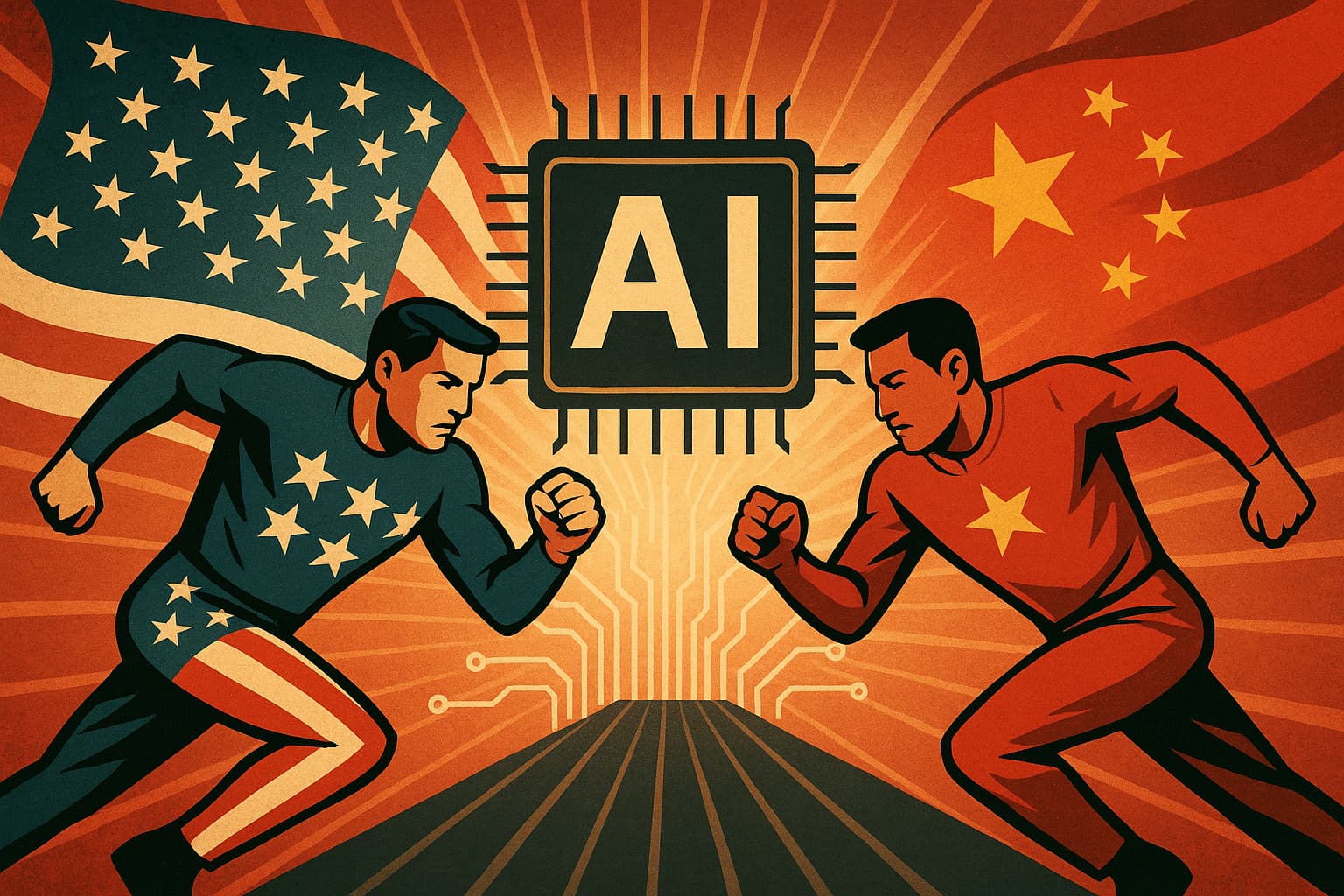
Nvidia CEO Jensen Huang said China is ‘nanoseconds’ behind the US in AI and urged Washington to lead by accelerating innovation and courting developers globally. He argued that excluding China would weaken the reach of US technology and risk splintering the ecosystem into incompatible stacks.
Huang’s remarks came amid ongoing export controls that bar Nvidia’s most advanced processors from the Chinese market. He acknowledged national security concerns but cautioned that strict limits can slow the spread of American tools that underpin AI research, deployment, and scaling.
Hardware remains central, Huang said, citing advanced accelerators and data-centre capacity as the substrate for training frontier models. Yet diffusion matters: widespread adoption of US platforms by global developers amplifies influence, reduces fragmentation, and accelerates innovation.
With sales of top-end chips restricted, Huang warned that Chinese firms will continue to innovate on domestic alternatives, increasing the likelihood of parallel systems. He called for policies that enable US leadership while preserving channels to the developer community in China.
Huang framed the objective as keeping America ahead, maintaining the world’s reliance on an American tech stack, and avoiding strategies that would push away half the world’s AI talent.
Would you like to learn more about AI, tech, and digital diplomacy? If so, ask our Diplo chatbot!
Salesforce has signed a definitive agreement to acquire Spindle AI, a company specialising in agentic analytics and machine learning. The deal aims to strengthen Salesforce’s Agentforce platform by integrating Spindle’s advanced data modelling and forecasting technologies.
Spindle AI has developed neuro-symbolic AI agents capable of autonomously generating and optimising scenario models. Its analytics tools enable businesses to simulate and assess complex decisions, from pricing strategies to go-to-market plans, using AI-driven insights.
Salesforce said the acquisition will enhance its focus on Agent Observability and Self-Improvement within Agentforce 360. Executives described Spindle AI’s expertise as critical to building more transparent and reliable agentic systems capable of explaining and refining their own reasoning.
The acquisition, subject to customary closing conditions, is expected to be completed in Salesforce’s fourth fiscal quarter of 2026. Once finalised, Spindle AI will join Agentforce to expand AI-powered analytics, continuous optimisation, and ROI forecasting for enterprise customers worldwide.
Would you like to learn more about AI, tech and digital diplomacy? If so, ask our Diplo chatbot!
Sweden’s data protection authority, IMY, has opened an investigation into a massive ransomware-related data breach that exposed personal information belonging to 1.5 million people. The breach originated from a cyberattack on IT provider Miljödata in August, which affected roughly 200 municipalities.
Hackers reportedly stole highly sensitive data, including names, medical certificates, and rehabilitation records, much of which has since been leaked on the dark web. Swedish officials have condemned the incident, calling it one of the country’s most serious cyberattacks in recent years.
The IMY said the investigation will examine Miljödata’s data protection measures and the response of several affected public bodies, such as Gothenburg, Älmhult, and Västmanland. The regulator’s goal is to identify security shortcomings for future cyber threats.
Authorities have yet to confirm how the attackers gained access to Miljödata’s systems, and no completion date for the investigation has been announced. The breach has reignited calls for tighter cybersecurity standards across Sweden’s public sector.
Would you like to learn more about AI, tech and digital diplomacy? If so, ask our Diplo chatbot!
Hackers are experimenting with malware that taps large language models to morph in real time, according to Google’s Threat Intelligence Group. An experimental family dubbed PROMPTFLUX can rewrite and obfuscate its own code as it executes, aiming to sidestep static, signature-based detection.
PROMPTFLUX interacts with Gemini’s API to request on-demand functions and ‘just-in-time’ evasion techniques, rather than hard-coding behaviours. GTIG describes the approach as a step toward more adaptive, partially autonomous malware that dynamically generates scripts and changes its footprint.
Investigators say the current samples appear to be in development or testing, with incomplete features and limited Gemini API access. Google says it has disabled associated assets and has not observed a successful compromise, yet warns that financially motivated actors are exploring such tooling.
Researchers point to a maturing underground market for illicit AI utilities that lowers barriers for less-skilled offenders. State-linked operators in North Korea, Iran, and China are reportedly experimenting with AI to enhance reconnaissance, influence, and intrusion workflows.
Defenders are turning to AI, using security frameworks and agents like ‘Big Sleep’ to find flaws. Teams should expect AI-assisted obfuscation, emphasise behaviour-based detection, watch model-API abuse, and lock down developer and automation credentials.
Would you like to learn more about AI, tech, and digital diplomacy? If so, ask our Diplo chatbot!
A High Court judge warned that a solicitor who pushed an expert to accept an AI-generated draft breached their duty. Mr Justice Waksman called it a gross breach and cited a case from the latest survey. He noted 14% of experts would accept such terms, which is unacceptable.
Updated guidance clarifies what limited judicial AI use is permissible. Judges may use a private ChatGPT 365 for summaries with confidential prompts. There is no duty to disclose, but the judgment must be the judge’s own.
Waksman cautioned against legal research or analysis done by AI. Hallucinated authorities and fake citations have already appeared. Experts must not let AI answer the questions they are retained to decide.
Survey findings show wider use of AI for drafting and summaries. Waksman drew a bright line between back-office aids and core duties. Convenience cannot trump independence, accuracy and accountability.
For practitioners, two rules follow. Solicitors must not foist AI-drafted expert opinions, and experts should refuse. Within courts, limited, non-determinative AI may assist, but outcomes must be human.
Would you like to learn more about AI, tech, and digital diplomacy? If so, ask our Diplo chatbot!
Large language models (LLMs) are increasingly used to grade, hire, and moderate text. UZH research shows that evaluations shift when participants are told who wrote identical text, revealing source bias. Agreement stayed high only when authorship was hidden.
When told a human or another AI wrote it, agreement fell, and biases surfaced. The strongest was anti-Chinese across all models, including a model from China, with sharp drops even for well-reasoned arguments.
AI models also preferred ‘human-written’ over ‘AI-written’, showing scepticism toward machine-authored text. Such identity-triggered bias risks unfair outcomes in moderation, reviewing, hiring, and newsroom workflows.
Researchers recommend identity-blind prompts, A/B checks with and without source cues, structured rubrics focused on evidence and logic, and human oversight for consequential decisions.
They call for governance standards: disclose evaluation settings, test for bias across demographics and nationalities, and set guardrails before sensitive deployments. Transparency on prompts, model versions, and calibration is essential.
Would you like to learn more about AI, tech, and digital diplomacy? If so, ask our Diplo chatbot!