Canada’s telecommunications regulator, the CRTC, announced on Wednesday that it will impose a fee on Google to cover the costs of enforcing the Online News Act, which requires large tech platforms to pay for news content shared on their sites. The levy, which will be implemented from April 1, will vary each year and has no upper limit. This move comes amid rising tensions between Canada and the US over issues like trade and a digital services tax on American tech firms.
The CRTC stated that most of its operations are funded by fees from the companies it regulates, and the new charge aims to recover costs related to the law. Google, which had previously raised concerns about the fairness of such a rule, had argued that it was unreasonable to impose 100% of the costs on one company. Despite this, Google has agreed to pay C$100 million annually to Canadian publishers in a deal that ensures its search results continue to feature news content.
The law, which is part of a global trend to make internet giants pay for news, was introduced last year in response to concerns that tech firms were crowding out news businesses in the online advertising market. While both Google and Meta were identified as major platforms required to make payments, Meta chose to block news from its platforms in Canada instead. Google, however, has continued to negotiate with the Canadian government, although it has yet to comment further on the CRTC’s decision.
For more information on these topics, visit diplomacy.edu.
A US judge ruled that Meta must face a lawsuit alleging it prioritises hiring foreign workers to pay them lower wages. The proposed class action involves three US citizens who claim they were repeatedly rejected despite being qualified for roles at the company.
The plaintiffs argue that Meta systematically favours visa holders, citing statistics showing a significant portion of its US workforce holds H-1B visas. The company denies the claims, stating there is no evidence of intentional discrimination or that the plaintiffs would have been hired otherwise.
A 2021 settlement saw Meta agree to pay up to $14.25 million over similar government allegations. The latest ruling follows a 2023 appeals court decision, which cited a Civil War-era law protecting US citizens from discrimination in contracts.
Plaintiffs hope the lawsuit will expose widespread hiring biases in the tech sector. Their legal team suggests further enforcement or legislative action may be necessary to address the issue.
For more information on these topics, visit diplomacy.edu.
Meta Platforms is reportedly in talks to build a new data centre campus for its AI projects, potentially costing over $200 billion, according to sources familiar with the matter. The company is considering locations in states like Louisiana, Wyoming, and Texas, with senior executives visiting potential sites this month.
This comes as the AI sector sees a surge in investment, especially following the launch of Microsoft-backed OpenAI’s ChatGPT in 2022. Companies are eager to incorporate AI into their products, leading to significant spending on AI infrastructure.
Despite the report, a Meta spokesperson denied the claims, stating that its data centre plans and capital expenditures have already been disclosed and calling the rest ‘pure speculation’. Meta’s CEO, Mark Zuckerberg, had previously mentioned that the company plans to invest up to $65 billion this year to expand its AI infrastructure.
In comparison, Microsoft has pledged around $80 billion in data centre investments for fiscal 2025, while Amazon has indicated its 2025 spending could exceed $75 billion.
For more information on these topics, visit diplomacy.edu.
Italy is demanding 12.5 million euros ($13 million) from Elon Musk’s social network X following a tax probe linked to a broader investigation into Meta. The case, which focuses on value-added tax (VAT) claims for the years 2016 to 2022, is significant as it raises questions about how social networks provide access to their services. Italian tax authorities argue that user registrations on platforms like X, Facebook, and Instagram should be considered taxable transactions, as they involve the exchange of personal data for a membership account.
This case could have major implications for the tech sector in Europe, potentially altering the way business models are structured in the 27-nation European Union, as VAT is a harmonised EU tax. Although the claim of 12.5 million euros is a small amount for X, the outcome of this case could influence future tax policies across the region. Both X and Meta must respond to the tax authority’s observations by late March or early April, with the option to either accept the charges or challenge them in court.
The investigation also comes at a sensitive time, as US President Donald Trump has criticised digital taxes in countries like Italy that target US tech firms. Musk, who has strong ties with Italian Prime Minister Giorgia Meloni, is also keen to expand his Starlink business in the country. If no agreement is reached, Italy’s Revenue Agency may pursue a lengthy judicial review, which could take up to 10 years to resolve.
For more information on these topics, visit diplomacy.edu.
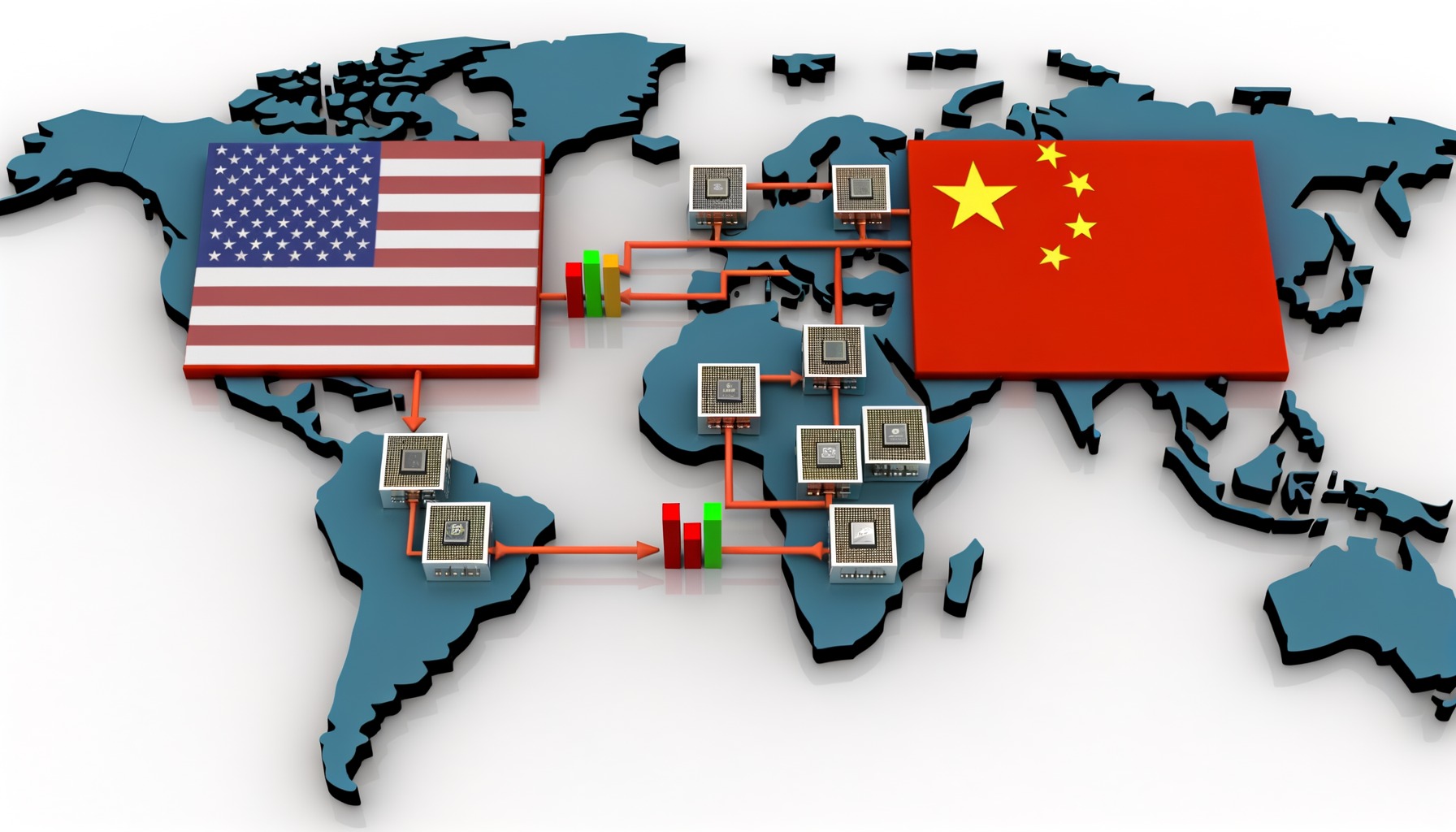
China has warned that the United States‘ efforts to pressure other nations into targeting its semiconductor industry will ultimately backfire.
During a regular press briefing, Chinese foreign ministry spokesperson Lin Jian criticised Washington’s approach, arguing that it would disrupt the global semiconductor supply chain and hinder industry development worldwide.
Lin Jian emphasised that such actions not only undermine fair competition but also threaten the stability of the global technology market.
Tensions between the US and China over semiconductor access have escalated in recent years, with Washington implementing export controls and encouraging its allies to adopt similar measures.
Beijing has consistently opposed these restrictions, calling them politically motivated attempts to curb China’s technological progress.
For more information on these topics, visit diplomacy.edu.
Taiwan‘s economy minister stated that the government has not received any official information regarding a potential overseas investment by chip giant TSMC in Intel or the United States.
Media reports have suggested that TSMC, the world’s largest contract chipmaker, has been in talks to take a stake in Intel, but neither company has confirmed the speculation. Any significant foreign investment by a Taiwanese company requires government approval through the economy ministry’s investment review commission.
Speaking to reporters in Taipei, Economy Minister Kuo Jyh-huei clarified that the ministry cannot comment on market rumours without receiving an official report from TSMC. He confirmed that no application or formal communication has been submitted so far.
Kuo also highlighted that, given the foreign investment nature of such a deal, a formal review process would be necessary before any discussions could take place.
The potential deal has gained attention amid heightened US-Taiwan trade tensions. Former US President Donald Trump previously criticised Taiwan for its dominance in the semiconductor market and expressed a desire to bring more manufacturing back to the United States.
Meanwhile, Taiwan continues to run a significant trade surplus with the US, adding further complexity to any potential cross-border investment.
For more information on these topics, visit diplomacy.edu.
Stronger semiconductor restrictions on China are being considered by Donald Trump’s team, expanding on measures introduced during Joe Biden’s presidency. Bloomberg News reported that discussions have taken place about tightening controls on chip exports and maintenance.
US officials have recently met with their Japanese and Dutch counterparts to explore limits on engineers from Tokyo Electron and ASML working on semiconductor equipment in China.
Additional restrictions on Nvidia chip exports are also under consideration, aiming to further curb Beijing’s technological capabilities.
Trump’s team is pushing for greater alignment with key allies to mirror restrictions already imposed on American chipmakers, such as Lam Research, KLA, and Applied Materials. Tokyo Electron, ASML, and various government officials have either declined or not responded to requests for comment.
For more information on these topics, visit diplomacy.edu.
Microsoft has reportedly scrapped leases for significant data centre capacity in the United States, raising concerns about a potential slowdown in its AI infrastructure expansion.
TD Cowen analysts revealed that the company cancelled leases amounting to “a couple of hundred megawatts” with at least two private data-centre operators. The move has added weight to investor worries that the AI-driven market surge may be losing momentum.
Despite the lease cancellations, Microsoft maintains its commitment to invest over $80 billion in AI and cloud capacity this fiscal year.
A company spokesperson confirmed the investment plan remains intact, noting that adjustments to infrastructure are part of strategic planning rather than a broader scale-back.
Analysts suggest the lease cancellations might reflect a shift in Microsoft’s data centre strategy following years of aggressive expansion to meet AI demand.
Supply chain constraints had previously forced the company to secure excess capacity, sometimes at premium rates.
However, with growing investor scepticism around the costs of AI infrastructure and emerging competition from low-cost Chinese firms like DeepSeek, Microsoft’s recalibration has intensified concerns about the long-term sustainability of the AI boom.
For more information on these topics, visit diplomacy.edu.
Vanguard International Semiconductor has cautioned that US tariffs on imported chips may drive inflation and weaken global economic growth.
Chairman Leuh Fang stated that while the direct impact on Vanguard would be minimal, broader consequences for the semiconductor industry remain uncertain.
The company remains in a wait-and-see mode, as it is unclear how far the proposed tariffs will go. Higher import duties could reduce purchasing power and slow economic expansion, Fang noted.
However, the firm expects little direct exposure to the tariffs due to its focus on legacy chips for automotive and display applications.
Vanguard has no plans to establish a US manufacturing facility. Meanwhile, larger industry players such as TSMC, which owns over a quarter of Vanguard’s shares, are investing in American production to navigate trade uncertainties.
For more information on these topics, visit diplomacy.edu.
Tesla has introduced a long-awaited update to its Autopilot software in China, adding city navigation features that allow for automatic lane changes and traffic light detection. However, many Chinese Tesla owners were disappointed, expressing that the update did not meet the high expectations set by CEO Elon Musk. The new features, while similar to the company’s Full Self-Driving (FSD) system, are less advanced in China due to insufficient data on local roads and traffic rules.
Tesla faces stiff competition from Chinese automakers like Huawei, Xiaomi, and BYD, which offer advanced driver-assistance systems at lower prices or even for free. These rivals have already launched vehicles capable of navigating complex Chinese traffic, leaving Tesla behind in the race for smart-driving technology. Despite this, Tesla continues to charge its customers nearly $9,000 for the limited version of its FSD software, which many feel does not live up to the promises made by the company.
The delays in rolling out full FSD in China are partly due to regulatory hurdles and restrictions on data transfer between China and the US. Tesla is working on gaining approval from Beijing for its advanced systems, but China currently only requires registration for level-two autonomous features like Autopilot. Tesla is also looking into establishing a data centre in China to train its AI software, though the process has been complicated by strict Chinese data laws.
While Tesla’s Autopilot update is seen as a step forward, it faces growing criticism for not keeping pace with the rapidly evolving smart-driving features offered by local competitors. Tesla’s challenge in China highlights the complex balance the company must maintain between innovation, regulatory compliance, and local competition.
For more information on these topics, visit diplomacy.edu.