Italy’s antitrust watchdog has investigated Meta Platforms over allegations that the company may have abused its dominant position by integrating its AI assistant directly into WhatsApp.
The Rome-based authority, formally known as the Autorità Garante della Concorrenza e del Mercato (AGCM), announced the probe on Wednesday, stating that Meta may have breached European Union competition regulations.
The regulator claims that the introduction of the Meta AI assistant into WhatsApp was carried out without obtaining prior user consent, potentially distorting market competition.
Meta AI, the company’s virtual assistant designed to provide chatbot-style responses and other generative AI functions, has been embedded in WhatsApp since March 2025. It is accessible through the app’s search bar and is intended to offer users conversational AI services directly within the messaging interface.
The AGCM is concerned that this integration may unfairly favour Meta’s AI services by leveraging the company’s dominant position in the messaging market. It warned that such a move could steer users toward Meta’s products, limit consumer choice, and disadvantage competing AI providers.
‘By pairing Meta AI with WhatsApp, Meta appears to be able to steer its user base into the new market not through merit-based competition, but by ‘forcing’ users to accept the availability of two distinct services,’ the authority said.
It argued that this strategy may undermine rival offerings and entrench Meta’s position across adjacent digital services. In a statement, Meta confirmed cooperating fully with the Italian authorities.
The company defended the rollout of its AI features, stating that their inclusion in WhatsApp aimed to improve the user experience. ‘Offering free access to our AI features in WhatsApp gives millions of Italians the choice to use AI in a place they already know, trust and understand,’ a Meta spokesperson said via email.
The company maintains its approach, which benefits users by making advanced technology widely available through familiar platforms. The AGCM clarified that its inquiry is conducted in close cooperation with the European Commission’s relevant offices.
The cross-border collaboration reflects the growing scrutiny Meta faces from regulators across the EU over its market practices and the use of its extensive user base to promote new services.
If the authority finds Meta in breach of EU competition law, the company could face a fine of up to 10 percent of its global annual turnover. Under Article 102 of the Treaty on the Functioning of the European Union, abusing a dominant market position is prohibited, particularly if it affects trade between member states or restricts competition.
To gather evidence, AGCM officials inspected the premises of Meta’s Italian subsidiary, accompanied by Guardia di Finanza, the tax police’s special antitrust unit in Italy.
The inspections were part of preliminary investigative steps to assess the impact of Meta AI’s deployment within WhatsApp. Regulators fear that embedding AI assistants into dominant platforms could lead to unfair advantages in emerging AI markets.
By relying on its established user base and platform integration, Meta may effectively foreclose competition by making alternative AI services harder to access or less visible to consumers. Such a case would not be the first time Meta has faced regulatory scrutiny in Europe.
The company has been the subject of multiple investigations across the EU concerning data protection, content moderation, advertising practices, and market dominance. The current probe adds to a growing list of regulatory pressures facing the tech giant as it expands its AI capabilities.
The AGCM’s investigation comes amid broader EU efforts to ensure fair competition in digital markets. With the Digital Markets Act and AI Act emerging, regulators are becoming more proactive in addressing potential risks associated with integrating advanced technologies into consumer platforms.
As the investigation continues, Meta’s use of AI within WhatsApp will remain under close watch. The outcome could set an essential precedent for how dominant tech firms can release AI products within widely used communication tools.
Would you like to learn more about AI, tech, and digital diplomacy? If so, ask our Diplo chatbot!
Google has confirmed it will sign the European Union’s General Purpose AI Code of Practice, joining other companies, including major US model developers.
The tech giant hopes the Code will support access to safe and advanced AI tools across Europe, where rapid adoption could add up to €1.4 trillion annually to the continent’s economy by 2034.
Kent Walker, Google and Alphabet’s President of Global Affairs, said the final Code better aligns with Europe’s economic ambitions than earlier drafts, noting that Google had submitted feedback during its development.
However, he warned that parts of the Code and the broader AI Act might hinder innovation by introducing rules that stray from EU copyright law, slow product approvals or risk revealing trade secrets.
Walker explained that such requirements could restrict Europe’s ability to compete globally in AI. He highlighted the need to balance regulation with the flexibility required to keep pace with technological advances.
Google stated it will work closely with the EU’s new AI Office to help shape a proportionate, future-facing approach.
Would you like to learn more aboutAI, tech and digital diplomacy? If so, ask our Diplo chatbot!
Europe’s AI crackdown officially begins soon, as the EU enforces the first rules targeting developers of generative AI models like ChatGPT.
Under the AI Act, firms must now assess systemic risks, conduct adversarial testing, ensure cybersecurity, report serious incidents, and even disclose energy usage. The goal is to prevent harms related to bias, misinformation, manipulation, and lack of transparency in AI systems.
Although the legislation was passed last year, the EU only released developer guidance on 10 July, leaving tech giants with little time to adapt.
Meta, which developed the Llama AI model, has refused to sign the voluntary code of practice, arguing that it introduces legal uncertainty. Other developers have expressed concerns over how vague and generic the guidance remains, especially around copyright and practical compliance.
The EU also distinguishes itself from the US, where a re-elected Trump administration has launched a far looser AI Action Plan. While Washington supports minimal restrictions to encourage innovation, Brussels is focused on safety and transparency.
Trade tensions may grow, but experts warn that developers should not rely on future political deals instead of taking immediate steps toward compliance.
The AI Act’s rollout will continue into 2026, with the next phase focusing on high-risk AI systems in healthcare, law enforcement, and critical infrastructure.
Meanwhile, questions remain over whether AI-generated content qualifies for copyright protection and how companies should handle AI in marketing or supply chains. For now, Europe’s push for safer AI is accelerating—whether Big Tech likes it or not.
Would you like to learn more aboutAI, tech and digital diplomacy? If so, ask our Diplo chatbot!
In the digital world, tracking occurs through digital signals sent from one computer to a server, and from a server to an organisation. Almost immediately, a profile of a user can be created. The information can be leveraged to send personalised advertisements for products and services consumers are interested in, but it can also classify people into categories to send them advertisements to steer them in a certain direction, for example, politically (2024 Romanian election, Cambridge Analytica Scandal skewing the 2016 Brexit referendum and 2016 US Elections).
Digital tracking can be carried out with minimal costs, rapid execution and the capacity to reach hundreds of thousands of users simultaneously. These methods require either technical skills (such as coding) or access to platforms that automate tracking.
This phenomenon has been well documented and likened to George Orwell’s 1984, in which the people of Oceania are subject to constant surveillance by ‘Big Brother’ and institutions of control; the Ministry of Truth (propaganda), Peace (military control), Love (torture and forced loyalty) and Plenty (manufactured prosperity).
A related concept is the Panopticon, developed by the French philosopher Michel Foucault’s social theory based on the architecture of a prison, enabling constant observation from a central point. Prisoners never know if they are being watched and thus self-regulate their behaviour. In today’s tech-driven society, our digital behaviour is similarly regulated through the persistent possibility of surveillance.
How are we tracked? The case of cookies and device fingerprinting
Cookies
Cookies are small, unique text files placed on a user’s device by their web browser at the request of a website. When a user visits a website, the server can instruct the browser to create or update a cookie. These cookies are then sent back to the server with each subsequent request to the same website, allowing the server to recognise and remember certain information (login status, preferences, or tracking data).
If a user visits multiple websites about a specific topic, that pattern can be collected and sold to advertisers targeting that interest. This applies to all forms of advertising, not just commercial but also political and ideological influence.
Device fingerprinting
Device fingerprinting involves generating a unique identifier using a device’s hardware and software characteristics. Types include browser fingerprinting, mobile fingerprinting, desktop fingerprinting, and cross-device tracking. To assess how unique a browser is, users can test their setup via the Cover Your Tracks tool by the Electronic Frontier Foundation.
Different information will be collected, such as your operating system, language version, keyboard settings, screen resolution, font used, device make and model and more. The more data points collected, the more unique an individual’s device will be.
A common reason to use device fingerprinting is for advertising. Since each individual has a unique identifier, advertisers can distinguish individuals from one another and see which websites they visit based on past collected data.
Similar to cookies, device fingerprinting is not purely about advertising, as it has some legitimate security purposes. Device fingerprinting, as it creates a unique ID of a device, allows websites to recognise a user’s device. This is useful to combat fraud. For instance, if a known device suddenly logs in from an unknown fingerprint, fraud detection mechanisms may flag and block the login attempt.
Legal considerations
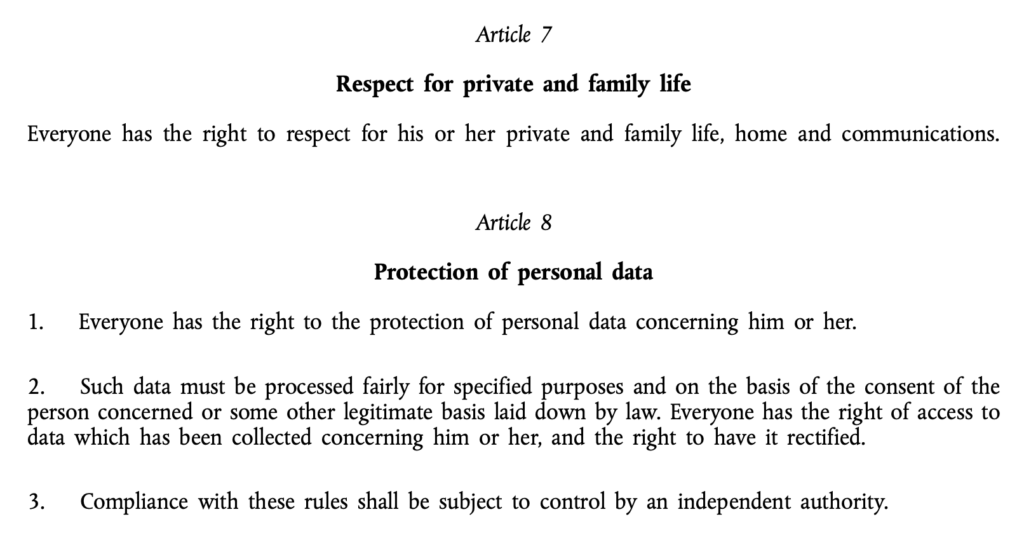
Apart from societal impacts, there are legal considerations to be made, specifically concerning fundamental rights. In the EU and Europe, Articles 7 and 8 of the Charter of Fundamental Rights and Article 8 of the European Convention on Human Rights are what give rise to the protection of personal data in the first place. They form the legal bedrock of digital privacy legislation, such as the GDPR and the ePrivacy Directive. Stemming from the GDPR, there is a protection against unlawful, unfair and opaque processing of personal data.
Articles 7 and 8 of the Charter of Fundamental Rights
For tracking to be carried out lawfully, one of the six legal bases of the GDPR must be relied upon. In this case, tracking is usually only lawful if the legal basis of consent is relied upon (Article 6(1)(a) GDPR, which stems from Article 5(1) of the ePrivacy Directive).
Other legal bases, such as the legitimate interest of a business, may allow for limited analytical cookies to be placed, of which the cookies referred to in this analysis are not.
Regardless of this, to obtain consent, website visitors must ensure that consent is collected prior to processing occurring, freely given, specific, informed and unambiguous. In most cases of website tracking, consent is not collected prior to processing.
In practice, this means that before a consent request is fulfilled by a website visitor, cookies are placed on the user’s device. There are additional concerns about consent not being informed, as users do not know what processing personal data to enable tracking entails.
Moreover, consent is not specific to what is necessary to the processing, given that processing occurs for broad and unspecified reasons, such as improving visitor experience and understanding the website better, and those explanations are generic and broad.
Further, tracking is typically unfair as users do not expect to be tracked across sites or have digital profiles made about themselves based on website visits. Tracking is also opaque, as users do not understand how tracking occurs. Website owners state that tracking occurs with a lack of explanation on how it occurs in the first place. Users do not know for how long it occurs, what personal data is being used to track or how it benefits website owners.
Can we refuse tracking
In theory, it is possible to prevent tracking from the get-go. This can be done by refusing to give consent when tracking occurs. However, in practice, refusing consent can still lead to tracking. Outlined below are two concrete examples of this happening daily.
Cookies
Regarding cookies, simply put, the refusal of all requests is not honoured, it is ignored. Studies have found that when a user visits a website and refuses to give consent, their request is not honoured. Cookies and similar tracking technologies are placed on the user’s device as if they had accepted cookies.
This increases user frustration as they are given a choice that is non-existent. This occurs as non-essential cookies, which can be refused, are lumped together with essential cookies, which cannot be refused. Therefore, when refusing consent to non-essential cookies, not all are refused, as some are mislabelled.
Another reason for this occurrence is that cookies are placed before consent is sought. Often, website owners outsource cookie banner compliance to more experienced companies. These websites use consent management platforms (CMPs) such as Cookiebot by Usercentrics or One Trust.
When verifying when cookies are placed via these CMPs, the option to load cookies after consent is sought needs to be manually selected. Therefore, website owners need to have knowledge about consent requirements to understand that cookies are not to be placed prior to consent being sought.
Another example is related to Google Consent Mode (GCM). GCM is relevant to mention here as Google is the most common third-party tracker on the web, thus the most likely tracker users will encounter. They have a vast array of trackers ranging from statistics, analytics, preferences, marketing and more. GCM essentially creates a path for website analytics to occur despite consent being refused. This occurs as GCM claims that it can send cookieless ping signals to user devices to know how many users have viewed a website, clicked on a page, searched a term, etc.
This is a novel solution Google is presenting, and it claims to be privacy-friendly, as no cookies are required for this to occur. However, a study on tags, specifically GCM tags, found that GCM is not privacy-friendly and infringes the GDPR. The study found that Google still collects personal data in these ‘cookieless ping signals’ such as user language, screen resolution, computer architecture, user agent string, operating system and its version, complete web page URL and search keywords. Since this data is collected and processed despite the user refusing consent, there are undoubtedly legal issues.
The first reason comes from the lawfulness general principle whereby Google has no lawful basis to process this personal data as the user refused consent, and no other legal basis is used. The second reason stems from the general principle of fairness, as users do not expect that, after refusing trackers and choosing the more privacy-friendly option, their data is still processed as if their consent choice did not matter.
Therefore, from Google’s perspective, GCM is privacy-friendly as no cookies are placed, thus no consent is required to be sought. However, a recent study revealed that personal data is still being processed without any permission or legal basis.
What next?
On an individual level:
Many solutions have been developed for individuals to reduce the tracking they are subject to. From browser extensions to using devices that are more privacy-friendly and using ad blockers. One notable company tackling this issue is Duck Duck Go, which by default rejects trackers, allows for email protection, and overall reduces trackers when using their browser. Duck Duck Go is not the only company to allow this, many more, such as uBlock Origin and Ghostery, offer similar services.
Specifically, regarding fingerprint ID, researchers have developed ways to prevent device fingerprinting. In 2023, researchers proposed ShieldF, which is a Chromium add-on that reduces fingerprinting for mobile apps and browsers. Other measures include using an IP address that many people use, which is not ideal for home Wi-Fi. Using a combination of a browser extension and a VPN is also unsuitable for every individual, as this demands a substantial amount of effort and sometimes financial costs.
On a systemic level:
CMPs and GCM are active tracking stakeholders in the tracking ecosystem, and their actions are subject to enforcement bodies. In this case, predominantly data protection authorities (DPA). One prominent DPA working on cookie enforcement is the Dutch DPA, the Autoriteit Persoonsgegevens (AP). In the early months of 2025, the AP has publicly stated that its focus for this upcoming year will be to check cookie compliance. They announced that they would be investigating 10,000 websites in the Netherlands. This has led to investigations into companies with unlawful cookie banners, concluding with warnings and sanctions.
However, these investigations require extensive time and effort. DPAs have already stated that they are overworked and do not have enough personnel or financial resources to cope with the increase in responsibility. Coupled with the fact that sanctioned companies set aside financial pots for these sanctions, or that non-EU businesses do not comply with DPA sanction decisions (the case of Clearview AI). Different ways to tackle non-compliance should be investigated.
For example, in light of the GDPR simplification package, whilst simplifying some measures, other liability measures could be introduced to ensure that enforcement is as vigorous as the legislation itself. The EU has not shied away from holding management boards liable for non-compliance. In a separate legislation on cybersecurity, NIS II Article 20(1) states that ‘management bodies of essential and important entities approve the cybersecurity risk-management measures (…) can be held liable for infringements (…)’. That article allows for board member liability for specific cybersecurity risk-management measures in Article 21. If similar measures cannot be introduced during this time, other moments of amendment can be consulted for this.
Conclusion
Cookies and device fingerprinting are two common ways in which tracking occurs. The potential larger societal and legal consequences of tracking demand that existing robust legislation is enforced to ensure that past politically related historical mistakes are not repeated.
Ultimately, there is no way to completely prevent fingerprinting and cookie-based tracking without significantly compromising the user’s browsing experience. For this reason, the burden of responsibility must shift toward CMPs. This shift should begin with the implementation of privacy-by-design and privacy-by-default principles in the development of their tools (preventing cookie placement prior to consent seeking).
Accountability should occur through tangible consequences, such as liability for board members in cases of negligence. By attributing responsibility to the companies which develop cookie banners and facilitate trackers, the source of the problem can be addressed and held accountable for their human rights violations.
Would you like to learn more about AI, tech and digital diplomacy? If so, ask our Diplo chatbot!
The European Commission has accused Temu of breaching the Digital Services Act by failing to assess and address the sale of illegal or dangerous products.
The accusation follows months of investigation and a review of a required risk report submitted by Temu, which the Commission found too vague.
A mystery shopping exercise by the EU uncovered unsafe toys and electronics on the platform, raising concerns over consumer safety.
Additional parts of the probe are ongoing, including scrutiny of Temu’s use of addictive designs, algorithmic transparency and product recommendations.
Temu now has a few weeks to respond to the preliminary findings, though no final deadline has been given. Under the DSA, confirmed violations could result in fines of up to 6% of a company’s global turnover.
Would you like to learn more about AI, tech and digital diplomacy? If so, ask our Diplo chatbot!
The European Data Protection Supervisor (EDPS) has ended its enforcement action against the European Commission over its use of Microsoft, following improvements to data protection practices. The decision came after the Commission revised its contract with Microsoft to improve privacy standards.
Under the updated terms, Microsoft must clarify the reasons for data transfers outside the European Economic Area and name the recipients. Transfers are only allowed to countries with EU-recognised protections or in public interest cases.
Microsoft must also inform the Commission if a foreign government requests access to EU data, unless the request comes from within the EU or a country with equivalent safeguards. The EDPS urged other EU institutions to adopt similar contractual protections if using Microsoft 365.
Despite the EDPS’ clearance, the Commission remains concerned about relying too heavily on a non-EU tech provider for essential digital services. It continues to support the current EU-US data adequacy deal, though recent political changes in the US have cast doubt on its long-term stability.
Would you like to learn more about AI, tech and digital diplomacy? If so, ask our Diplo chatbot!
A recent survey has found that most US and the EU users are open to using Chinese large language models, even amid ongoing political and cybersecurity scrutiny.
According to the report, 71 percent of respondents in the US and 87 percent in the EU would consider adopting models developed in China.
The findings highlight increasing international curiosity about the capabilities of Chinese AI firms such as DeepSeek, which have recently attracted global attention.
While the technology is gaining credibility, many Western users remain cautious about data privacy and infrastructure control.
More than half of those surveyed said they would only use Chinese AI models if hosted outside China. However, this suggests that while trust in the models’ performance is growing, concerns over data governance remain a significant barrier to adoption.
The results come amid heightened global competition in the AI race, with Chinese developers rapidly advancing to challenge US-based leaders. DeepSeek and similar firms now face balancing global outreach with geopolitical limitations.
Would you like to learn more about AI, tech and digital diplomacy? If so, ask our Diplo chatbot!
A joint statement committed to signing an administrative agreement on AI, aligned with principles from the Hiroshima AI Process. Shared initiatives include a €4 million EU-supported quantum R&D project named Q‑NEKO and the 6G MIRAI‑HARMONY research effort.
Both parties pledge to enhance data governance, digital identity interoperability, regulatory coordination across platforms, and secure connectivity via submarine cables and Arctic routes. The accord builds on the Strategic Partnership Agreement activated in January 2025, reinforcing their mutual platform for rules-based, value-driven digital and innovation cooperation.
Would you like to learn more about AI, tech and digital diplomacy? If so, ask our Diplo chatbot!
Meta, LinkedIn and X have filed appeals against a sweeping VAT claim by Italy, marking the first time the country has failed to settle such cases with major tech firms. Italy is demanding nearly €1 billion combined over the value of user data exchanged during free account registrations.
Italian authorities argue that providing platform access in exchange for personal data constitutes a taxable service, which if upheld, could have far-reaching implications across the EU. The case marks a significant legal shift as it challenges traditional definitions of taxable transactions in the digital economy.
Meta strongly disagreed with the concept, saying it should not be liable for VAT on free platform access. While LinkedIn offered no public comment, X did not respond to media inquiries.
Italy is now preparing to refer the issue to the EU Commission’s VAT Committee for advisory input. Though the committee’s opinion will not be binding, a rejection could derail Italy’s efforts and lead to a withdrawal of the tax claims.
Would you like to learn more about AI, tech and digital diplomacy? If so, ask our Diplo chatbot!
Meta has refused to endorse the European Union’s new voluntary Code of Practice for general-purpose AI, citing legal overreach and risks to innovation.
The company warns that the framework could slow development and deter investment by imposing expectations beyond upcoming AI laws.
In a LinkedIn post, Joel Kaplan, Meta’s chief global affairs officer, called the code confusing and burdensome, criticising its requirements for reporting, risk assessments and data transparency.
He argued that such rules could limit the open release of AI models and harm Europe’s competitiveness in the field.
The code, published by the European Commission, is intended to help companies prepare for the binding AI Act, set to take effect from August 2025. It encourages firms to adopt best practices on safety and ethics while building and deploying general-purpose AI systems.
While firms like Microsoft are expected to sign on, Meta’s refusal could influence other developers to resist what they view as Brussels overstepping. The move highlights ongoing friction between Big Tech and regulators as global efforts to govern AI rapidly evolve.
Would you like to learn more about AI, tech and digital diplomacy? If so, ask our Diplo chatbot!