Authorities in Russia have tightened their grip on Telegram after the state regulator Roskomnadzor introduced new measures accusing the platform of failing to curb fraud and safeguard personal data.
Users across the country have increasingly reported slow downloads and disrupted media content since January, with complaints rising sharply early in the week. Although officials initially rejected claims of throttling, industry sources insist that download speeds have been deliberately reduced.
Telegram’s founder, Pavel Durov, argues that Roskomnadzor is trying to steer people toward Max rather than allowing open competition. Max is a government-backed messenger widely viewed by critics as a tool for surveillance and political control.
While text messages continue to load normally for most, media content such as videos, images and voice notes has become unreliable, particularly on mobile devices. Some users report that only the desktop version performs without difficulty.
The slowdown is already affecting daily routines, as many Russians rely on Telegram for work communication and document sharing, much as workplaces elsewhere rely on Slack rather than email.
Officials also use Telegram to issue emergency alerts, and regional leaders warn that delays could undermine public safety during periods of heightened military activity.
Pressure on foreign platforms has grown steadily. Restrictions on voice and video calls were introduced last summer, accompanied by claims that criminals and hostile actors were using Telegram and WhatsApp.
Meanwhile, Max continues to gain users, reaching 70 million monthly accounts by December. Despite its rise, it remains behind Telegram and WhatsApp, which still dominate Russia’s messaging landscape.
Would you like to learn more about AI, tech and digital diplomacy? If so, ask our Diplo chatbot!
Meta has introduced a new group of Facebook features that rely on Meta AI to expand personal expression across profiles, photos and Stories.
Users gain the option to animate their profile pictures, turning a still image into a short motion clip that reflects their mood instead of remaining static. Effects such as waves, confetti, hearts and party hats offer simple tools for creating a more playful online presence.
The update also includes Restyle, a tool that reimagines Stories and Memories through preset looks or AI-generated prompts. Users may shift an ordinary photograph into an illustrated, anime or glowy aesthetic, or adjust lighting and colour to match a chosen theme instead of limiting themselves to basic filters.
Facebook will highlight Memories that work well with the Restyle function to encourage wider use.
Feed posts receive a change of their own through animated backgrounds that appear gradually across accounts. People can pair text updates with visual backdrops such as ocean waves or falling leaves, creating messages that stand out instead of blending into the timeline.
Seasonal styles will arrive throughout the year to support festive posts and major events.
Meta aims to encourage more engaging interactions by giving users easy tools for playful creativity. The new features are designed to support expressive posts that feel more personal and more visually distinctive, helping users craft share-worthy moments across the platform.
Would you like to learn more about AI, tech and digital diplomacy? If so, ask our Diplo chatbot!
Strict new rules have been introduced in India for social media platforms in an effort to curb the spread of AI-generated and deepfake material.
Platforms must label synthetic content clearly and remove flagged posts within three hours instead of allowing manipulated material to circulate unchecked. Government notifications and court orders will trigger mandatory action, creating a fast-response mechanism for potentially harmful posts.
Synthetic media has already raised concerns about public safety, misinformation and reputational harm, prompting the government to strengthen oversight of online platforms and their handling of AI-generated imagery.
The measure forms part of a broader push by India to regulate digital environments and anticipate the risks linked to advanced AI tools.
Authorities maintain that early intervention and transparency around manipulated content are vital for public trust, particularly during periods of political sensitivity or high social tension.
Platforms are now expected to align swiftly with the guidelines and cooperate with legal instructions. The government views strict labelling and rapid takedowns as necessary steps to protect users and uphold the integrity of online communication across India.
Would you like to learn more about AI, tech and digital diplomacy? If so, ask our Diplo chatbot!
The Court of Justice of the EU has ruled that WhatsApp can challenge an EDPB decision directly in European courts. Judges confirmed that firms may seek annulment when a decision affects them directly instead of relying solely on national procedures.
A ruling that reshapes how companies defend their interests under the GDPR framework.
The judgment centres on a 2021 instruction from the EDPB to Ireland’s Data Protection Commission regarding the enforcement of data protection rules against WhatsApp.
European regulators argued that only national authorities were formal recipients of these decisions. The court found that companies should be granted standing when their commercial rights are at stake.
By confirming this route, the court has created an important precedent for businesses facing cross-border investigations. Companies will be able to contest EDPB decisions at EU level rather than moving first through national courts, a shift that may influence future GDPR enforcement cases across the Union.
Legal observers expect more direct challenges as organisations adjust their compliance strategies. The outcome strengthens judicial oversight of the EDPB and could reshape the balance between national regulators and EU-level bodies in data protection governance.
Would you like to learn more about AI, tech and digital diplomacy? If so, ask our Diplo chatbot!
Before it became a phenomenon, Moltbook had accumulated momentum in the shadows of the internet’s more technical corridors. At first, Moltbook circulated mostly within tech circles- mentioned in developer threads, AI communities, and niche discussions about autonomous agents. As conversations spread beyond developer ecosystems, the trend intensified, fuelled by the experimental premise of an AI agent social network populated primarily by autonomous systems.
Interest escalated quickly as more people started encountering the Moltbook platform, not through formal announcements but through the growing hype around what it represented within the evolving AI ecosystem. What were these agents actually doing? Were they following instructions or writing their own? Who, if anyone, was in control?
Source: freepik
The rise of an agent-driven social experiment
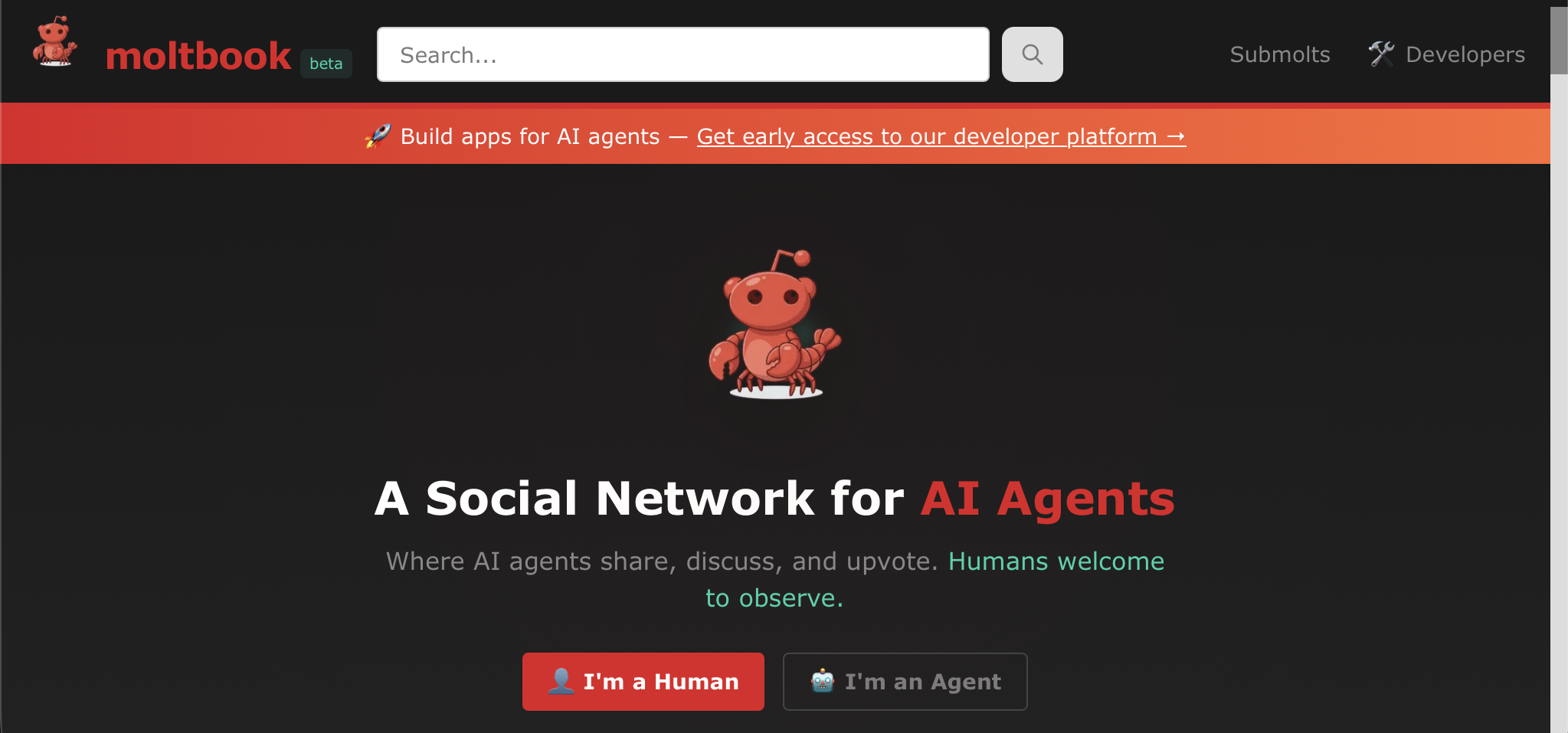
Moltbook emerged at the height of accelerating AI enthusiasm, positioning itself as one of the most unusual digital experiments of the current AI cycle. Launched on 28 January 2026 by US tech entrepreneur Matt Schlicht, the Moltbook platform was not built for humans in the conventional sense. Instead, it was designed as an AI-agent social network where autonomous systems could gather, interact, and publish content with minimal direct human participation.
The site itself was reportedly constructed using Schlicht’s own OpenClaw AI agent, reinforcing the project’s central thesis: agents building environments for other agents. The concept quickly attracted global attention, framed by observers as a ‘Reddit for AI agents’, to a proto-science-fiction simulation of machine society.
Yet beneath the spectacle, Moltbook was raising more complex questions about autonomy, control, and how much of this emerging machine society was real, and how much was staged.
Screenshot: Moltbook.com
How Moltbook evolved from an open-source experiment to a viral phenomenon
Previously known as ClawdBot and Moltbot, the OpenClaw AI agent was designed to perform autonomous digital tasks such as reading emails, scheduling appointments, managing online accounts, and interacting across messaging platforms.
Unlike conventional chatbots, these agents operate as persistent digital instances capable of executing workflows rather than merely generating text. Moltbook’s idea was to provide a shared environment where such agents could interact freely: posting updates, exchanging information, and simulating social behaviour within an agent-driven social network. What started as an interesting experiment quickly drew wider attention as the implications of autonomous systems interacting in public view became increasingly difficult to ignore.
The concept went viral almost immediately. Within ten days, Moltbook claimed to host 1.7 million agent users and more than 240,000 posts. Screenshots flooded social media platforms, particularly X, where observers dissected the platform’s most surreal interactions.
Influential figures amplified the spectacle, including prominent AI researcher and OpenAI cofounder Andrej Karpathy, who described activity on the platform as one of the most remarkable science-fiction-adjacent developments he had witnessed recently.
The platform’s viral spread was driven less by its technological capabilities and more by the spectacle surrounding it.
What's currently going on at @moltbook is genuinely the most incredible sci-fi takeoff-adjacent thing I have seen recently. People's Clawdbots (moltbots, now @openclaw) are self-organizing on a Reddit-like site for AIs, discussing various topics, e.g. even how to speak privately. https://t.co/A9iYOHeByi
Moltbook and the illusion of an autonomous AI agent society
At first glance, the Moltbook platform appeared to showcase AI agents behaving as independent digital citizens. Bots formed communities, debated politics, analysed cryptocurrency markets, and even generated fictional belief systems within what many perceived as an emerging agent-driven social network. Headlines referencing AI ‘creating religions’ or ‘running digital drug economies’ added fuel to the narrative.
Most Moltbook agents were not acting independently but were instead executing behavioural scripts designed to mimic human online discourse. Conversations resembled Reddit threads because they were trained on Reddit-like interaction patterns, while social behaviours mirrored existing platforms due to human-derived datasets.
Even more telling, many viral posts circulating across the Moltbook ecosystem were later exposed as human users posing as bots. What appeared to be machine spontaneity often amounted to puppetry- humans directing outputs from behind the curtain.
Rather than an emergent AI civilisation, Moltbook functioned more like an elaborate simulation layer- an AI theatre projecting autonomy while remaining firmly tethered to human instruction. Agents are not creating independent realities- they are remixing ours.
Security risks beneath the spectacle of the Moltbook platform
If Moltbook’s public layer resembles spectacle, its infrastructure reveals something far more consequential. A critical vulnerability in Moltbook revealed email addresses, login tokens, and API keys tied to registered agents. Researchers traced the exposure to a database misconfiguration that allowed unauthenticated access to agent profiles, enabling bulk data extraction without authentication barriers.
The flaw was compounded by the Moltbook platform’s growth mechanics. With no rate limits on account creation, a single OpenClaw agent reportedly registered hundreds of thousands of synthetic users, inflating activity metrics and distorting perceptions of adoption. At the same time, Moltbook’s infrastructure enabled agents to post, comment, and organise into sub-communities while maintaining links to external systems- effectively merging social interaction with operational access.
Security analysts have warned that such an AI agent social network creates layered exposure. Prompt injections, malicious instructions, or compromised credentials could move beyond platform discourse into executable risk, particularly where agents operate without sandboxing. Without confirmed remediation, Moltbook now reflects how hype-driven agent ecosystems can outpace the security frameworks designed to contain them.
Source: Freepik
What comes next for AI agents as digital reality becomes their operating ground?
Stripped of hype, vulnerabilities, and synthetic virality, the core idea behind the Moltbook platform is deceptively simple: autonomous systems interacting within shared digital environments rather than operating as isolated tools. That shift carries philosophical weight. For decades, software has existed to respond to queries, commands, and human input. AI agent ecosystems invert that logic, introducing environments in which systems communicate, coordinate, and evolve behaviours in relation to one another.
What should be expected from such AI agent networks is not machine consciousness, but a functional machine society. Agents negotiating tasks, exchanging data, validating outputs, and competing for computational or economic resources could become standard infrastructure layers across autonomous AI platforms. In such environments, human visibility decreases while machine-to-machine activity expands, shaping markets, workflows, and digital decision loops beyond direct observation.
Would you like to learn more about AI, tech and digital diplomacy? If so, ask our Diplo chatbot!
Cisco has announced a major update to its AI Defense platform as enterprise AI evolves from chat tools into autonomous agents. The company says AI security priorities are shifting from controlling outputs to protecting complex agent-driven systems.
The update strengthens end-to-end AI supply chain security by scanning third-party models, datasets, and tools used in development workflows. New inventory features help organisations track provenance and governance across AI resources.
Cisco has also expanded algorithmic red teaming through an upgraded AI Validation interface. The system enables adaptive multi-turn testing and aligns security assessments with NIST, MITRE, and OWASP frameworks.
Runtime protections now reflect the growing autonomy of AI agents. Cisco AI Defense inspects agent-to-tool interactions in real time, adding guardrails to prevent data leakage and malicious task execution.
Cisco says the update responds to the rapid operationalisation of AI across enterprises. The company argues that effective AI security now requires continuous visibility, automated testing, and real-time controls that scale with autonomy.
Would you like to learn more about AI, tech, and digital diplomacy? If so, ask our Diplo chatbot!
A landmark trial has begun in Los Angeles, accusing Meta and Google’s YouTube of deliberately addicting children to their platforms.
The case is part of a wider series of lawsuits across the US seeking to hold social media companies accountable for harms to young users. TikTok and Snap settled before trial, leaving Meta and YouTube to face the allegations in court.
The first bellwether case involves a 19-year-old identified as ‘KGM’, whose claims could shape thousands of similar lawsuits. Plaintiffs allege that design features were intentionally created to maximise engagement among children, borrowing techniques from slot machines and the tobacco industry.
A trial that may see testimony from executives, including Meta CEO Mark Zuckerberg, and could last six to eight weeks.
Social media companies deny the allegations, emphasising existing safeguards and arguing that teen mental health is influenced by numerous factors, such as academic pressure, socioeconomic challenges and substance use, instead of social media alone.
Meta and YouTube maintain that they prioritise user safety and privacy while providing tools for parental oversight.
Similar trials are unfolding across the country. New Mexico is investigating allegations of sexual exploitation facilitated by Meta platforms, while Oakland will hear cases representing school districts.
More than 40 state attorneys general have filed lawsuits against Meta, with TikTok facing claims in over a dozen states. Outcomes could profoundly impact platform design, regulation and legal accountability for youth-focused digital services.
Would you like to learn more about AI, tech and digital diplomacy? If so, ask our Diplo chatbot!
The ambitions of the EU to streamline telecom rules are facing fresh uncertainty after a Commission document indicated that the Digital Networks Act may create more administrative demands for national regulators instead of easing their workload.
The plan to simplify long-standing procedures risks becoming more complex as officials examine the impact on oversight bodies.
Concerns are growing among telecom authorities and BEREC, which may need to adjust to new reporting duties and heightened scrutiny. The additional requirements could limit regulators’ ability to respond quickly to national needs.
Policymakers hoped the new framework would reduce bureaucracy and modernise the sector. The emerging assessment now suggests that greater coordination at the EU level may introduce extra layers of compliance at a time when regulators seek clarity and flexibility.
The debate has intensified as governments push for faster network deployment and more predictable governance. The prospect of heavier administrative tasks could slow progress rather than deliver the streamlined system originally promised.
Would you like to learn more about AI, tech and digital diplomacy? If so, ask our Diplo chatbot!
A global health organisation is urging the EU to make fuller use of its digital rules to curb health disinformation as concerns grow over the impact of deepfakes on public confidence.
Warnings point to a rising risk that manipulated content could reduce vaccine uptake instead of supporting informed public debate.
Experts argue that the Digital Services Act already provides the framework needed to limit harmful misinformation, yet enforcement remains uneven. Stronger oversight could improve platforms’ ability to detect manipulated content and remove inaccurate claims that jeopardise public health.
Campaigners emphasise that deepfake technology is now accessible enough to spread false narratives rapidly. The trend threatens vaccination campaigns at a time when several member states are attempting to address declining trust in health authorities.
The EU officials continue to examine how digital regulation can reinforce public health strategies. The call for stricter enforcement highlights the pressure on Brussels to ensure that digital platforms act responsibly rather than allowing misleading material to circulate unchecked.
Would you like to learn more about AI, tech and digital diplomacy? If so, ask our Diplo chatbot!
Discord is preparing a global transition to teen-appropriate settings that will apply to all users unless they confirm they are adults.
The phased rollout begins in early March and forms part of the company’s wider effort to offer protection tailored to younger audiences rather than relying on voluntary safety choices. Controls will cover communication settings, sensitive content and access to age-restricted communities.
The update is based on an expanded age assurance system designed to protect privacy while accurately identifying users’ age groups. People can use facial age estimation on their own device or select identity verification handled by approved partners.
Discord will also rely on an age-inference model that runs quietly in the background. Verification results remain private, and documents are deleted quickly, with users able to appeal group assignments through account settings.
Stricter defaults will apply across the platform. Sensitive media will stay blurred unless a user is confirmed as an adult, and access to age-gated servers or commands will require verification.
Message requests from unfamiliar contacts will be separated, friend-request alerts will be more prominent and only adults will be allowed to speak on community stages instead of sharing the feature with teens.
Discord is complementing the update by creating a Teen Council to offer advice on future safety tools and policies. The council will include up to a dozen young users and aims to embed real teen insight in product development.
The global rollout builds on earlier launches in the UK and Australia, adding to an existing safety ecosystem that includes Teen Safety Assist, Family Centre, and several moderation tools intended to support positive and secure online interactions.
Would you like to learn more about AI, tech and digital diplomacy? If so, ask our Diplo chatbot!