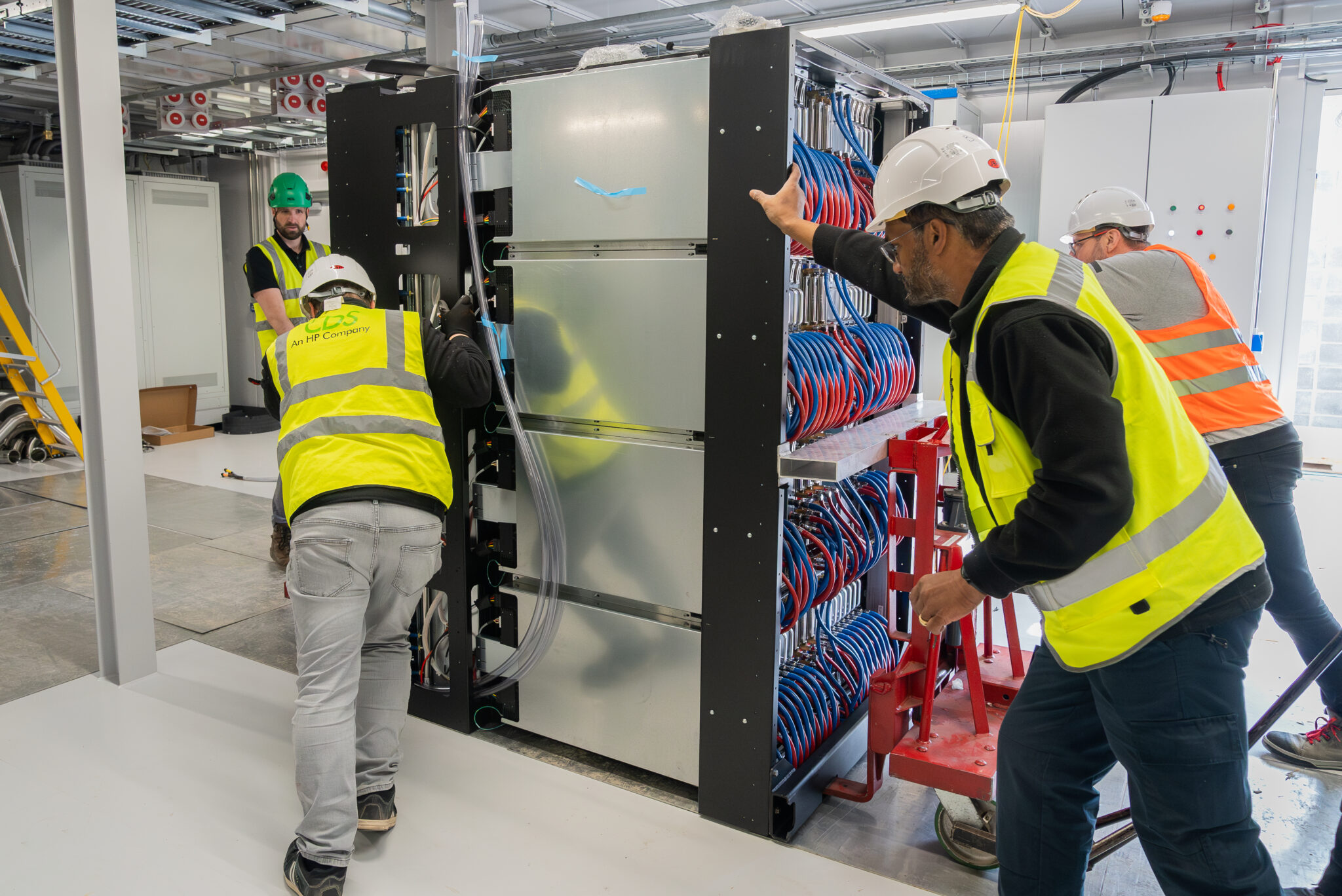
Isambard-AI launch brings Britain closer to AI breakthroughs

The UK’s most powerful AI supercomputer, Isambard-AI, has officially launched in Bristol. Developed with HPE and NVIDIA, the £225 million system marks a major step in national research capability.

It can compute in one second what the global population would take 80 years to process. Housed at the National Composites Centre, it aims to drive breakthroughs in healthcare, robotics, climate science and more.

Built by the University of Bristol’s Centre for Supercomputing, the machine is part of the UK Government’s AI Research Resource (AIRR) and was launched by Science Secretary Peter Kyle.

Alongside the Dawn supercomputer in Cambridge, Isambard-AI will deliver 23 AI ExaFLOPs — equal to the UK population working non-stop for 85,000 years. It is 100,000 times faster than an average laptop and supports drug discovery, personalised medicine and advanced data analysis.

Powered by 5,400 Nvidia GH200 Grace Hopper Superchips and HPE’s Cray EX platform, it is among the greenest supercomputers globally, running on zero-carbon electricity and using direct liquid cooling to cut energy use by up to 90%.

Plans are underway to reuse its waste heat for nearby homes and businesses. Its sustainable design cuts emissions by 72% versus traditional builds.

The University of Bristol, chosen for its AI and HPC expertise, also offers a government-backed master’s through the Sparck AI scholarship. Vice-Chancellor Professor Evelyn Welch called the launch a milestone for British AI.

Researchers are already using Isambard-AI to analyse data from wearable cameras for assisted living support, and to scan MRI data to speed up cancer detection and treatment planning.

Other teams are modelling disease-related proteins and using AI to detect illness in dairy cattle by monitoring herd behaviour — showing the system’s broad real-world impact.

Would you like to learn more about AI, tech and digital diplomacy? If so, ask our Diplo chatbot!

Drug‑testing firm exposes 748,000 records in breach

In a massive data breach revealed in July 2025, the Texas Alcohol & Drug Testing Service (TADTS) admitted hackers gained access to sensitive information belonging to approximately 748,763 individuals.

Attackers remained inside the network for five days in July 2024 before detection, later leaking hundreds of gigabytes of data via the BianLian ransomware group.

Exposed records include a dangerous mix of personal and financial data—names, Social Security and passport numbers, driver’s licence and bank account details, biometric information, health‑insurance files and login credentials.

The breadth of this data presents a significant risk of identity theft and financial fraud.

Despite identifying the breach shortly after, TADTS delayed notifying those affected until July 2025 and provided no credit monitoring or identity theft services.

The company is now under classic action scrutiny, with law firms investigating its response and breach notification delays.

Security experts warn that the extended timeline and broad data exposure could lead to scams, account takeovers and sustained damage to victims.

Affected individuals are urged to monitor statements, access free credit reports, and remain alert for suspicious activity.

Would you like to learn more about AI, tech and digital diplomacy? If so, ask our Diplo chatbot!

Salt Typhoon targets routers in sweeping campaign

Since early 2025, the Chinese-linked hacking group Salt Typhoon has aggressively targeted telecom infrastructure worldwide, compromising routers, switches and edge devices used by clients of major operators such as Comcast, MTN and LG Uplus.

Exploiting known but unpatched vulnerabilities, attackers gained persistent access to these network devices, potentially enabling further intrusions into core telecom systems.

The pattern suggests a strategic shift: the group broadly sweeps telecom infrastructure to establish ready-made access across critical communication channels.

Affected providers emphasised that only client-owned hardware was breached and confirmed no internal networks were compromised, but the campaign raises deeper concerns.

Experts warn that such indiscriminate telecommunications targeting could threaten data security and disrupt essential services, revealing a long-term cyber‑espionage strategy.

Would you like to learn more about AI, tech and digital diplomacy? If so, ask our Diplo chatbot!

Meta lures AI leaders as Apple faces instability

Meta has hired two senior AI researchers from Apple, Mark Lee and Tom Gunter, as part of its ongoing effort to attract top talent in AI, according to Bloomberg.

Instead of staying within Apple’s ranks, both experts have joined Meta’s Superintelligence Labs, following Ruoming Pang, Apple’s former head of large language model development, whom Meta recently secured with a reported compensation package worth over $200 million.

Gunter, once a distinguished engineer at Apple, briefly worked for another AI firm before accepting Meta’s offer.

The moves reflect increasing instability inside Apple’s AI division, where leadership is reportedly exploring partnerships with external providers like OpenAI to power future Siri features rather than relying solely on in-house solutions.

Meta’s aggressive hiring strategy comes as CEO Mark Zuckerberg prioritises AI development, pledging substantial investment in talent and computing power to rival companies such as OpenAI and Google.

Some Apple employees have been presented with counteroffers, but these reportedly fail to match the scale of Meta’s packages.

Instead of slowing down, Meta appears determined to solidify its position as a leader in AI research, continuing to lure key experts away from competitors while Apple faces challenges retaining its top engineers.

Would you like to learn more about AI, tech and digital diplomacy? If so, ask our Diplo chatbot!

Crypto crime surges to record levels in 2025

The cryptocurrency industry faces a record-breaking year for theft in 2025, with losses surpassing $2.17 billion by mid-July, according to a Chainalysis report. The amount stolen so far has surpassed the total for all of 2024, highlighting a concerning increase in digital asset crime.

A large proportion, around $1.5 billion, stems from the North Korea-linked Bybit hack, which accounts for nearly 70% of thefts targeting crypto services this year.

While centralised exchanges remain prime targets, personal wallets now represent almost a quarter of stolen funds. The report highlights a rise in violent ‘wrench attacks,’ where criminals coerce Bitcoin holders into revealing private keys through threats or physical force.

Kidnappings of crypto executives and family members have also increased, with 2025 expected to double the number of such physical assaults compared to previous years.

Sophistication in laundering stolen crypto varies depending on the target. Hackers focusing on exchanges use advanced techniques like chain-hopping and mixers to obscure transactions.

Conversely, attackers targeting personal wallets often employ simpler methods. Interestingly, criminals are holding stolen assets longer and are willing to pay fees up to 14.5 times higher than average to swiftly move illicit funds and avoid detection.

Would you like to learn more about AI, tech and digital diplomacy? If so, ask our Diplo chatbot

Perplexity AI valued at $18 billion after new $100 million raise

AI startup Perplexity AI has raised $100 million in new funding, pushing its valuation to $18 billion, Bloomberg has reported. The deal reflects growing investor interest in AI tools amid the continued rise of chatbots and AI-powered search agents.

The funding follows a previous round from earlier in the year, which valued the company at $14 billion. Perplexity’s rapid valuation growth highlights the pace at which leading AI startups are expanding in the current market climate.

According to The Wall Street Journal, Perplexity was previously in advanced talks to raise $500 million at the earlier valuation. Venture capital firm Accel had been expected to lead that round. Other reports in March suggested that Perplexity aimed to raise as much as $1 billion.

The company has been making moves to challenge major tech incumbents. Just last week, it launched a new AI-powered web browser called ‘Comet’. The tool is designed to compete with Google Chrome by integrating advanced AI search functionality directly into browsing.

Perplexity is backed by Nvidia and is positioning itself at the intersection of search, generative AI, and user experience. Industry observers view its fast-growing valuation as a sign of heightened investor confidence in AI-native platforms.

Would you like to learn more about AI, tech and digital diplomacy? If so, ask our Diplo chatbot!

Eric Schmidt warns that AI growth is limited by electricity

Former Google chief executive Eric Schmidt has warned that electricity, rather than semiconductors, will limit the future growth of AI.

Speaking on the Moonshots podcast, Schmidt said the push towards artificial superintelligence—AI that exceeds human cognitive ability in almost all domains—will depend on securing sufficient power instead of just developing more advanced chips.

Schmidt noted the US alone may require an extra 92 gigawatts of electricity to support AI growth, equivalent to dozens of nuclear power stations.

Instead of waiting for new plants, companies such as Microsoft are seeking to retrofit closed facilities, including the Three Mile Island plant targeted for relaunch in 2028.

Schmidt highlighted growing environmental pressures, citing Microsoft’s 34% increase in water use within a year, a trend experts link directly to rising AI workloads.

Major AI developers like OpenAI’s Sam Altman also acknowledge energy as a key constraint. Altman has invested in nuclear fusion through Helion, while firms such as Microsoft and AMD are pressing US policymakers to fast-track energy permits.

Environmental groups, including Greenpeace, warn that unchecked AI expansion risks undermining climate goals instead of supporting them.

Schmidt believes superintelligence is inevitable and approaching rapidly, predicting specialised AI tools across all fields within five years. Rather than focusing solely on AI’s capabilities, he stressed the urgent need for planning energy infrastructure today to match tomorrow’s AI demands.

Would you like to learn more about AI, tech and digital diplomacy? If so, ask our Diplo chatbot!

Amazon cuts hundreds of AWS jobs amid AI shift

Amazon has reportedly cut hundreds of jobs within its Amazon Web Services cloud computing division, according to sources familiar with the matter.

Instead of providing specific numbers, Amazon confirmed the decision, citing ongoing efforts to optimise resources while continuing to invest in customer-focused innovation.

These layoffs follow warnings by CEO Andy Jassy, who recently said the rising use of generative AI would reduce workforce needs across the company.

The cuts affect several AWS teams, including specialists who support customers in developing new products and selling services. Employees reported receiving termination emails on Thursday, with their system access deactivated soon after.

Rather than focusing solely on AWS, Amazon has also been reducing roles in other units, such as its books division, devices and services unit, and Wondery podcast platform.

Despite these workforce reductions, AWS sales rose 17% in the first quarter to $29.3 billion compared to a year earlier, with operating income increasing by 23% to $11.5 billion.

Amazon, alongside firms like Microsoft, Meta, and CrowdStrike, is increasingly relying on AI tools instead of human workers to automate tasks, write software code, and streamline operations as part of a broader trend affecting the tech industry.

Amazon’s latest cuts reflect efforts by Jassy to reduce bureaucracy and eliminate managerial layers, aiming to keep the company agile amid rapid AI adoption and changing business priorities.

Would you like to learn more about AI, tech and digital diplomacy? If so, ask our Diplo chatbot!

Irish hospital turns to AI for appointment management

Beaumont Hospital in Dublin plans to deploy AI to predict patient no-shows and late cancellations, aiming to reduce wasted resources.

Instead of relying solely on reminders, the hospital will pilot AI software costing up to €110,000, using patient data to forecast missed appointments. Currently, no-shows account for 15.5% of its outpatient slots.

The system will integrate with Beaumont’s existing two-way text messaging service. Rather than sending uniform reminders, the AI model will tailor messages based on the likelihood of attendance while providing hospital staff with real-time insights to better manage clinic schedules.

The pilot is expected to begin in late 2025 or early 2026, potentially expanding into a full €1.2 million contract.

The move forms part of Beaumont Hospital’s strategic plan through 2030 to reduce outpatient non-attendance. It follows the broader adoption of AI in Irish healthcare, including Mater Hospital’s recent launch of an AI and Digital Health centre designed to tackle clinical challenges using new technologies.

Instead of viewing AI as a future option, Irish hospitals now increasingly treat it as an immediate solution to operational inefficiencies, hoping it will transform healthcare delivery and improve patient service.

Would you like to learn more about AI, tech and digital diplomacy? If so, ask our Diplo chatbot!

Sberbank prepares to offer cryptocurrency custody services

Russia’s largest lender, Sberbank, is preparing to offer custody services for cryptocurrency assets, providing security and safeguards against hacking. The bank has proposed treating Bitcoin and digital assets like traditional bank accounts to Russia’s central bank.

These proposals include measures to freeze assets if law enforcement suspects illegal activity.

The central bank has eased its stance, supporting digital assets for international trade to bypass Western sanctions over the Ukraine conflict. Sberbank’s executive director highlighted the growing global trend of banks offering custody services and expressed a desire for Russia to keep pace.

In addition to custody, Sberbank has launched Bitcoin-linked structured bonds and plans to roll out Bitcoin futures and similar investment products on the Moscow Exchange.

Industry experts emphasise that establishing local custody services is vital to reduce reliance on foreign companies and strengthen the security of Russia’s crypto market.

Would you like to learn more about AI, tech and digital diplomacy? If so, ask our Diplo chatbot