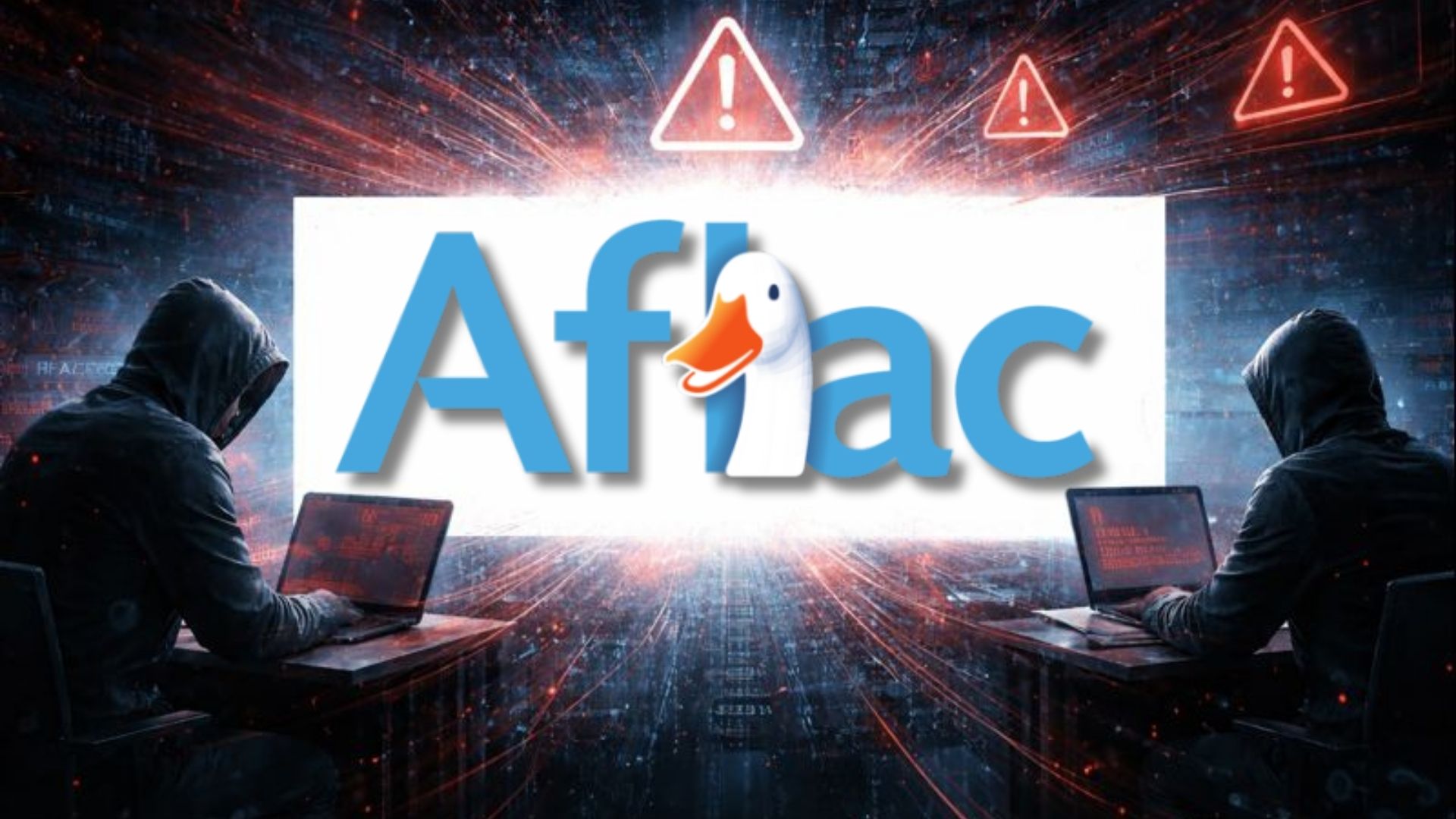
US insurance firm Aflac has confirmed that a cyberattack disclosed in June affected around 22.65 million people. The breach involved the theft of sensitive personal and health information; however, the company initially did not specify the number of individuals affected.
In filings with the Texas attorney general, Aflac said the compromised data includes names, dates of birth, home addresses, government-issued identification numbers, driving licence details, and Social Security numbers. Medical and health insurance information was also accessed during the incident.
A separate filing with the Iowa attorney general suggested the attackers may be linked to a known cybercriminal organisation. Federal law enforcement and external cybersecurity specialists indicated the group had been targeting the insurance sector more broadly.
Security researchers have linked a wave of recent insurance-sector breaches to Scattered Spider, a loosely organised group of predominantly young, English-speaking hackers. The timing and targeting of the Aflac incident align with the group’s activity.
The US company stated that it has begun notifying the affected individuals. The company, which reports having around 50 million customers, did not respond to requests for comment. Other insurers, including Erie Insurance and Philadelphia Insurance Companies, reported breaches during the same period.
Would you like to learn more about AI, tech, and digital diplomacy? If so, ask our Diplo chatbot!
Deutsche Bank has warned that surging AI investment is helping to prop up US economic growth. Analysts say that broader spending would have stalled without the heavy outlays on technology.
The bank estimates hyperscalers could spend $4 trillion on AI data centres by 2030. Analysts cautioned returns remain uncertain despite the scale of investment.
Official data showed US GDP grew at a 4.3% annualised rate in the third quarter. Economists linked much of the momentum to AI-driven capital expenditure.
Market experts remain divided on risks, although many reject fears of a bubble. Corporate cash flows, rather than excessive borrowing, are funding the majority of AI infrastructure.
Would you like to learn more about AI, tech and digital diplomacy? If so, ask our Diplo chatbot!
Increasingly, YouTube creators are utilising AI-generated music to enhance video quality, saving time and costs. Selecting tracks that align with the content tone and audience expectations is crucial for engagement.
Subtle, balanced music supports narration without distraction and guides viewers through sections. Thoughtful use of intros, transitions and outros builds channel identity and reinforces branding.
Customisation tools allow creators to adjust tempo, mood and intensity for better pacing and cohesion with visuals. Testing multiple versions ensures the music feels natural and aligns with storytelling.
Understanding licensing terms protects monetisation and avoids copyright issues. Combining AI music with creative judgement keeps content authentic and original while maximising production impact.
Would you like to learn more about AI, tech, and digital diplomacy? If so, ask our Diplo chatbot!
Meta has restricted access in India to two AI-generated videos posted by the Congress party. The clips depicted Prime Minister Narendra Modi alongside Gautam Adani, Chairman of the Adani Group.
The company stated that the content did not violate its community standards. Action followed takedown notices issued by Delhi Police under India’s information technology laws.
Meta warned that ignoring the orders could jeopardise safe harbour protections. Loss of those protections would expose platforms to direct legal liability.
The case highlights growing scrutiny of political AI content in India. Recent rule changes have tightened procedures for ordering online takedowns.
Would you like to learn more about AI, tech and digital diplomacy? If so, ask our Diplo chatbot!
Japan’s competition authority will probe AI search services from major domestic and international tech firms. The investigation aims to identify potential antitrust violations rather than impose immediate sanctions.
The probe is expected to cover LY Corp., Google, Microsoft and AI providers such as OpenAI and Perplexity AI. Concerns centre on how AI systems present and utilise news content within search results.
Legal action by Japanese news organisations alleges unauthorised use of articles by AI services. Regulators are assessing whether such practices constitute abuse of market dominance.
The inquiry builds on a 2023 review of news distribution contracts that warned against the use of unfair terms for publishers. Similar investigations overseas, including within the EU, have guided the commission’s approach.
Would you like to learn more about AI, tech, and digital diplomacy? If so, ask our Diplo chatbot!
AI is extending the clinical value of chest X-rays beyond lung and heart assessment. Researchers are investigating whether routine radiographs can support broader disease screening without the need for additional scans. Early findings suggest existing images may contain underused diagnostic signals.
A study in Radiology: Cardiothoracic Imaging examined whether AI could detect hepatic steatosis from standard frontal chest X-rays. Researchers analysed more than 6,500 images from over 4,400 patients across two institutions. Deep learning models were trained and externally validated.
The AI system achieved area-under-curve scores above 0.8 in both internal and external tests. Saliency maps showed predictions focused near the diaphragm, where part of the liver appears on chest X-rays. Results suggest that reliable signal extraction can be achieved from routine imaging.
Researchers argue the approach could enable opportunistic screening during standard care. Patients flagged by AI could be referred for a dedicated liver assessment when appropriate. The method adds clinical value without increasing imaging costs or radiation exposure.
Experts caution that the model is not a standalone diagnostic tool and requires further prospective validation. Integration with clinical and laboratory data remains necessary to reduce false positives. If validated, AI-enhanced X-rays could support scalable risk stratification.
Would you like to learn more about AI, tech, and digital diplomacy? If so, ask our Diplo chatbot!
Chief financial officers predict AI will shift finance from experimentation to enterprise-wide impact in 2026. Real-time insights, scenario modelling and strategic decision-making are expected to become central to finance functions.
Success depends on trusted data, strong governance, modernised architectures and human judgement. AI will not replace expertise, but rather reveal gaps and reward organisations that integrate AI with their strategy.
CFOs plan to use AI for capital allocation, forecasting, risk management and operational efficiency. The focus is moving from efficiency gains to transformative, high-value work that drives measurable outcomes.
Enterprise-wide adoption of AI will require robust oversight and upskilling of finance teams. Leaders who modernise systems and combine AI with human expertise will gain a competitive edge.
Would you like to learn more about AI, tech, and digital diplomacy? If so, ask our Diplo chatbot!
A new research paper published in Aging-US uses AI to map a century of global ageing research. The study analyses how scientific priorities have shifted over time. Underexplored areas are also identified.
Researchers analysed more than 460,000 scientific abstracts published between 1925 and 2023. Natural language processing and machine learning were used to cluster themes and track trends. The aim was to provide an unbiased view of the field’s evolution.
Findings show a shift from basic biological studies toward clinical research, particularly age-related diseases such as Alzheimer’s and dementia. Basic science continues to focus on cellular mechanisms. Limited overlap persists between laboratory and clinical research.
Several fast-growing topics, including autophagy, RNA biology, and nutrient sensing, remain weakly connected to clinical applications. Strong links endure in areas such as cancer and ageing. Other associations, including epigenetics and autophagy, are rarely explored.
The analysis highlights gaps that may shape future ageing research priorities. AI-based mapping provides insights into how funding and policy shape focus areas. Greater integration could support more effective translation into clinical outcomes.
Would you like to learn more about AI, tech, and digital diplomacy? If so, ask our Diplo chatbot!
Mandatory facial verification will be introduced in South Korea for anyone opening a new mobile phone account, as authorities try to limit identity fraud.
Officials said criminals have been using stolen personal details to set up phone numbers that later support scams such as voice phishing instead of legitimate services.
Major mobile carriers, including LG Uplus, Korea Telecom and SK Telecom, will validate users by matching their faces against biometric data stored in the PASS digital identity app.
Such a requirement expands the country’s identity checks rather than replacing them outright, and is intended to make it harder for fraud rings to exploit stolen data at scale.
The measure follows a difficult year for data security in South Korea, marked by cyber incidents affecting more than half the population.
SK Telecom reported a breach involving all 23 million of its customers and now faces more than $1.5 billion in penalties and compensation.
Regulators also revealed that mobile virtual network operators were linked to 92% of counterfeit phones uncovered in 2024, strengthening the government’s case for tougher identity controls.
Would you like to learn more aboutAI, tech and digital diplomacy? If so, ask our Diplo chatbot!
Amid growing attention on AI, Google DeepMind chief Demis Hassabis has argued that future systems could learn anything humans can.
He suggested that as technology advances, AI may no longer remain confined to single tasks. Instead of specialising narrowly, it could solve different kinds of problems and continue improving over time.
Supporters say rapid progress already shows how powerful the technology has become.
Other experts disagree and warn that human intelligence remains deeply complex. People rely on emotions, personal experience and social understanding when they think, while machines depend on data and rules.
Critics argue that comparing AI with the human mind oversimplifies how intelligence really works, and that even people vary widely in ability.
Elon Musk has supported the idea that AI could eventually learn as much as humans, while repeating his long-standing view that powerful systems must be handled carefully. His backing has intensified the debate, given his influence in the technology world.
The discussion matters because highly capable AI could reshape work, education and creativity, raising questions over safety and control.
For now, AI performs specific tasks extremely well yet cannot think or feel like humans, and no one can say for certain whether true human-level intelligence will ever emerge.
Would you like to learn more aboutAI, tech and digital diplomacy? If so, ask our Diplo chatbot!