
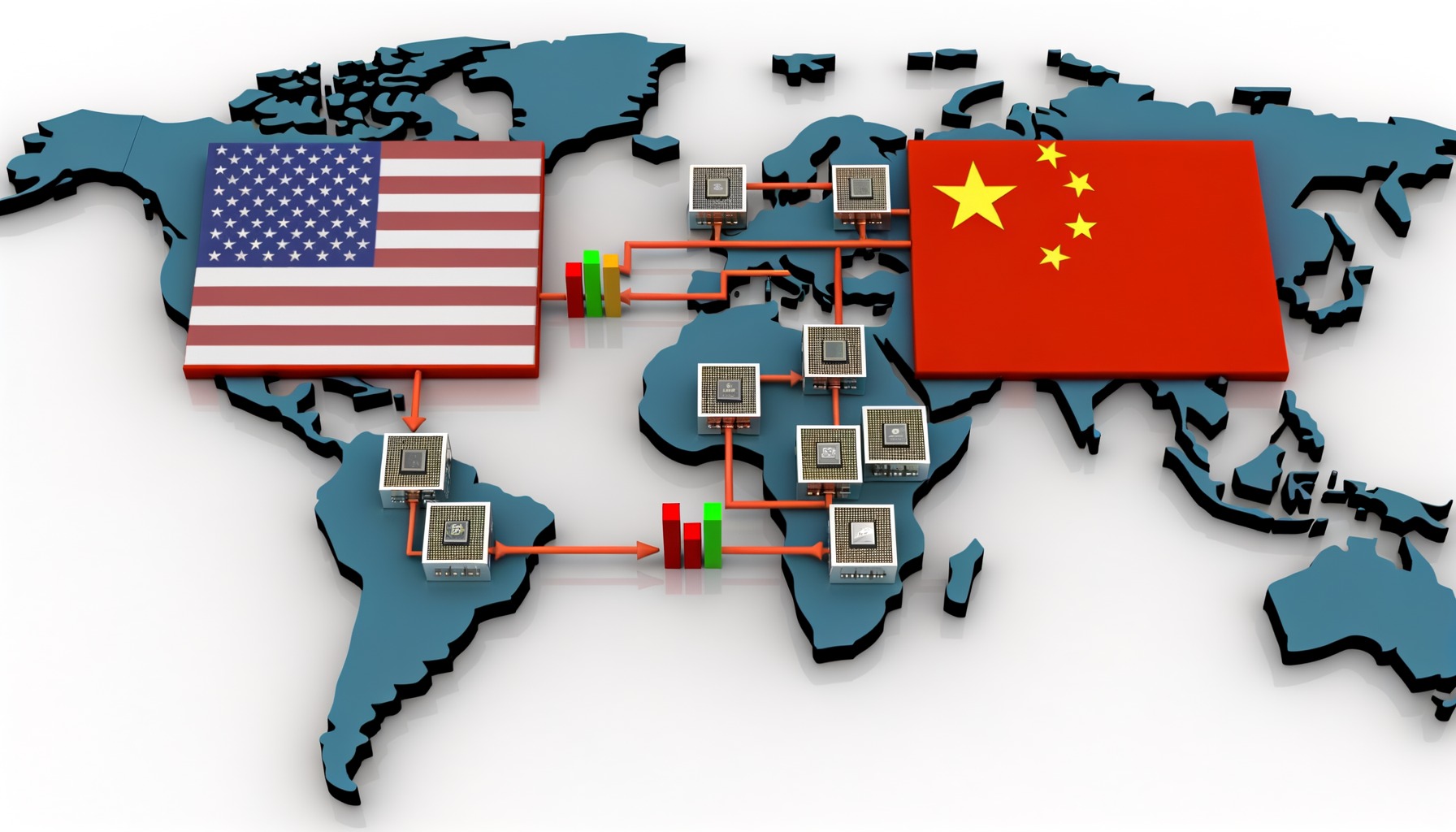
China’s chipmaking equipment purchases are expected to decline in 2025, following three years of growth, due to overcapacity and increasing restrictions from US sanctions. After purchasing $41 billion in equipment in 2024, which accounted for 40% of global sales, China’s spending is predicted to fall by 6% to $38 billion this year, marking the first decline since 2021. The drop in demand is attributed to reduced purchases in response to export controls and an excess of manufacturing capacity.
Despite these challenges, China has been a key driver for the global wafer fabrication equipment market over the past few years, even as other sectors saw downturns. Much of China’s equipment buying has been linked to stockpiling efforts in response to US sanctions aimed at limiting China’s ability to produce advanced chips, particularly for military use. Chinese firms, like SMIC and Huawei, have continued to advance in chip production, although at a higher cost and with more effort, while also focusing on expanding in the mature-node chip market.
In addition to growing its domestic production capabilities, China’s leading equipment manufacturers, such as Naura Technology Group and AMEC, are expanding internationally. However, the country still faces significant challenges in self-sufficiency, particularly in areas like lithography systems, testing, and assembly tools. While China’s domestic companies have made strides in equipment sales, they still rely heavily on foreign suppliers for advanced technology in these areas.
For more information on these topics, visit diplomacy.edu.
Apple has partnered with Chinese tech giant Alibaba to develop AI features for iPhones in China, aiming to bolster its presence in a highly competitive market. The collaboration follows months of uncertainty over Apple’s AI strategy in the country, where rivals like Huawei have already integrated AI tools into their devices. The move marks a shift from Apple’s earlier preference for Baidu, which reportedly fell short of the company’s expectations.
The partnership could help Apple regain lost ground after a decline in iPhone sales during the holiday season, a period typically strong for the company. The AI-powered features have been submitted for regulatory approval in China, a crucial step before their rollout. Apple’s stock saw a 1.5% rise following the news, while Alibaba’s US-listed shares gained 2.6%.
Apple’s decision to work with Alibaba was reportedly influenced by the e-commerce giant’s vast datasets on user shopping and payment habits, which could enhance AI model training and improve personalised services. As Apple anticipates strong sales growth in the current quarter, this partnership could play a key role in driving renewed demand for iPhones in China.
For more information on these topics, visit diplomacy.edu.
Anduril, a defence technology startup founded by Palmer Luckey, will take charge of the US Army’s $22 billion mixed-reality headset program. The project, known as the Integrated Visual Augmentation System (IVAS), aims to equip soldiers with augmented and virtual reality capabilities to enhance situational awareness and mission command of unmanned systems.
The agreement sees Anduril assuming responsibility for the production, hardware, and software development of the IVAS project, while Microsoft Azure will serve as the preferred cloud platform for associated workloads.
Microsoft’s earlier development efforts utilised HoloLens technology to meet the Army’s high-tech demands.
The partnership comes amid a global push by defence firms to integrate artificial intelligence and smart peripherals into military technology. Anduril is also collaborating with OpenAI and Palantir to leverage defence data for AI training. Final approval from the US Department of Defense remains pending.
Reports suggest Anduril is in discussions to secure new funding that could boost its valuation to $28 billion. Luckey, who previously founded Oculus VR, acquired by Facebook in 2014, continues to play a significant role in the advancement of cutting-edge technology for defence applications.
For more information on these topics, visit diplomacy.edu.
Baidu, China’s tech giant, is set to unveil the next version of its AI model, Ernie 5, in the second half of 2025. This new iteration will introduce multimodal capabilities, allowing it to process and convert a variety of formats such as text, video, images, and audio, offering significant advancements in AI technology.
The release is timed to respond to increasing competition in China’s rapidly developing AI sector, particularly from the startup DeepSeek. The company has gained attention with a reasoning model that rivals OpenAI’s GPT while offering lower costs. Despite being one of the first to enter the AI space in China after the debut of ChatGPT in 2022, Baidu has faced challenges in gaining widespread adoption of its Ernie model.
Baidu’s AI offerings have struggled to keep pace with competitors like ByteDance’s Doubao chatbot and DeepSeek in terms of user uptake. The company maintains that its latest version, Ernie 4, is comparable to OpenAI’s GPT-4, but the adoption rate has been slower than anticipated. CEO Robin Li acknowledged the unpredictable nature of innovation, noting DeepSeek’s rise as a reminder that the future of AI is uncertain and can emerge from unexpected places.
Li also stressed the importance of continued investment in data centres and cloud infrastructure to keep up with the evolving demands of AI, even as newer models, such as DeepSeek’s, challenge the cost-efficiency of large AI models.
For more information on these topics, visit diplomacy.edu.
Lam Research, a leading US-based chip toolmaker, has announced plans to invest over 100 billion rupees ($1.2 billion) in Karnataka, India. The company has signed a memorandum of understanding with the Karnataka Industrial Area Development Board to facilitate the investment, which was revealed during the ‘Invest Karnataka’ event.
The initiative aligns with India’s efforts to strengthen its semiconductor ecosystem. Prime Minister Narendra Modi’s government has introduced a $10 billion incentive programme to attract global chip firms. With semiconductor market projected to reach $63 billion by 2026 in India, the country is emerging as a significant player in the global semiconductor race.
Karnataka, home to Bengaluru, serves as a critical driver of India’s economy. Known for its contributions to IT services, software, and manufacturing exports, the state is increasingly positioning itself as a hub for high-tech investments.
India’s IT minister hailed Lam Research’s investment as a major step in the nation’s semiconductor ambitions. The announcement reflects growing confidence in the government’s vision for a robust and competitive semiconductor industry.
For more information on these topics, visit diplomacy.edu.
European data protection authorities are set to discuss Chinese AI startup DeepSeek amid growing concerns about how the company handles personal data. The European Data Protection Board will review the firm’s practices at its monthly meeting on Tuesday, following questions from several national regulators about whether European user data is being used for AI training and if it could be transferred to China.
France‘s privacy watchdog, CNIL, has already questioned DeepSeek about its AI model and any potential risks to user privacy. Ireland‘s data protection authority has also requested information, while Italy has taken a more drastic step by ordering DeepSeek to block its chatbot in the country due to unresolved concerns over its privacy policy.
The European Union is known for its strict data protection laws, with the General Data Protection Regulation (GDPR) considered one of the most comprehensive privacy frameworks globally. Authorities are now working to coordinate their approach to ensure a consistent response to DeepSeek’s activities across the region.
Salesforce has announced plans to invest $500 million in AI initiatives in Saudi Arabia as global competition for AI investment intensifies. The company will introduce Hyperforce, its cloud platform architecture developed in partnership with Amazon Web Services, to the country. The investment was revealed at LEAP 2025, Saudi Arabia’s major global tech event, which secured nearly $15 billion in new AI-related investments.
As part of the initiative, Salesforce will collaborate with major firms, including Capgemini, Deloitte, IBM, and PwC, to expand the use of its AI-driven customer service platform, Agentforce. Additionally, it will introduce Arabic language support for its AI product suite, making its technology more accessible in the region.
Salesforce recently announced plans to establish a regional headquarters in Riyadh, aligning with Saudi Arabia‘s broader push to become a major player in the AI sector. The company has also committed to upskilling 30,000 Saudi citizens by 2030, reflecting its long-term commitment to developing AI talent in the region.
Brazil’s finance minister, Fernando Haddad, has dismissed claims that the country is considering taxing US tech companies in retaliation for new American tariffs on steel imports. The report, published by Folha de S.Paulo, suggested that President Luiz Inácio Lula da Silva’s administration was weighing levies on firms such as Amazon, Meta, and Google. Haddad stated that the information was incorrect and reaffirmed that the government would only make decisions based on concrete developments.
The United States is expected to introduce new 25% tariffs on steel and aluminium imports, adding to existing trade restrictions. As one of the largest suppliers of steel to the United States, Brazil has been closely monitoring the situation. Haddad emphasised that the government would adopt a measured approach, making announcements only when appropriate to avoid misinterpretation.
Previous discussions within Brazil‘s finance ministry have explored the possibility of taxing big tech firms as part of broader fiscal policies. However, no formal decision has been made, and Haddad’s comments suggest that any future action will depend on concrete economic considerations rather than speculation.
Saudi Arabia’s NEOM has signed an agreement with DataVolt to develop a 1.5-gigawatt net-zero AI project in its Oxagon industrial zone. The first phase will see an investment of $5 billion, with operations expected to begin in 2028. The initiative aims to position the kingdom as a leading AI hub in the region, competing with the United Arab Emirates and Qatar amid soaring demand for generative AI technology.
The Saudi government has been actively pursuing AI development, with plans for a $40 billion fund in collaboration with foreign partners. The governor of Saudi Arabia’s Public Investment Fund, Yasir Al-Rumayyan, has promoted the country as a potential global AI centre, citing its abundant energy resources and financial capacity. NEOM, a development nearly the size of Belgium, is a key part of the kingdom’s Vision 2030 strategy to diversify its economy beyond oil.
Oxagon is set to become an industrial city powered entirely by renewable energy, aligning with NEOM’s sustainability goals. However, the kingdom has scaled back some of its more ambitious projects to prioritise infrastructure essential for hosting major global events. Rising costs have influenced these adjustments, but AI remains a critical part of Saudi Arabia‘s long-term economic transformation.
AI chip startup Positron has raised $23.5 million in a bid to compete with industry leader Nvidia. The Reno-based company, which manufactures its chips in Arizona, claims its processors consume less than a third of the power of Nvidia’s high-performance H100 chips while maintaining similar capabilities. Investors in the funding round included Valor Equity Partners, Atreides Management, and Flume Ventures.
Positron’s chips are designed for AI inference, the stage where trained AI models are used rather than developed. While demand is currently higher for training chips, analysts predict that inference chips could soon become the more sought-after option as AI applications expand. This shift has led major players such as OpenAI, Google, and Meta to invest heavily in AI infrastructure, with spending expected to reach tens of billions of dollars this year.
Although Nvidia dominates roughly 80% of the AI chip market, rising costs and concerns over reliance on a single supplier have pushed major tech firms to seek alternatives. With its latest funding, Positron positions itself as a strong contender in the growing US and global AI chip industry, offering a more energy-efficient option for future AI applications.
For more information on these topics, visit diplomacy.edu