After its announcement in May, Opera has started rolling out Neon, its first AI-powered browser. Unlike traditional browsers, Neon is designed for professionals who want AI to simplify complex online workflows.
The browser introduces Tasks, which act like self-contained workspaces. AI can understand context, compare sources, and operate across multiple tabs simultaneously to manage projects more efficiently.
Neon also features cards and reusable AI prompts that users can customise or download from a community store, streamlining repeated actions and tasks.
Its standout tool, Neon Do, performs real-time on-screen actions such as opening tabs, filling forms, and gathering data, while keeping everything local. Opera says no data is shared, and all information is deleted after 30 days.
Neon is available by subscription at $19.90 per month. Invitations are limited during rollout, but Opera promises broader availability soon.
Would you like to learn more about AI, tech, and digital diplomacy? If so, ask our Diplo chatbot!
Kazakhstan has launched the Alem Crypto Fund to strengthen its presence in digital finance. The state-backed fund, created by the Ministry of Artificial Intelligence and Digital Development, will focus on long-term investments in digital assets and forming strategic reserves.
The initiative is managed by Qazaqstan Venture Group and registered within the Astana International Financial Centre (AIFC), a hub for financial innovation. Officials have suggested the fund could evolve into a tool for state-level savings, enhancing the country’s economic resilience.
Binance Kazakhstan, a locally licensed arm of the global exchange, has been named the fund’s strategic partner. They made their first investment in BNB, the native token of BNB Chain, which holds a market capitalisation of over $138 billion.
Government representatives and Binance Kazakhstan described the collaboration as a milestone for institutional recognition of cryptocurrencies in Kazakhstan. It signals a move toward a more transparent and secure digital asset market integrated with global technologies.
Would you like to learn more about AI, tech and digital diplomacy? If so, ask our Diplo chatbot!
A £100m AI data centre has been approved for construction on the outskirts of Stockton, with developers Latos Data Centres pledging up to 150 new jobs.
The Preston Farms Industrial Estate site will feature two commercial units, plants, substations and offices, designed to support the growing demands of AI and advanced computing.
Work on the Neural Data Centre is set to begin at the end of the year, with full operations expected by 2028. The project has been welcomed by Industry Minister and Stockton North MP Chris McDonald, who described it as a significant investment in skills and opportunities for the future.
Latos managing director Andy Collin said the facility was intended to be ‘future proof’, calling it a purpose-built factory for the modern digital economy. Local leaders hope the investment will help regenerate Teesside’s industrial base, positioning the region as a hub for cutting-edge infrastructure.
The announcement follows the UK government’s decision to create an AI growth zone in the North East, covering sites in Northumberland and Tyneside. Teesworks in Redcar was not included in the initial allocation, but ministers said further proposals from Teesside were still under review.
Would you like to learn more aboutAI, tech and digital diplomacy? If so, ask our Diplo chatbot!
Abu Dhabi’s Mohamed bin Zayed University of AI (MBZUAI) claims to have rapidly become central to the UAE’s ambition to lead in AI.
Founded six years ago, the state-backed institute has hired over 100 faculty, recruited students from 49 nations, and now counts more than 700 alumni. All students receive full scholarships, while professors enjoy freedom from chasing research grants.
The university works closely with G42, the UAE’s flagship AI firm, and has opened a research lab in Silicon Valley. It has already unveiled non-English language models, including Arabic, Kazakh, and Hindi, and recently launched K2 Think, an open-source reasoning model.
MBZUAI is part of a wider national strategy that pairs investment in semiconductor chips with the creation of a global talent pipeline. The UAE now holds over 188,000 AI chips, second only to the US, and aims for AI to contribute 20% of its non-oil GDP by 2031.
About 80% of graduates have remained in the country, aided by long-term residency incentives and tax-free salaries. Analysts say the university’s success will depend on whether it can sustain momentum and secure permanent endowments to outlast shifting UAE government priorities.
Would you like to learn more about AI, tech and digital diplomacy? If so, ask our Diplo chatbot!
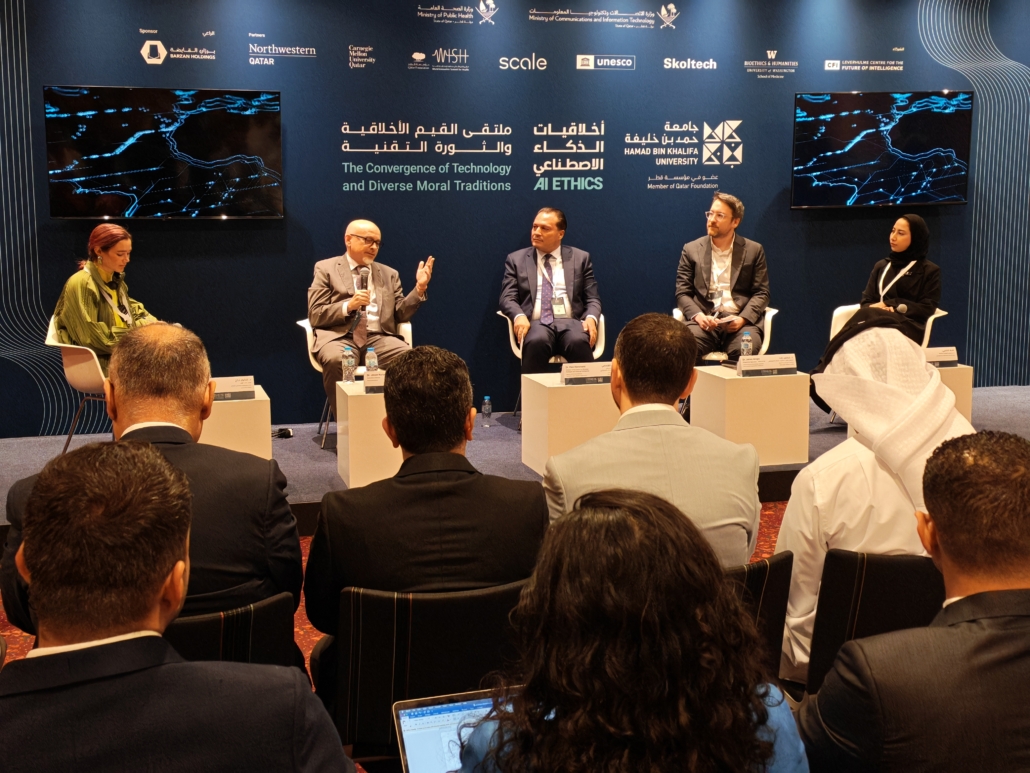
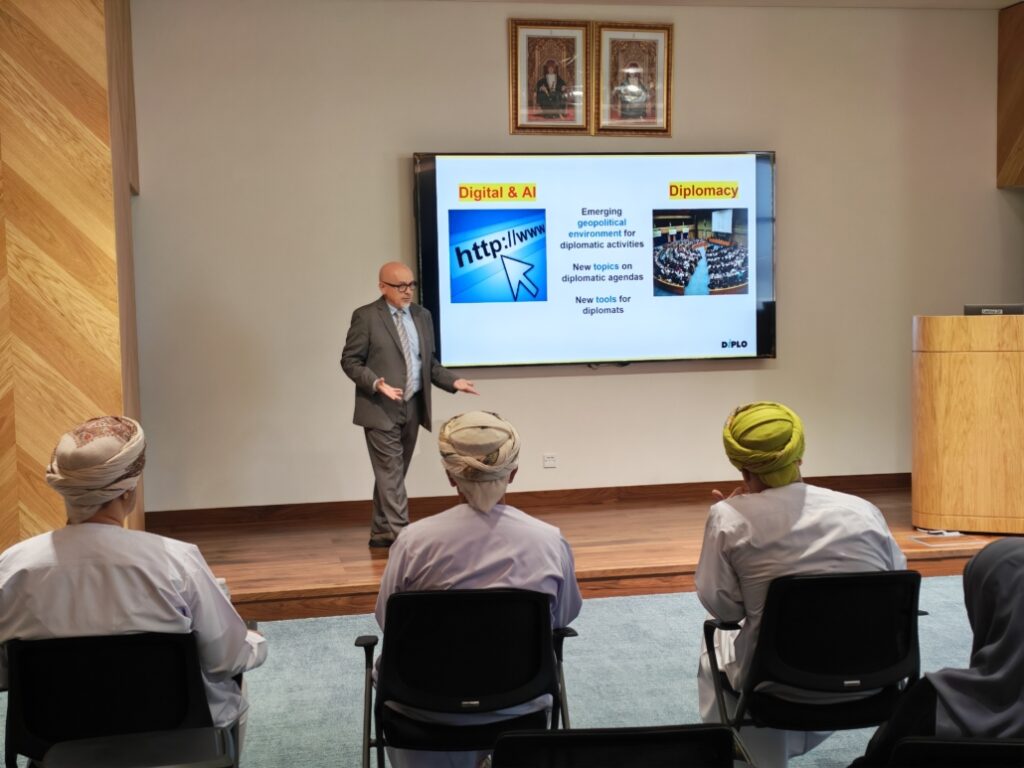
DiploFoundation has taken its work on AI and governance to the Gulf, with engagements in Oman and Qatar focused on how AI is reshaping diplomacy and policymaking. In Muscat, Jovan Kurbalija delivered a lecture on AI’s geopolitical implications, led a workshop on the future of digital diplomacy, and met with institutions advancing Oman’s National AI Strategy and innovation ecosystem.
The Gulf engagements highlighted the need to balance innovation with responsibility. Discussions focused on equipping government staff with AI expertise, ensuring technology is integrated into governance that reflects cultural values, and shaping diplomatic practice around collaboration with tech companies.
Diplo’s programme builds on its long-standing research into how Arabic and Islamic philosophical traditions can enrich global debates on AI. The initiative aims to advance inclusive, practical, and ethical approaches to AI in international policy and diplomacy by bringing these perspectives to the table.
Would you like to learn more about AI, tech, and digital diplomacy? If so, ask our Diplo chatbot!
Apple is internally testing its upcoming Siri upgrade with a chatbot-style tool called Veritas, according to a report by Bloomberg. The app enables employees to experiment with new capabilities and provide structured feedback before a public launch.
Veritas enables testers to type questions, engage in conversations, and revisit past chats, making it similar to ChatGPT and Gemini. Apple is reportedly using the feedback to refine Siri’s features, including data search and in-app actions.
The tool remains internal and is not planned for public release. Its purpose is to make Siri’s upgrade process more efficient and guide Apple’s decision on future chatbot-like experiences.
Apple executives have said they prefer integrating AI into daily tasks instead of offering a separate chatbot. Craig Federighi confirmed at WWDC that Apple is focused on natural task assistance rather than a standalone product.
Bloomberg reports that the new Siri will use Apple’s own AI models alongside external systems like Google’s Gemini, with a launch expected next spring.
Would you like to learn more about AI, tech, and digital diplomacy? If so, ask our Diplo chatbot!
European ministers have signed the Declaration of the Semicon Coalition, calling for a revised EU Chips Act 2.0 to boost semiconductor resilience, innovation, and competitiveness. The declaration outlines five priorities: collaboration, investment, skills, sustainability, and global partnerships.
Over fifty leading European and international semiconductor players have endorsed the declaration. This support strengthens momentum for placing end-markets at the core of the EU’s semiconductor strategy and aligns with Mario Draghi’s report on competitiveness.
The priorities include aligning EU and national funding, accelerating approvals for strategic projects, building a skilled talent pipeline, and promoting circular, energy-efficient manufacturing. International partnerships will also be deepened while safeguarding European strategic autonomy.
Minister Karremans said the strategy demonstrates Europe’s response to global tensions and its commitment to boosting semiconductor capacity, research funding, and readiness for demand in AI, automotive, energy, and defense.
Would you like to learn more about AI, tech and digital diplomacy? If so, ask our Diplo chatbot!
OpenAI CEO Sam Altman has warned that AI could soon automate up to 40 percent of the tasks humans currently perform. He made the remarks in an interview with German newspaper Die Welt, highlighting the potential economic shift AI will trigger.
Altman described OpenAI’s latest model, GPT-5, as the most advanced yet and claimed it is ‘smarter than me and most people’. He said artificial general intelligence (AGI), capable of outperforming humans in all areas, could arrive before 2030.
Instead of focusing on job losses, Altman suggested examining the percentage of tasks that AI will automate. He predicted that 30 to 40 per cent of tasks currently carried out by humans may soon be completed by AI systems.
These comments contribute to the growing debate about the societal impact of AI, with mass layoffs already being linked to automation. Altman emphasised that this wave of change will reshape economies and workplaces, requiring businesses and governments to prepare for disruption.
As AGI approaches, Altman urged individuals to focus on acquiring in-demand skills to stay relevant in an AI-enabled economy. The relationship between humans and machines, he said, will be permanently reshaped by these developments.
Would you like to learn more about AI, tech and digital diplomacy? If so, ask our Diplo chatbot!
Kazakhstan’s President Kassym-Jomart Tokayev has outlined a bold vision to transform the nation into a fully digital state within three years. He plans to leverage AI to modernise the economy and public administration.
At the opening of a new parliamentary session, Tokayev emphasised the need for comprehensive digitalisation to ensure socio-economic stability amid global challenges. A new Ministry of AI and Digital Development will drive the agenda under a Digital Code for AI, big data, and the platform economy.
Tokayev urged a revised investment policy to boost competitiveness, focusing on high-tech manufacturing instead of reliance on raw materials. The government has been tasked with streamlining investment processes, with the Prime Minister directly responsible for attracting funds.
The Asset Recovery Committee will be reshaped into the Committee for Investors’ Rights after recovering 850 billion tenge for public projects like schools and healthcare.
The President proposed parliamentary reform, calling for a unicameral Parliament elected by party lists by 2027, pending public debate and a referendum. The move aims to enhance legislative efficiency and align with global parliamentary traditions.
Agriculture, transport, and water management will undergo digital upgrades, with AI optimising land use, logistics, and resource conservation for sustainable development.
Kazakhstan will strengthen its Eurasian transit hub role with projects like the Trans-Caspian Route and a digital freight platform, Smart Cargo. Tokayev urged unity and patriotism to tackle global challenges and build a prosperous digital Kazakhstan.
Would you like to learn more about AI, tech and digital diplomacy? If so, ask our Diplo chatbot!
A team of physicists at the California Institute of Technology has unveiled a quantum computing breakthrough, creating an array of 6,100 qubits, the largest of its kind to date.
The leap surpasses previous systems, which typically contained around a thousand qubits, and marks a step closer to practical quantum algorithms.
Researchers used caesium atoms as qubits, trapping them with laser tweezers inside an ultra-high-vacuum chamber.
These qubits maintained superposition for almost 13 seconds, nearly ten times longer than previous benchmarks. They could also be manipulated with 99.98 percent accuracy, proving that scaling up need not compromise precision.
Unlike classical bits, qubits exploit superposition, allowing a spread of probabilities instead of fixed binary states. It enables powerful computations but also demands error correction to overcome qubit fragility. The surplus qubits in this new array provide a path to large, error-corrected machines.
Physicists believe the next milestone will involve harnessing entanglement, enabling the shift from storing quantum information to processing it. If progress continues, quantum computers could soon revolutionise science by uncovering new materials, forms of matter, and fundamental laws of physics.
Would you like to learn more aboutAI, tech and digital diplomacy? If so, ask our Diplo chatbot!