Microsoft CEO Satya Nadella recently delivered a key insight, stating that the biggest hurdle to deploying new AI solutions is now electrical power, not chip supply. The massive energy requirements for running large language models (LLMs) have created a critical bottleneck for major cloud providers.
Nadella specified that Microsoft currently has a ‘bunch of chips sitting in inventory’ that cannot be plugged in and utilised. The problem is a lack of ‘warm shells’, meaning data centre buildings that are fully equipped with the necessary power and cooling capacity.
The escalating power requirements of AI infrastructure are placing extreme pressure on utility grids and capacity. Projections from the Lawrence Berkeley National Laboratory indicate that US data centres could consume up to 12 percent of the nation’s total electricity by 2028.
The disclosure should serve as a warning to investors, urging them to evaluate the infrastructure challenges alongside AI’s technological promise. This energy limitation could create a temporary drag on the sector, potentially slowing the massive projected returns on the $5 trillion investment.
Would you like to learn more about AI, tech and digital diplomacy? If so, ask our Diplo chatbot!
Massive new data centres, built to power the AI industry, are being blamed for a dramatic rise in electricity costs across the US. Residential utility bills in states with high concentrations of these facilities, such as Virginia and Illinois, are surging far beyond the national average.
The escalating energy demand has caused a major capacity crisis on large grids like the PJM Interconnection, with data centre load identified as the primary reason for a multi-billion pound spike in future power costs. These extraordinary increases are being passed directly to consumers, making affordability a central issue for politicians ahead of upcoming elections.
Lawmakers are now targeting tech companies and AI labs, promising to challenge what they describe as ‘sweetheart deals’ and to make the firms contribute more to the infrastructure they rely upon.
Although rising costs are also attributed to an ageing grid and inflation, experts warn that utility bills are unlikely to decrease this decade due to the unprecedented demand from rapid data centre expansion.
Would you like to learn more about AI, tech and digital diplomacy? If so, ask our Diplo chatbot!
Class-action privacy litigation continues to grow in frequency, repurposing older laws to address modern data tracking technologies. Recent high-profile lawsuits have applied the California Invasion of Privacy Act and the Video Privacy Protection Act.
A unanimous jury verdict recently found Meta Platforms violated CIPA Section 632 (which is now under appeal) by eavesdropping on users’ confidential communications without consent. The court ruled that Meta intentionally used its SDK within a sexual health app, Flo, to intercept sensitive real-time user inputs.
That judgement suggests an electronic device under the statute need not be physical, with a user’s phone qualifying as the requisite device. The legal success in these cases highlights a significant, rising risk for all companies utilising tracking pixels and software development kits (SDKs).
Separately, the VPPA has found new power against tracking pixels in the case of Jancik v. WebMDconcerning video-viewing data. The court held that a consumer need not pay for a video service but can subscribe by simply exchanging their email address for a newsletter.
Companies must ensure their privacy policies clearly disclose all such tracking conduct to obtain explicit, valid consent. The courts are taking real-time data interception seriously, noting intentionality may be implied when a firm fails to stem the flow of sensitive personally identifiable information.
Would you like to learn more about AI, tech and digital diplomacy? If so, ask our Diplo chatbot!
US legislators in Wisconsin and Michigan are weighing proposals that would restrict the use of VPNs to access sites deemed harmful to minors. The bills build on age-verification rules for websites hosting sexual content, which lawmakers say are too easy to bypass when users connect via VPNs.
In Wisconsin, a bill that has already passed the State Assembly would require adult sites to both verify age and block visitors using VPNs, potentially making the state the first in the US to outlaw VPN use for accessing such content if the Senate approves it.
In Michigan, similar legislation would go further by obliging internet providers to monitor and block VPN connections, though that proposal has yet to advance.
The Digital Rights Group and the Electronic Frontier Foundation argue that the approach would erode privacy for everyone, not just minors.
It warns that blanket restrictions would affect businesses, students, journalists and abuse survivors who rely on VPNs for security, calling the measures ‘surveillance dressed up as safety’ and urging lawmakers instead to improve education, parental tools and support for safer online environments.
The debate comes as several European countries, including France, Italy and the UK, have introduced age-verification rules for pornography sites, but none have proposed banning VPNs.
Would you like to learn more about AI, tech and digital diplomacy? If so, ask our Diplo chatbot!
Google will pour 40 billion dollars into Texas by 2027, expanding digital infrastructure. Funding focuses on new cloud and AI facilities alongside existing campuses in Midlothian and Dallas.
Three new US data centres are planned, one in Armstrong County and two in Haskell County. One Haskell site will sit beside a solar plant and battery storage facility. Investment is accompanied by agreements for more than 6,200 megawatts of additional power generation.
Google will create a 30 million dollar Energy Impact Fund supporting Texan energy efficiency and affordability projects. The company backs training for existing electricians and over 1,700 apprentices through electrical training programmes.
Spending strengthens Texas as a major hub for data centres and AI development. Google says expanded infrastructure and workforce will help maintain US leadership in advanced computing technologies. Company highlights its 15 year presence in Texas and pledges ongoing community support.
Would you like to learn more about AI, tech and digital diplomacy? If so, ask our Diplo chatbot!
eBay is deepening its investment in AI as part of a multi-year effort to revive the platform after years of stagnant growth.
The company, which saw renewed momentum during the pandemic, has launched five new AI features this year, including AI-generated shipping estimates, an AI shopping agent and a partnership with OpenAI.
Chief executive Jamie Iannone argues that eBay’s long history gives it an advantage in the AI era, citing decades of product listings, buyer behaviour data and more than two billion active listings. That data underpins tools such as the ‘magical listing’ feature, which automatically produces item descriptions from photos, and an AI assistant that answers buyer questions based on a listing’s details.
These tools are also aimed at unlocking supply: eBay says the average US household holds thousands of dollars’ worth of unused goods.
Analysts note that helping casual sellers overcome the friction of listing and photographing items could lift the company’s gross merchandise volume, which grew 10 percent in the most recent quarter.
AI is also reshaping the buyer experience. Around 70 percent of eBay transactions come from enthusiasts who already know how to navigate the platform. The new ‘eBay.ai’ tool is designed to help less experienced users by recommending products based on natural-language descriptions.
Despite this push, the platform still faces intense competition from Amazon, Google, Shein and emerging AI-shopping agents. Iannone has hinted that eBay may integrate with external systems such as OpenAI’s instant-checkout tools to broaden discovery beyond the platform.
Would you like to learn more about AI, tech and digital diplomacy? If so, ask our Diplo chatbot!
Microsoft has opened Fairwater, a new class of AI datacentres networked across the US. Atlanta began operating in October and links with the Wisconsin build to act as a single superfactory. The design targets faster training for models used by Microsoft, OpenAI and Copilot.
Fairwater sites pack hundreds of thousands of advanced GPUs with liquid cooling. Company materials highlight near-zero operational water use at Atlanta’s system and efficiency improvements in Wisconsin. Coverage confirms multi-site networking intended to accelerate model development.
Residents and experts voice concern over noise, power demand and water risks near proposed AI hubs. Georgia communities have pursued restrictions, citing environmental strain and rising utility bills, while Wisconsin groups demand transparency.
Microsoft expanded its Wisconsin investment and cancelled a separate Caledonia plan after severe local pushback. The Mount Pleasant project continues, with commitments on infrastructure costs and efficient cooling noted in filings and reports.
Would you like to learn more about AI, tech and digital diplomacy? If so, ask our Diplo chatbot!
The US AI safety and research company, Anthropic, has announced a $50 billion investment to expand AI computing infrastructure inside the country, partnering with Fluidstack to build data centres in Texas and New York, with additional sites planned.
These facilities are designed to optimise efficiency for Anthropic’s workloads, supporting frontier research and development in AI.
The project is expected to generate approximately 800 permanent jobs and 2,400 construction positions as sites come online throughout 2026.
An investment that aligns with the Trump administration’s AI Action Plan, aiming to maintain the US leadership in AI while strengthening domestic technology infrastructure and competitiveness.
Dario Amodei, CEO and co-founder of Anthropic, highlighted the importance of such an infrastructure in developing AI systems capable of accelerating scientific discovery and solving complex problems.
The company serves over 300,000 business customers, with a sevenfold growth in large accounts over the past year, demonstrating strong market demand for its Claude AI platform.
Fluidstack was selected as Anthropic’s partner for its agility in rapidly deploying high-capacity infrastructure. The collaboration aims to provide cost-effective and capital-efficient solutions to meet the growing demand, ensuring that research and development can continue to be at the forefront of AI innovation.
Would you like to learn more aboutAI, tech and digital diplomacy? If so, ask our Diplo chatbot!
A US federal judge has ruled that a landmark copyright case against OpenAI can proceed, rejecting the company’s attempt to dismiss claims brought by authors and the Authors Guild.
The authors argue that ChatGPT’s summaries of copyrighted works, including George R.R. Martin’s Game of Thrones, unlawfully replicate the original tone, plot, and characters, raising concerns about AI-generated content infringing on creative rights.
The Publishers Association (PA) welcomed the ruling, warning that generative AI could ‘devastate the market’ for books and other creative works by producing infringing content at scale.
It urged the UK government to strengthen transparency rules to protect authors and publishers, stressing that AI systems capable of reproducing an author’s style could undermine the value of original creation.
The case follows a £1.5bn settlement against Anthropic earlier this year for using pirated books to train its models and comes amid growing scrutiny of AI firms.
In Britain, Stability AI recently avoided a copyright ruling after a claim by Getty Images was dismissed on grounds of jurisdiction. Still, the PA stated that the outcome highlighted urgent gaps in UK copyright law regarding AI training and output.
Would you like to learn more about AI, tech and digital diplomacy? If so, ask our Diplo chatbot!
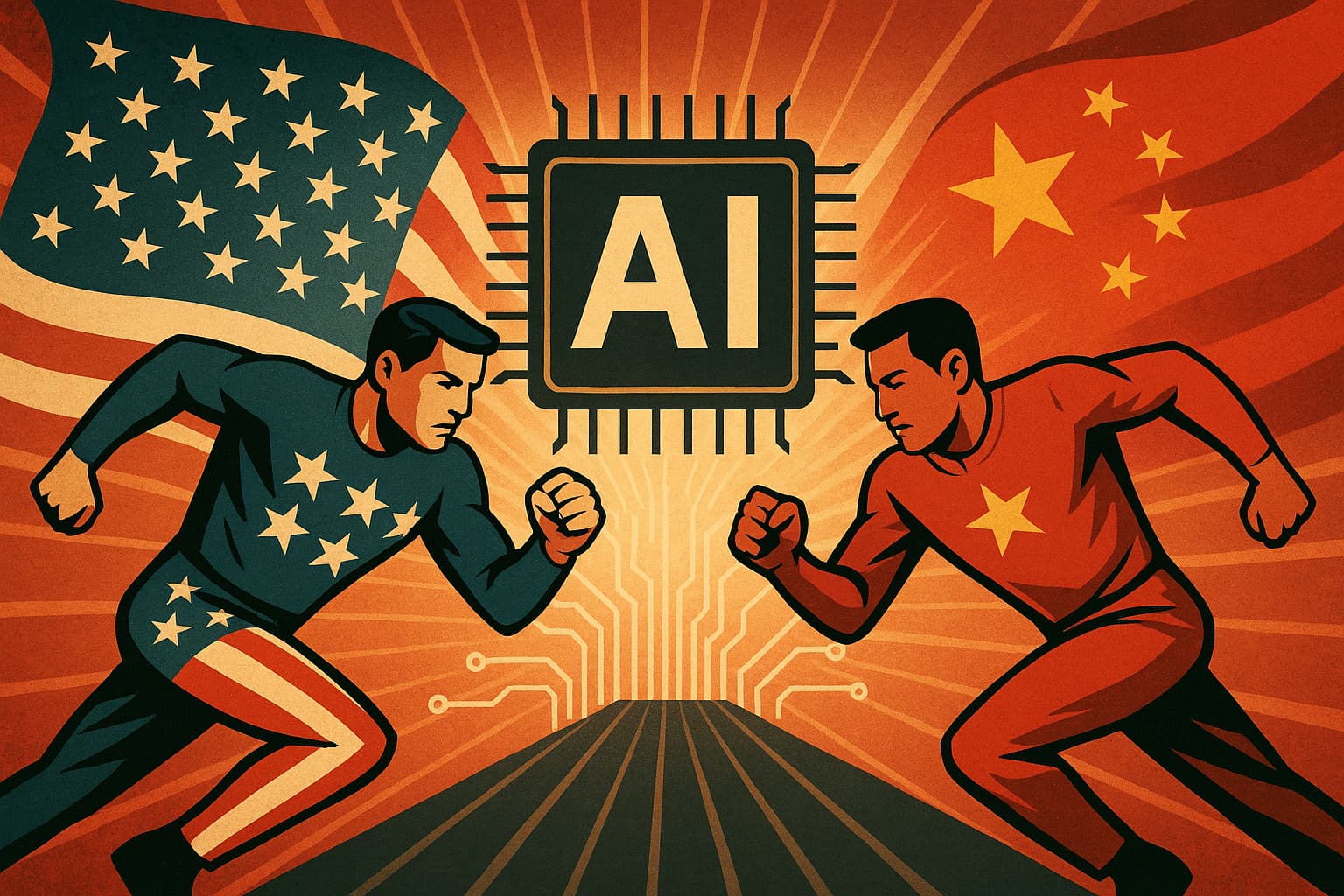
Nvidia CEO Jensen Huang said China is ‘nanoseconds’ behind the US in AI and urged Washington to lead by accelerating innovation and courting developers globally. He argued that excluding China would weaken the reach of US technology and risk splintering the ecosystem into incompatible stacks.
Huang’s remarks came amid ongoing export controls that bar Nvidia’s most advanced processors from the Chinese market. He acknowledged national security concerns but cautioned that strict limits can slow the spread of American tools that underpin AI research, deployment, and scaling.
Hardware remains central, Huang said, citing advanced accelerators and data-centre capacity as the substrate for training frontier models. Yet diffusion matters: widespread adoption of US platforms by global developers amplifies influence, reduces fragmentation, and accelerates innovation.
With sales of top-end chips restricted, Huang warned that Chinese firms will continue to innovate on domestic alternatives, increasing the likelihood of parallel systems. He called for policies that enable US leadership while preserving channels to the developer community in China.
Huang framed the objective as keeping America ahead, maintaining the world’s reliance on an American tech stack, and avoiding strategies that would push away half the world’s AI talent.
Would you like to learn more about AI, tech, and digital diplomacy? If so, ask our Diplo chatbot!