E-Gov’A 2026, taking place from 14 to 16 May 2026 in Yaoundé, Cameroon, is the first edition of a pan-African event dedicated to e-governance and digital innovation in public services. The event is organised under the patronage of the Ministry of Posts and Telecommunications (Minpostel) and supported by the Smart Click Africa association and Digital Business Africa.
The program is structured around four main components:
- E-Gov’A Summit: High-level ministerial and technical panels bringing together ministers, international experts, senior civil servants, and innovators to discuss the digital transformation of African administrations and public services.
- E-Gov’A Expo: An exhibition space featuring institutional, corporate, and GovTech startup booths, along with live demonstrations of digital solutions improving public sector efficiency.
- E-Gov’A Workshops: Practical training sessions offered by companies and institutions, covering topics such as integrating AI for more effective public administration.
- E-Gov’A Startup Challenge: A hackathon recognising innovative citizen-led digital solutions
- E-Gov’A Awards: Awards highlighting outstanding achievements in GovTech across Africa.
The event aims to accelerate the digital transformation of public services, promote inclusive and citizen-centric e-governance, and foster collaboration between governments, startups, institutions, and technology companies. It provides a platform to showcase innovative digital solutions, explore challenges and opportunities in e-governance, and facilitate strategic reflection on building a modern, efficient, and accessible public administration.
The 2026 G7 Leaders’ Summit is an international leaders’ meeting scheduled to take place from 15 to 17 June 2026 in Évian-les-Bains, Haute-Savoie, France. It will bring together the heads of state and government of the Group of Seven (G7) — Canada, France (as host), Germany, Italy, Japan, the UK, and the USA — along with representatives of the EU to discuss key global issues.
Under the French Presidency of the G7 in 2026, the summit is expected to focus on addressing structural imbalances in the global economy, enhancing international cooperation, and reinforcing dialogue among major economic powers.
The Presidency has also organised a series of preparatory ministerial and technical meetings across thematic tracks — including foreign affairs, finance, trade, environment, digital policy, development, and home affairs — in the lead-up to the leaders’ meeting.
UN Open Source Week 2026 is a global convening focused on open-source technologies and digital cooperation, scheduled to take place 22–26 June 2026 at UN Headquarters in New York. Co-hosted by the UN Office for Digital and Emerging Technologies (ODET) and the UN Office of Information and Communications Technology (OICT), the event serves as a platform for multistakeholder dialogue and collaboration.
The programme is organised across the week, beginning with a Community Hackathon on Monday (22 June), followed by discussions on the intersection of open source and AI on Tuesday (23 June), Digital Public Infrastructure (DPI) Day on Wednesday (24 June), Open Source Programme Offices (OSPOs) for public interest objectives (25 June), and community-led events (26 June).
Pre-registration for UN Open Source Week 2026 is currently open.
The WSIS Forum 2026 is the 2026 edition of the annual multistakeholder gathering established under the World Summit on the Information Society (WSIS) process, which brings together actors engaged in digital cooperation, information and communication technologies (ICTs), and sustainable development. The Forum is scheduled to take place in Geneva, Switzerland, from 6 to 10 July 2026.
It will convene representatives from governments, international organisations, civil society, the private sector, academia, and technical communities to exchange knowledge, highlight innovative solutions, and engage in multistakeholder dialogue to advance the implementation of WSIS Action Lines and contribute to broader global development goals.
The event is co-organised by the International Telecommunication Union (ITU), the UN Educational, Scientific and Cultural Organization (UNESCO), the UN Development Programme (UNDP), and the UN Conference on Trade and Development (UNCTAD), in collaboration with more than 50 UN entities.
WSIS Forum 2026 will serve as a principal platform for reviewing progress, strengthening partnerships, and identifying future directions in digital cooperation and ICT‑related development initiatives.
The AI for Good Global Summit 2026 is scheduled to take place from 7 to 10 July 2026 at Palexpo in Geneva, Switzerland.
Organised by the International Telecommunication Union (ITU) in partnership with more than 50 UN agencies and co-convened with the Government of Switzerland, thesummit focused on exploring and advancing the practical application of AI to address global challenges and support the UN sustainable development goals (SDGs).
The summit brings together representatives from governments, international organisations, the private sector, civil society, academia, and technical communities.
Participants will engage in discussions, presentations, and collaborative sessions on topics including AI governance, innovative AI solutions, capacity-building, standards development, and ethical considerations.
The programme includes keynote speeches, panels, exhibitions, workshops, and related initiatives to identify scalable AI applications that contribute to sustainable development and societal benefit. The event also offers opportunities for networking, knowledge exchange, and stakeholder engagement across the global AI ecosystem.
The first substantive session of the Global Mechanism on developments in the field of ICTs in the context of international security and advancing responsible State behaviour in the use of ICTs will be held on 20-24 July.
This session marks the start of the substantive work of the Global Mechanism, a new single-track, permanent forum on ICT security under UN auspices.
Within this framework, states will advance discussions across the five established pillars of responsible state behaviour in the use of ICTs, covering existing and potential threats, rules, norms and principles, the application of international law, confidence-building measures, and capacity-building efforts.
The Global Mechanism will convene in different formats.
It will hold substantive plenary sessions once a year during each biennial cycle, the first being scheduled for July 2026.
It will hold two dedicated thematic groups—one addressing general substantive issues and one focused on capacity building—intended to enable more in-depth discussions, building on the outcomes of the plenary. In 2026, the dedicated thematic groups are scheduled to take place from 7 to 11 December.
In addition, the mechanism will convene a review conference every five years to assess progress and guide its future direction.
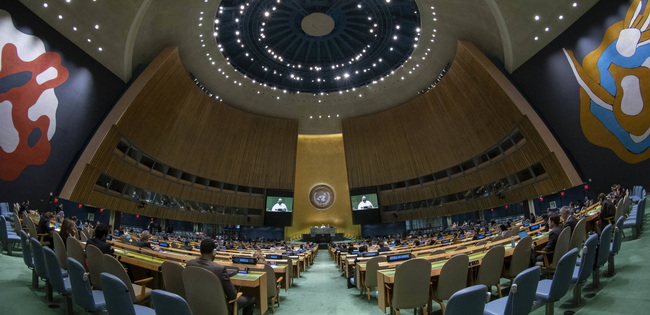
The 81st session of the UN General Assembly (UNGA 81) will open on Tuesday, 8 September 2026. The general debate of the 81st session of the General Assembly will open on Tuesday, 22 September, continuing through Saturday, 26 September, and concluding on Monday, 28 September 2026.
The general debate of the UN General Assembly is the opportunity for heads of state and government and ministers to come together at the UN Headquarters and discuss world issues, such as climate change, sustainable development, and international peace and security.
The presidency of the 81st session will be held by a representative from the Asia-Pacific Group, following the customary regional rotation.
The 2026 dedicated thematic groups of the Global Mechanism on developments in the field of ICTs in the context of international security and advancing responsible State behaviour in the use of ICTs will be held on 7-11 December 2026.
The two groups are:
- An integrated, policy-oriented and cross-cutting dedicated thematic group drawing on the five pillars of the framework to address specific challenges in the sphere of ICT security in the context of international security in order to promote an open, secure, stable, accessible, peaceful, and interoperable ICT environment, with the participation of, inter alia, technical experts and other stakeholders. (DTG 1)
- An integrated, policy-oriented and cross-cutting dedicated thematic group drawing on the five pillars of the framework to accelerate ICT security capacity-building, with the participation of, inter alia, capacity-building experts, practitioners, and other stakeholders. (DTG 2)
The Global Mechanism on cybersecurity will convene in different formats.
It will hold substantive plenary sessions once a year during each biennial cycle, the first of which is scheduled for July 2026.
It will hold two dedicated thematic groups each year—one addressing general substantive issues and one focused on capacity building—intended to enable more in-depth discussions, building on the outcomes of the plenary.
In addition, the mechanism will convene a review conference every five years to assess progress and guide its future direction.