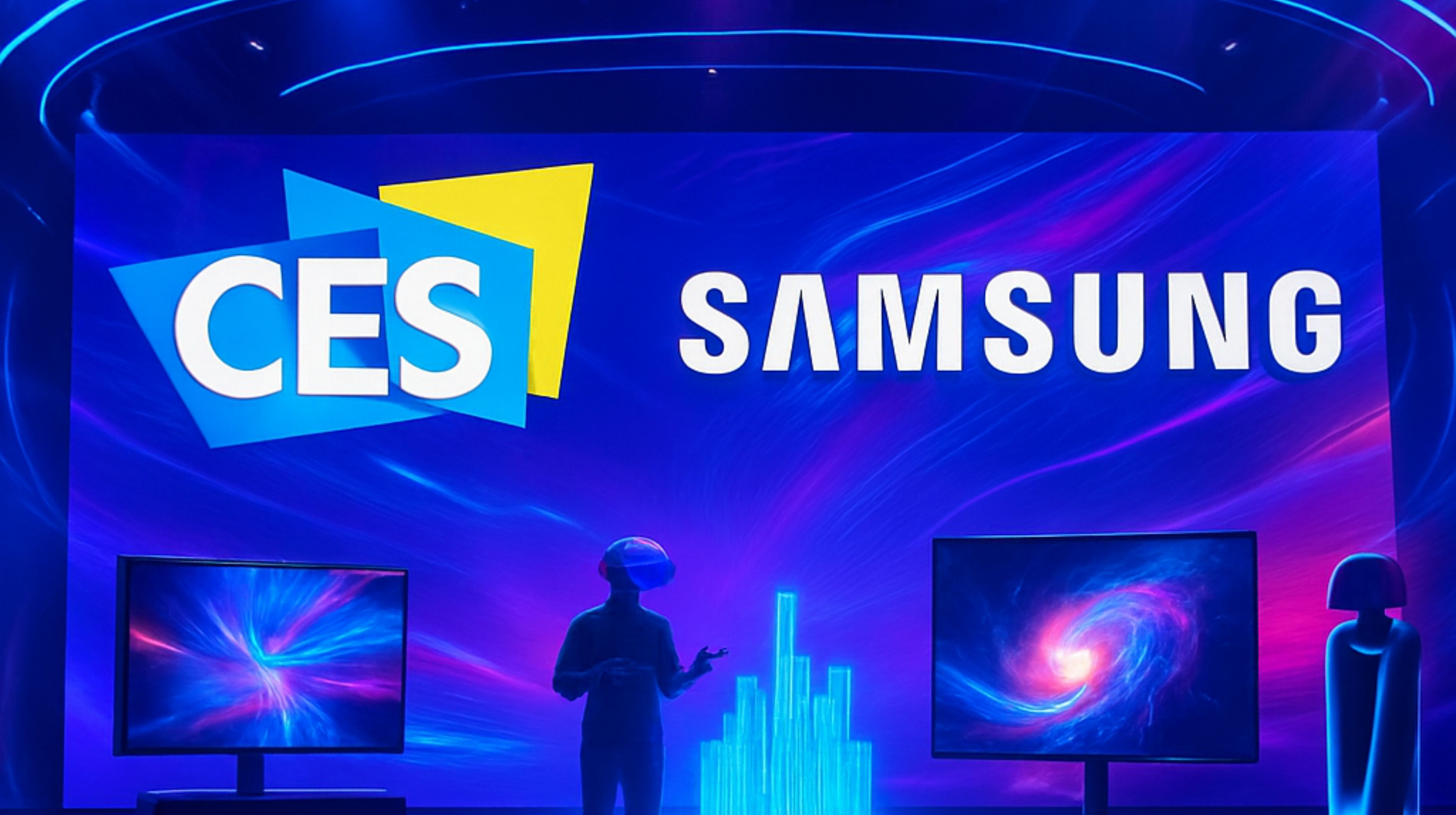
Samsung will open its CES 2026 presence with a Sunday evening press conference focused on integrating AI across its product portfolio. The event will take place on 4 January at the Wynn in Las Vegas and will be livestreamed online.
Senior executives, including TM Roh, head of the Device eXperience division, and leaders from Samsung’s visual display and digital appliance businesses, are expected to outline the company’s AI strategy. Samsung says the presentation will emphasise AI as a core layer across products and services.
The company has already previewed several AI-enabled devices ahead of CES. The devices include a portable projector that adapts to its surroundings, expanded Google Photos integration on Samsung TVs, and new Micro RGB television displays.
The company is also highlighting AI-powered home appliances designed to anticipate user needs. Examples include refrigerators that track food supplies, generate shopping lists, and detect early signs of device malfunction.
New smartphones are not expected at the event, with the next Galaxy Unpacked launch reportedly scheduled for later in January or early February.
Would you like to learn more about AI, tech, and digital diplomacy? If so, ask our Diplo chatbot!
A large energy and AI campus is taking shape outside Amarillo, Texas, as startup Fermi America plans to build what it says would be the world’s largest private power grid. The project aims to support large-scale AI training using nuclear, gas, and solar power.
Known as Project Matador, the development would host millions of square metres of data centres and generate more electricity than many US states consume at peak demand. The site is near the Pantex nuclear weapons facility and is part of a broader push for US energy and AI dominance.
Fermi is led by former Texas governor and energy secretary Rick Perry alongside investor Toby Neugebauer. The company plans to deploy next-generation nuclear reactors and offer off-grid computing infrastructure, though it has yet to secure a confirmed anchor tenant.
The scale and cost of the project have raised questions among analysts and local residents. Critics point to financing risks, water use, and the challenge of delivering nuclear reactors on time and within budget, while supporters argue the campus could drive economic growth and national security benefits.
Backed by political momentum and rising demand for AI infrastructure, Fermi is pressing ahead with construction and partnerships. Whether Project Matador can translate ambition into delivery remains a key test as competition intensifies in the global race to power next-generation AI systems.
Would you like to learn more about AI, tech, and digital diplomacy? If so, ask our Diplo chatbot!
AI is reshaping Australia’s labour market at a pace that has reignited anxiety about job security and skills. Experts say the speed and visibility of AI adoption have made its impact feel more immediate than previous technological shifts.
Since the public release of ChatGPT in late 2022, AI tools have rapidly moved from novelty to everyday workplace technology. Businesses are increasingly automating routine tasks, including through agentic AI systems that can execute workflows with limited human input.
Research from the HR Institute of Australia suggests the effects are mixed. While some entry-level roles have grown in the short term, analysts warn that clerical and administrative jobs remain highly exposed as automation expands across organisations.
Economic modelling indicates that AI could boost productivity and incomes if adoption is carefully managed, but may also cause short-term job displacement. Sectors with lower automation potential, including construction, care work, and hands-on services, are expected to absorb displaced workers.
Experts and unions say outcomes will depend on skills, policy choices, and governance. Australia’s National AI Plan aims to guide the transition, while researchers urge workers to upskill and use AI as a productivity tool rather than avoiding it.
Would you like to learn more about AI, tech, and digital diplomacy? If so, ask our Diplo chatbot!
A Guardian investigation has found that Google’s AI Overviews have displayed false and misleading health information that could put people at risk of harm. The summaries, which appear at the top of search results, are generated using AI and are presented as reliable snapshots of key information.
The investigation identified multiple cases where Google’s AI summaries provided inaccurate medical advice. Examples included incorrect guidance for pancreatic cancer patients, misleading explanations of liver blood test results, and false information about women’s cancer screening.
Health experts warned that such errors could lead people to dismiss symptoms, delay treatment, or follow harmful advice. Some charities said the summaries lacked essential context and could mislead users during moments of anxiety or crisis.
Concerns were also raised about inconsistencies, with the same health queries producing different AI-generated answers at different times. Experts said this variability undermines trust and increases the risk that misinformation will influence health decisions.
Google said most AI Overviews are accurate and helpful, and that the company continually improves quality, particularly for health-related topics. It said action is taken when summaries misinterpret content or lack appropriate context.
Would you like to learn more about AI, tech, and digital diplomacy? If so, ask our Diplo chatbot!
Chinese President Xi Jinping said 2025 marked a year of major breakthroughs for the country’s AI and semiconductor industries. In his New Year’s address, he said that Chinese technology firms had made significant progress in AI models and domestic chip development.
China’s AI sector gained global attention with the rise of DeepSeek. The company launched advanced models focused on reasoning and efficiency, drawing comparisons with leading US systems and triggering volatility in global technology markets.
Other Chinese firms also expanded their AI capabilities. Alibaba released new frontier models and pledged large-scale investment in cloud and AI infrastructure, while Huawei announced new computing technologies and AI chips to challenge dominant suppliers.
China’s progress prompted mixed international responses. Some European governments restricted the use of Chinese AI models over data security concerns, while US companies continued engaging with Chinese-linked AI firms through acquisitions and partnerships.
Looking ahead to 2026, China is expected to prioritise AI and semiconductors in its next five-year development plan. Analysts anticipate increased research funding, expanded infrastructure, and stronger support for emerging technology industries.
Would you like to learn more about AI, tech, and digital diplomacy? If so, ask our Diplo chatbot!
Nvidia is in discussions with Taiwan Semiconductor Manufacturing Co. (TSMC) about expanding production of its H200 AI chips, following large requests from Chinese technology companies for 2026 deliveries, according to people familiar with the talks.
Those sources stated that Chinese firms have placed orders for more than 2 million H200 chips for 2026, far exceeding Nvidia’s current stock of roughly 700,000 units. Work on the additional output is expected to start in the second quarter of 2026, though the extra volume Nvidia wants has not been publicly detailed.
The H200 is viewed by Chinese buyers as a significant step up from the previously available H20 chips, which were restricted, helping to explain the rush to secure supply. Sources said Nvidia has indicated pricing around $27,000 per chip, while an eight-chip module could cost about 1.5 million yuan, and some prospective buyers see that premium as worthwhile given the performance boost.
The order talks also sit under a cloud of policy uncertainty. While the Trump administration recently allowed H200 exports to China under a framework that includes a 25% fee, Chinese authorities have not yet approved imports, and officials are weighing how such sales could affect the country’s push to build up domestic AI chip suppliers, potentially including rules that tie purchases to local alternatives.
Nvidia stated that it continually manages its supply chain and argued that licensed sales to approved Chinese customers would not impact its ability to serve US clients, while TSMC declined to comment. Separately, a report cited by other coverage stated that ByteDance is considering spending approximately 100 billion yuan on Nvidia chips in 2026, contingent upon the success of H200 product sales in China.
Would you like to learn more about AI, tech and digital diplomacy? If so, ask our Diplo chatbot!
President Donald Trump has ordered the unwinding of a small US semiconductor-related deal, citing national security concerns tied to China. In an executive order dated 2 January 2026, Trump said there was ‘credible evidence’ that HieFo Corporation is controlled by a citizen of the People’s Republic of China, and that the acquisition ‘might take action that threatens to impair the national security of the United States.’
The order bars HieFo from owning any interest in the purchased Emcore assets and gives the company 180 days to divest them (unless the US foreign-investment review committee grants an extension). It also imposes restrictions meant to prevent access to sensitive, non-public technical information while the divestment is pending.
The transaction at the centre of the order was completed on 30 April 2024, and involved Emcore’s digital chips business and indium-phosphide wafer fabrication operations. Emcore previously stated that the sale price was approximately $2.92 million, while other reports described it as a roughly $2.9 million deal that also included the assumption of $1 million in liabilities.
Officials did not publicly specify the risk, but the executive order follows a review by the Committee on Foreign Investment in the United States (CFIUS), the interagency body that screens certain foreign deals for national security implications. HieFo and Emcore had not publicly responded at the time of publication, and the move is likely to reinforce the message that Washington is prepared to intervene, even after a deal has closed, when advanced manufacturing and China-linked ownership intersect.
Would you like to learn more about AI, tech and digital diplomacy? If so, ask our Diplo chatbot!
South Korea recorded its highest-ever export figures in 2025, driven largely by surging global demand for semiconductors used in AI technologies. Official data shows total exports exceeded $700 billion, marking a year-on-year increase despite ongoing trade pressures and economic uncertainty.
The semiconductor sector led the growth, with exports reaching a record $173.4 billion, up more than 20 per cent from the previous year. Strong demand for high-value memory chips used in AI data centres pushed shipments higher throughout the year, including a sharp rise in December that capped ten consecutive months of growth.
South Korea’s dominance in the chip market is underpinned by global leaders such as Samsung Electronics and SK Hynix, both key suppliers to the AI industry. The government is also doubling down on the sector, with President Lee Jae Myung pledging to triple national spending on AI in a bid to position the country among the world’s top AI powers.
Other export sectors also posted strong results. Car exports climbed to a record $72 billion, while agriculture and cosmetics benefited from sustained global interest in South Korean food, beauty products, and pop culture. These gains helped offset weaker shipments to the United States and China.
Exports to those two major partners declined amid tariffs on steel, automobiles, and machinery, although Seoul secured a reduced US tariff rate late in the year. While officials hailed the export record as a sign of economic resilience, they cautioned that global trade uncertainty and the durability of semiconductor demand could pose challenges ahead.
Would you like to learn more about AI, tech and digital diplomacy? If so, ask our Diplo chatbot!
More than 108,000 users of ManageMyHealth may have had their information exposed following a data breach affecting one of the country’s largest patient portals. The incident occurred on Wednesday and is believed to have affected between 6% and 7% of the platform’s 1.8 million registered users.
ManageMyHealth said affected users will be contacted within 48 hours with details about whether and how their data was accessed. Chief executive Vino Ramayah said the company takes the protection of health information extremely seriously and acknowledged the stress such incidents can cause.
He confirmed that the Office of the Privacy Commissioner has been notified and is working with the company to meet legal obligations.
Health Minister Simeon Brown described the breach as concerning but stated that there was no evidence to suggest that Health New Zealand systems, including My Health Account, had been compromised. He added that health services were continuing to operate as normal and that there had been no clinical impact on patient care.
Health New Zealand said it is coordinating with the National Cyber Security Centre and other agencies to understand the scope of the breach and ensure appropriate safeguards are in place.
Officials stressed expectations around security standards, transparency and clear communication, while ongoing engagement with primary care providers and GPs continues.
Would you like to learn more about AI, tech, and digital diplomacy? If so, ask our Diplo chatbot!
AI is rapidly becoming the starting point for many everyday activities, from planning and learning to shopping and decision-making. A new report by PYMNTS Intelligence suggests that AI is no longer just an added digital tool, but is increasingly replacing traditional entry points such as search engines and mobile apps.
The study shows that AI use in the United States has moved firmly into the mainstream, with more than 60 per cent of consumers using dedicated AI platforms over the past year. Younger users and frequent AI users are leading the shift, increasingly turning to AI first rather than using it to support existing online habits.
Researchers found that how people use AI matters as much as how often they use it. Heavy users rely on AI across many aspects of daily life, treating it as a general-purpose system, while lighter users remain cautious and limit AI to lower-risk tasks. Trust plays a decisive role, especially when it comes to sensitive areas such as finances and banking.
The report also points to changing patterns in online discovery. Consumers who use standalone AI platforms are more likely to abandon older methods entirely, while those encountering AI through search engines tend to blend it with familiar tools. That difference suggests that the design and context of AI services strongly influence user behaviour.
Looking ahead, the findings hint at how AI could reshape digital commerce. Many consumers say they would prefer to connect digital wallets directly to AI platforms for payments, signalling a potential shift in how intent turns into transactions. As AI becomes a common entry point to the digital world, businesses and financial institutions face growing pressure to adapt their systems to this new starting line.
Would you like to learn more about AI, tech and digital diplomacy? If so, ask our Diplo chatbot!