Elton John threatens legal fight over AI use

Sir Elton John has lashed out at the UK government over plans that could allow AI companies to use copyrighted content without paying artists, calling ministers ‘absolute losers’ and accusing them of ‘thievery on a high scale.’

He warned that younger musicians, without the means to challenge tech giants, would be most at risk if the proposed changes go ahead.

The row centres on a rejected House of Lords amendment to the Data Bill, which would have required AI firms to disclose what material they use.

Despite a strong majority in favour in the Lords, the Commons blocked the move, meaning the bill will keep bouncing between the two chambers until a compromise is reached.

Sir Elton, joined by playwright James Graham, said the government was failing to defend creators and seemed more interested in appeasing powerful tech firms.

More than 400 artists, including Sir Paul McCartney, have signed a letter urging Prime Minister Sir Keir Starmer to strengthen copyright protections instead of allowing AI to mine their work unchecked.

While the government insists no changes will be made unless they benefit creators, critics say the current approach risks sacrificing the UK’s music industry for Silicon Valley’s gain.

Sir Elton has threatened legal action if the plans go ahead, saying, ‘We’ll fight it all the way.’

Would you like to learn more about AI, tech and digital diplomacy? If so, ask our Diplo chatbot!
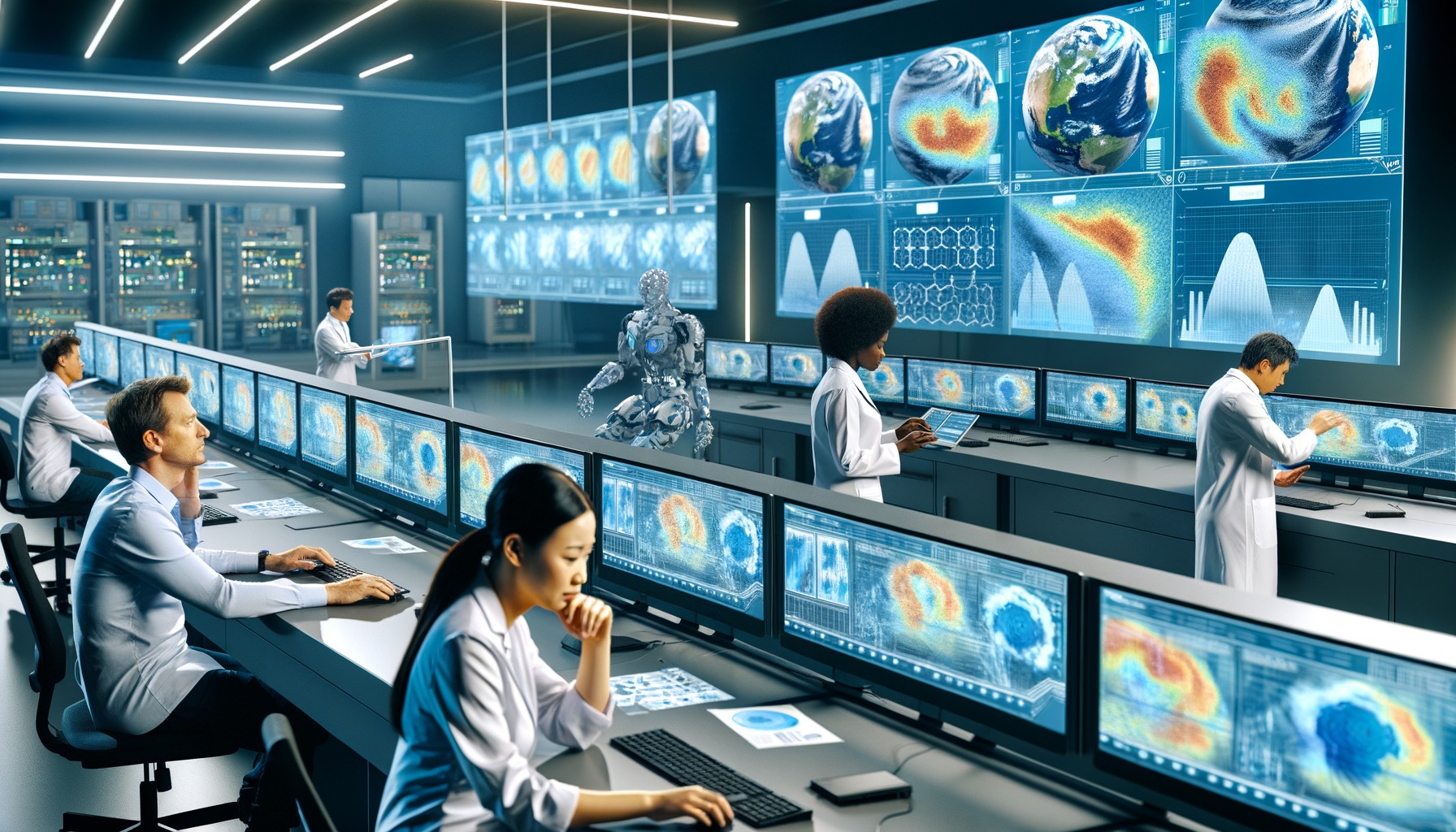
JMA to test AI-enhanced weather forecasting

The Japan Meteorological Agency (JMA) is exploring the use of AI to improve the accuracy of weather forecasts, with a particular focus on deep learning technologies, according to a source familiar with the plans.

A dedicated team was launched in April to begin developing the infrastructure and tools needed to integrate AI with JMA’s existing numerical weather prediction models. The goal is to combine traditional simulations with AI-generated forecasts based on historical weather data.

If implemented, AI systems could identify weather patterns more efficiently and enhance forecasts for variables such as rainfall and temperature. The technology may also offer improved accuracy in predicting extreme weather events like typhoons.

Currently, the JMA relies on supercomputers to simulate future atmospheric conditions based on observational data. Human forecasters then review the outputs, applying expert judgment before issuing final forecasts and alerts. Even with AI integration, human oversight will remain a core part of the process.

In addition to forecasting, the agency is also considering AI for processing data from the Himawari-10 satellite, which is expected to launch in fiscal 2029.

An official announcement outlining further AI integration measures is anticipated in June.

Would you like to learn more about AI, tech and digital diplomacy? If so, ask our Diplo chatbot!

UK workers struggle to keep up with AI

AI is reshaping the UK workplace, but many employees feel unprepared to keep pace, according to a major new study by Henley Business School.

While 56% of full-time professionals expressed optimism about AI’s potential, 61% admitted they were overwhelmed by how quickly the technology is evolving.

The research surveyed over 4,500 people across nearly 30 sectors, offering what experts call a clear snapshot of AI’s uneven integration into British industries.

Professor Keiichi Nakata, director of AI at The World of Work Institute, said workers are willing to embrace AI, but often lack the training and guidance to do so effectively.

Instead of empowering staff through hands-on learning and clear internal policies, many companies are leaving their workforce under-supported.

Nearly a quarter of respondents said their employers were failing to provide sufficient help, while three in five said they would use AI more if proper training were available.

Professor Nakata argued that AI has the power to simplify tasks, remove repetitive duties, and free up time for more meaningful work.

But he warned that without better support, businesses risk missing out on what could be a transformative force for both productivity and employee satisfaction.

Would you like to learn more about AI, tech and digital diplomacy? If so, ask our Diplo chatbot!

US bans nonconsensual explicit deepfakes nationwide

The US is introducing a landmark federal law aimed at curbing the spread of non-consensual explicit deepfake images, following mounting public outrage.

President Donald Trump is expected to sign the Take It Down Act, which will criminalise the sharing of explicit images, whether real or AI-generated, without consent. The law will also require tech platforms to remove such content within 48 hours of notification, instead of leaving the matter to patchy state laws.

The legislation is one of the first at the federal level to directly tackle the misuse of AI-generated content. It builds on earlier laws that protected children but had left adults vulnerable due to inconsistent state regulations.

The bill received rare bipartisan support in Congress and was backed by over 100 organisations, including tech giants like Meta, TikTok and Google. First Lady Melania Trump also supported the act, hosting a teenage victim of deepfake harassment during the president’s address to Congress.

The act was prompted in part by incidents like that of Elliston Berry, a Texas high school student targeted by a classmate who used AI to alter her social media image into a nude photo. Similar cases involving teen girls across the country highlighted the urgency for action.

Tech companies had already started offering tools to remove explicit images, but the lack of consistent enforcement allowed harmful content to persist on less cooperative platforms.

Supporters of the law argue it sends a strong societal message instead of allowing the exploitation to continue unchallenged.

Advocates like Imran Ahmed and Ilana Beller emphasised that while no law is a perfect solution, this one forces platforms to take real responsibility and offers victims some much-needed protection and peace of mind.

Would you like to learn more about AI, tech and digital diplomacy? If so, ask our Diplo chatbot!

UAE to host world’s biggest AI site outside the US

The United Arab Emirates will build the largest artificial intelligence infrastructure outside the United States, following a high-level meeting between UAE President Sheikh Mohamed bin Zayed Al Nahyan and President Trump in Abu Dhabi.

It will be constructed by G42 and involve US firms under the newly established US-UAE AI Acceleration Partnership. Spanning 10 square miles in Abu Dhabi, the AI campus will run on a mix of nuclear, solar and gas energy to limit emissions and will feature a dedicated science park to drive innovation.

A 5GW capacity will enable it to serve half the global population, offering US cloud providers a vital regional hub. As part of the agreement, the UAE has pledged to align its national security rules with US standards, including strict technology safeguards and tighter access controls for computing power.

The UAE may also be permitted to purchase up to 500,000 Nvidia AI chips annually starting this year.

Would you like to learn more about AI, tech and digital diplomacy? If so, ask our Diplo chatbot!

Grok AI glitch reignites debate on trust and safety in AI tools

Elon Musk’s AI chatbot, Grok, has caused a stir by injecting unsolicited claims about ‘white genocide’ in South Africa into unrelated user queries. These remarks, widely regarded as part of a debunked conspiracy theory, appeared across various innocuous prompts before being quickly removed.

The strange behaviour led to speculation that Grok’s system prompt had been tampered with, possibly by someone inside xAI. Although Grok briefly claimed it had been instructed to mention the topic, xAI has yet to issue a full technical explanation.

Rival AI leaders, including OpenAI’s Sam Altman, joined public criticism on X, calling the episode a concerning sign of possible editorial manipulation. While Grok’s responses returned to normal within hours, the incident reignited concerns about control and transparency in large AI models.

Would you like to learn more about AI, tech and digital diplomacy? If so, ask our Diplo chatbot!

Canva merges data and storytelling

Canva has introduced Sheets, a new spreadsheet platform combining data, design, and AI to simplify and visualise analytics. Announced at the Canva Create: Uncharted event, it redefines spreadsheets by enabling users to turn raw data into charts, reports and content without leaving the Canva interface.

Built-in tools like Magic Formulas, Magic Insights, and Magic Charts, Canva Sheets supports automated analysis and visual storytelling. Users can generate dynamic charts and branded content across platforms in seconds, thanks to Canva AI and features like bulk editing and multilingual translation.

Data Connectors allow seamless integration with platforms such as Google Analytics and HubSpot, ensuring live updates across all connected visuals. The platform is designed to reduce manual tasks in recurring reports and keep teams synchronised in real time.

Would you like to learn more about AI, tech and digital diplomacy? If so, ask our Diplo chatbot!

Google’s quantum chip hints at multiverse

Google’s new quantum computer chip, Willow, has performed a computation in under five minutes that would take traditional supercomputers ten septillion years. Experts now believe this feat could support the multiverse theory, as Willow might be tapping into parallel universes to process information.

Willow also significantly reduces error rates, a major breakthrough in the field of quantum computing. The chip’s unprecedented speed and accuracy could pave the way for hybrid AI systems that combine quantum and classical computing.

Physicists like Hartmut Neven and David Deutsch suggest quantum mechanics implies multiple realities, reinforcing theories once considered speculative. If accessible and scalable, Willow could usher in an era of AI powered by multiverse-level processing.

Would you like to learn more about AI, tech and digital diplomacy? If so, ask our Diplo chatbot!

Japan approves preemptive cyberdefence law

Japan’s parliament has passed a new law enabling active cyberdefence measures, allowing authorities to legally monitor communications data during peacetime and neutralise foreign servers if cyberattacks occur.

Instead of reacting only after incidents, this law lets the government take preventive steps to counter threats before they escalate.

Operators of vital infrastructure, such as electricity and railway companies, must now report cyber breaches directly to the government. The shift follows recent cyber incidents targeting banks and an airline, prompting Japan to put a full framework in place by 2027.

Although the law permits monitoring of IP addresses in communications crossing Japanese borders, it explicitly bans surveillance of domestic messages and their contents.

A new independent panel will authorise all monitoring and response actions beforehand, instead of leaving decisions solely to security agencies.

Police will handle initial countermeasures, while the Self-Defense Forces will act only when attacks are highly complex or planned. The law, revised to address opposition concerns, includes safeguards to ensure personal rights are protected and that government surveillance remains accountable.

Would you like to learn more about AI, tech and digital diplomacy? If so, ask our Diplo chatbot!

FBI warns against AI-powered text scams

The FBI has issued a fresh warning urging the public not to trust unsolicited texts or voice messages, even if they appear to come from senior officials. A new wave of AI-powered attacks is reportedly so convincing that traditional signs of fraud are almost impossible to spot.

These campaigns involve voice and text messages crafted with AI, mimicking the voices of known individuals and spoofing phone numbers of trusted contacts or organisations. US victims are lured into clicking malicious links, often under the impression that the messages are urgent or official.

The FBI advises users to verify all communications independently, avoid clicking links or downloading attachments from unknown sources, and listen for unnatural speech patterns or visual anomalies in videos and images.

Would you like to learn more about AI, tech and digital diplomacy? If so, ask our Diplo chatbot!