The UK’s new Online Safety Act has increased VPN use, as websites introduce stricter age restrictions to comply with the law. Popular platforms such as Reddit and Pornhub are either blocking minors or adding age verification, pushing many young users to turn to free VPNs to bypass the rules.
In the days following the Act’s enforcement on 25 July, five of the ten most-downloaded free apps in the UK were VPNs.
However, cybersecurity experts warn that unvetted free VPNs can pose serious risks, with some selling user data or containing malware.
Using a VPN means routing all your internet traffic through an external server, effectively handing over access to your browsing data.
While reputable providers like Proton VPN offer safe free tiers supported by paid plans, lesser-known services often lack transparency and may exploit users for profit.
Consumers are urged to check for clear privacy policies, audited security practices and credible business information before using a VPN. Trusted options for safer browsing include Proton VPN, TunnelBear, Windscribe, and hide.me.
Would you like to learn more about AI, tech and digital diplomacy? If so, ask our Diplo chatbot!
Europe’s AI crackdown officially begins soon, as the EU enforces the first rules targeting developers of generative AI models like ChatGPT.
Under the AI Act, firms must now assess systemic risks, conduct adversarial testing, ensure cybersecurity, report serious incidents, and even disclose energy usage. The goal is to prevent harms related to bias, misinformation, manipulation, and lack of transparency in AI systems.
Although the legislation was passed last year, the EU only released developer guidance on 10 July, leaving tech giants with little time to adapt.
Meta, which developed the Llama AI model, has refused to sign the voluntary code of practice, arguing that it introduces legal uncertainty. Other developers have expressed concerns over how vague and generic the guidance remains, especially around copyright and practical compliance.
The EU also distinguishes itself from the US, where a re-elected Trump administration has launched a far looser AI Action Plan. While Washington supports minimal restrictions to encourage innovation, Brussels is focused on safety and transparency.
Trade tensions may grow, but experts warn that developers should not rely on future political deals instead of taking immediate steps toward compliance.
The AI Act’s rollout will continue into 2026, with the next phase focusing on high-risk AI systems in healthcare, law enforcement, and critical infrastructure.
Meanwhile, questions remain over whether AI-generated content qualifies for copyright protection and how companies should handle AI in marketing or supply chains. For now, Europe’s push for safer AI is accelerating—whether Big Tech likes it or not.
Would you like to learn more aboutAI, tech and digital diplomacy? If so, ask our Diplo chatbot!
Australia has announced that YouTube will be banned for children under 16 starting in December, reversing its earlier exemption from strict new social media age rules. The decision follows growing concerns about online harm to young users.
Platforms like Facebook, Instagram, Snapchat, TikTok, and X are already subject to the upcoming restrictions, and YouTube will now join the list of ‘age-restricted social media platforms’.
From 10 December, all such platforms will be required to ensure users are aged 16 or older or face fines of up to AU$50 million (£26 million) for not taking adequate steps to verify age. Although those steps remain undefined, users will not need to upload official documents like passports or licences.
The government has said platforms must find alternatives instead of relying on intrusive ID checks.
Communications Minister Anika Wells defended the policy, stating that four in ten Australian children reported recent harm on YouTube. She insisted the government would not back down under legal pressure from Alphabet Inc., YouTube’s US-based parent company.
Children can still view videos, but won’t be allowed to hold personal YouTube accounts.
YouTube criticised the move, claiming the platform is not social media but a video library often accessed through TVs. Prime Minister Anthony Albanese said Australia would campaign at a UN forum in September to promote global backing for social media age restrictions.
Exemptions will apply to apps used mainly for education, health, messaging, or gaming, which are considered less harmful.
Would you like to learn more aboutAI, tech and digital diplomacy? If so, ask our Diplo chatbot!
Google has added a new dimension to NotebookLM by introducing Video Overviews, a feature that transforms your content into narrated slide presentations.
Originally revealed at Google I/O, the tool builds on the popularity of Audio Overviews, which generated AI-hosted podcast-style summaries. Instead of relying solely on audio, users can now enjoy visual storytelling powered by the same AI.
Video Overviews automatically pulls elements like images, diagrams, quotes and statistics from documents to create slide-based summaries.
The tool supports professionals and students by simplifying complex reports or academic papers into engaging visual formats. Users can also customise the video output by defining learning goals, selecting key topics, or tailoring it to a specific audience.
For now, the rollout is limited to English-speaking users on desktops, but Google plans to expand the formats. Narrated slides are the first to launch, combining clear visuals with spoken summaries, helping visual learners engage with content more effectively instead of reading lengthy text.
Alongside the new feature, Google has redesigned the NotebookLM Studio interface. Users can now generate and store multiple outputs—Audio Overviews, Reports, Study Guides, or Mind Maps—all within a single notebook.
The update also allows users to interact with different tools simultaneously, such as listening to an AI podcast while reviewing a study guide, offering a more integrated and versatile learning experience.
Would you like to learn more aboutAI, tech and digital diplomacy? If so, ask our Diplo chatbot!
In the digital world, tracking occurs through digital signals sent from one computer to a server, and from a server to an organisation. Almost immediately, a profile of a user can be created. The information can be leveraged to send personalised advertisements for products and services consumers are interested in, but it can also classify people into categories to send them advertisements to steer them in a certain direction, for example, politically (2024 Romanian election, Cambridge Analytica Scandal skewing the 2016 Brexit referendum and 2016 US Elections).
Digital tracking can be carried out with minimal costs, rapid execution and the capacity to reach hundreds of thousands of users simultaneously. These methods require either technical skills (such as coding) or access to platforms that automate tracking.
This phenomenon has been well documented and likened to George Orwell’s 1984, in which the people of Oceania are subject to constant surveillance by ‘Big Brother’ and institutions of control; the Ministry of Truth (propaganda), Peace (military control), Love (torture and forced loyalty) and Plenty (manufactured prosperity).
A related concept is the Panopticon, developed by the French philosopher Michel Foucault’s social theory based on the architecture of a prison, enabling constant observation from a central point. Prisoners never know if they are being watched and thus self-regulate their behaviour. In today’s tech-driven society, our digital behaviour is similarly regulated through the persistent possibility of surveillance.
How are we tracked? The case of cookies and device fingerprinting
Cookies
Cookies are small, unique text files placed on a user’s device by their web browser at the request of a website. When a user visits a website, the server can instruct the browser to create or update a cookie. These cookies are then sent back to the server with each subsequent request to the same website, allowing the server to recognise and remember certain information (login status, preferences, or tracking data).
If a user visits multiple websites about a specific topic, that pattern can be collected and sold to advertisers targeting that interest. This applies to all forms of advertising, not just commercial but also political and ideological influence.
Device fingerprinting
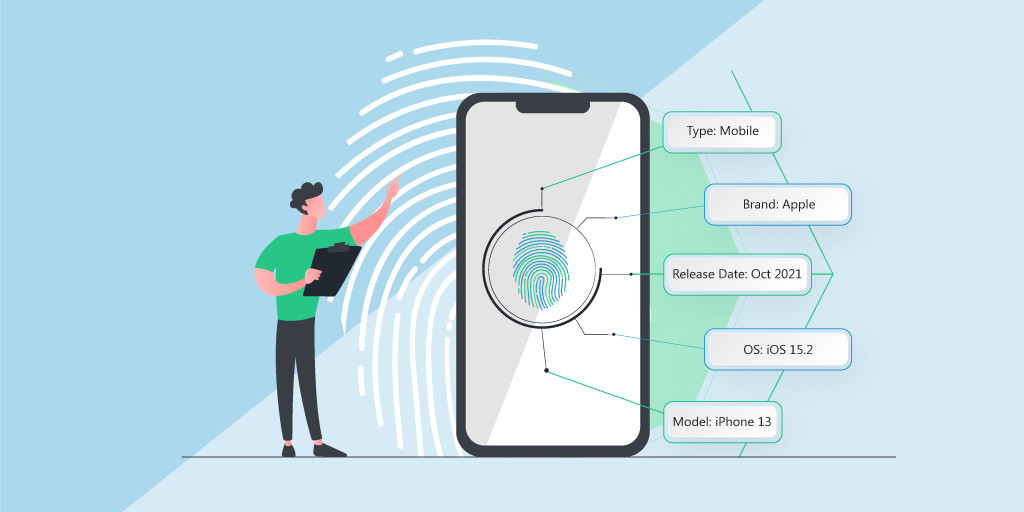
Device fingerprinting involves generating a unique identifier using a device’s hardware and software characteristics. Types include browser fingerprinting, mobile fingerprinting, desktop fingerprinting, and cross-device tracking. To assess how unique a browser is, users can test their setup via the Cover Your Tracks tool by the Electronic Frontier Foundation.
Different information will be collected, such as your operating system, language version, keyboard settings, screen resolution, font used, device make and model and more. The more data points collected, the more unique an individual’s device will be.
A common reason to use device fingerprinting is for advertising. Since each individual has a unique identifier, advertisers can distinguish individuals from one another and see which websites they visit based on past collected data.
Similar to cookies, device fingerprinting is not purely about advertising, as it has some legitimate security purposes. Device fingerprinting, as it creates a unique ID of a device, allows websites to recognise a user’s device. This is useful to combat fraud. For instance, if a known device suddenly logs in from an unknown fingerprint, fraud detection mechanisms may flag and block the login attempt.
Legal considerations
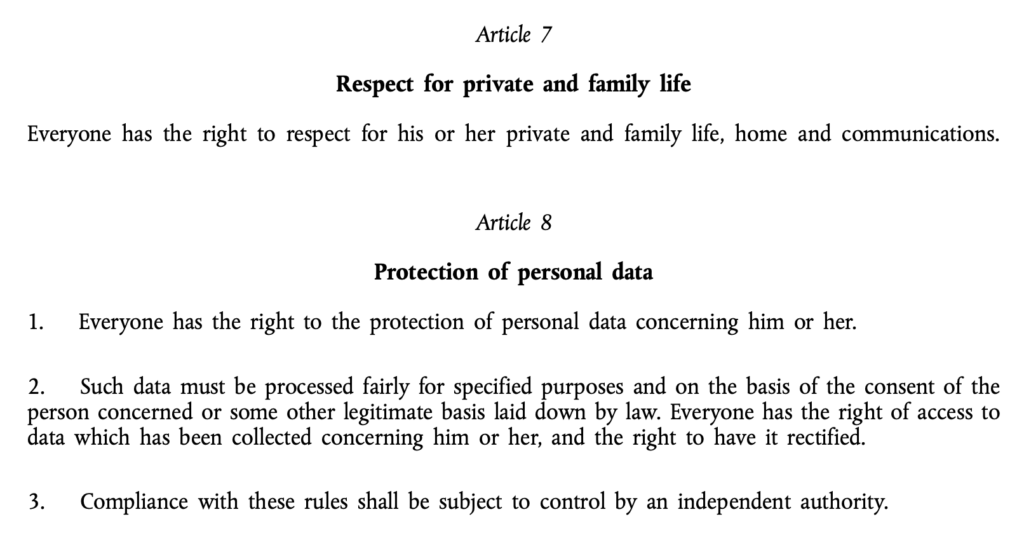
Apart from societal impacts, there are legal considerations to be made, specifically concerning fundamental rights. In the EU and Europe, Articles 7 and 8 of the Charter of Fundamental Rights and Article 8 of the European Convention on Human Rights are what give rise to the protection of personal data in the first place. They form the legal bedrock of digital privacy legislation, such as the GDPR and the ePrivacy Directive. Stemming from the GDPR, there is a protection against unlawful, unfair and opaque processing of personal data.
Articles 7 and 8 of the Charter of Fundamental Rights
For tracking to be carried out lawfully, one of the six legal bases of the GDPR must be relied upon. In this case, tracking is usually only lawful if the legal basis of consent is relied upon (Article 6(1)(a) GDPR, which stems from Article 5(1) of the ePrivacy Directive).
Other legal bases, such as the legitimate interest of a business, may allow for limited analytical cookies to be placed, of which the cookies referred to in this analysis are not.
Regardless of this, to obtain consent, website visitors must ensure that consent is collected prior to processing occurring, freely given, specific, informed and unambiguous. In most cases of website tracking, consent is not collected prior to processing.
In practice, this means that before a consent request is fulfilled by a website visitor, cookies are placed on the user’s device. There are additional concerns about consent not being informed, as users do not know what processing personal data to enable tracking entails.
Moreover, consent is not specific to what is necessary to the processing, given that processing occurs for broad and unspecified reasons, such as improving visitor experience and understanding the website better, and those explanations are generic and broad.
Further, tracking is typically unfair as users do not expect to be tracked across sites or have digital profiles made about themselves based on website visits. Tracking is also opaque, as users do not understand how tracking occurs. Website owners state that tracking occurs with a lack of explanation on how it occurs in the first place. Users do not know for how long it occurs, what personal data is being used to track or how it benefits website owners.
Can we refuse tracking
In theory, it is possible to prevent tracking from the get-go. This can be done by refusing to give consent when tracking occurs. However, in practice, refusing consent can still lead to tracking. Outlined below are two concrete examples of this happening daily.
Cookies
Regarding cookies, simply put, the refusal of all requests is not honoured, it is ignored. Studies have found that when a user visits a website and refuses to give consent, their request is not honoured. Cookies and similar tracking technologies are placed on the user’s device as if they had accepted cookies.
This increases user frustration as they are given a choice that is non-existent. This occurs as non-essential cookies, which can be refused, are lumped together with essential cookies, which cannot be refused. Therefore, when refusing consent to non-essential cookies, not all are refused, as some are mislabelled.
Another reason for this occurrence is that cookies are placed before consent is sought. Often, website owners outsource cookie banner compliance to more experienced companies. These websites use consent management platforms (CMPs) such as Cookiebot by Usercentrics or One Trust.
When verifying when cookies are placed via these CMPs, the option to load cookies after consent is sought needs to be manually selected. Therefore, website owners need to have knowledge about consent requirements to understand that cookies are not to be placed prior to consent being sought.
Another example is related to Google Consent Mode (GCM). GCM is relevant to mention here as Google is the most common third-party tracker on the web, thus the most likely tracker users will encounter. They have a vast array of trackers ranging from statistics, analytics, preferences, marketing and more. GCM essentially creates a path for website analytics to occur despite consent being refused. This occurs as GCM claims that it can send cookieless ping signals to user devices to know how many users have viewed a website, clicked on a page, searched a term, etc.
This is a novel solution Google is presenting, and it claims to be privacy-friendly, as no cookies are required for this to occur. However, a study on tags, specifically GCM tags, found that GCM is not privacy-friendly and infringes the GDPR. The study found that Google still collects personal data in these ‘cookieless ping signals’ such as user language, screen resolution, computer architecture, user agent string, operating system and its version, complete web page URL and search keywords. Since this data is collected and processed despite the user refusing consent, there are undoubtedly legal issues.
The first reason comes from the lawfulness general principle whereby Google has no lawful basis to process this personal data as the user refused consent, and no other legal basis is used. The second reason stems from the general principle of fairness, as users do not expect that, after refusing trackers and choosing the more privacy-friendly option, their data is still processed as if their consent choice did not matter.
Therefore, from Google’s perspective, GCM is privacy-friendly as no cookies are placed, thus no consent is required to be sought. However, a recent study revealed that personal data is still being processed without any permission or legal basis.
What next?
On an individual level:
Many solutions have been developed for individuals to reduce the tracking they are subject to. From browser extensions to using devices that are more privacy-friendly and using ad blockers. One notable company tackling this issue is Duck Duck Go, which by default rejects trackers, allows for email protection, and overall reduces trackers when using their browser. Duck Duck Go is not the only company to allow this, many more, such as uBlock Origin and Ghostery, offer similar services.
Specifically, regarding fingerprint ID, researchers have developed ways to prevent device fingerprinting. In 2023, researchers proposed ShieldF, which is a Chromium add-on that reduces fingerprinting for mobile apps and browsers. Other measures include using an IP address that many people use, which is not ideal for home Wi-Fi. Using a combination of a browser extension and a VPN is also unsuitable for every individual, as this demands a substantial amount of effort and sometimes financial costs.
On a systemic level:
CMPs and GCM are active tracking stakeholders in the tracking ecosystem, and their actions are subject to enforcement bodies. In this case, predominantly data protection authorities (DPA). One prominent DPA working on cookie enforcement is the Dutch DPA, the Autoriteit Persoonsgegevens (AP). In the early months of 2025, the AP has publicly stated that its focus for this upcoming year will be to check cookie compliance. They announced that they would be investigating 10,000 websites in the Netherlands. This has led to investigations into companies with unlawful cookie banners, concluding with warnings and sanctions.
However, these investigations require extensive time and effort. DPAs have already stated that they are overworked and do not have enough personnel or financial resources to cope with the increase in responsibility. Coupled with the fact that sanctioned companies set aside financial pots for these sanctions, or that non-EU businesses do not comply with DPA sanction decisions (the case of Clearview AI). Different ways to tackle non-compliance should be investigated.
For example, in light of the GDPR simplification package, whilst simplifying some measures, other liability measures could be introduced to ensure that enforcement is as vigorous as the legislation itself. The EU has not shied away from holding management boards liable for non-compliance. In a separate legislation on cybersecurity, NIS II Article 20(1) states that ‘management bodies of essential and important entities approve the cybersecurity risk-management measures (…) can be held liable for infringements (…)’. That article allows for board member liability for specific cybersecurity risk-management measures in Article 21. If similar measures cannot be introduced during this time, other moments of amendment can be consulted for this.
Conclusion
Cookies and device fingerprinting are two common ways in which tracking occurs. The potential larger societal and legal consequences of tracking demand that existing robust legislation is enforced to ensure that past politically related historical mistakes are not repeated.
Ultimately, there is no way to completely prevent fingerprinting and cookie-based tracking without significantly compromising the user’s browsing experience. For this reason, the burden of responsibility must shift toward CMPs. This shift should begin with the implementation of privacy-by-design and privacy-by-default principles in the development of their tools (preventing cookie placement prior to consent seeking).
Accountability should occur through tangible consequences, such as liability for board members in cases of negligence. By attributing responsibility to the companies which develop cookie banners and facilitate trackers, the source of the problem can be addressed and held accountable for their human rights violations.
Would you like to learn more about AI, tech and digital diplomacy? If so, ask our Diplo chatbot!
The women’s dating safety app Tea has suspended its messaging feature following a cyberattack that exposed thousands of private messages, posts and images.
The app, which helps women run background checks on men, confirmed that direct messages were accessed during the initial breach disclosed in late July.
Tea has 1.6 million users, primarily in the US. Affected users will be contacted directly and offered free identity protection services, including credit monitoring and fraud alerts.
The company said it is working to strengthen its security and will provide updates as the investigation continues. Some of the leaked conversations reportedly contain sensitive discussions about infidelity and abortion.
Experts have warned that the leak of both images and messages raises the risk of emotional harm, blackmail or identity theft. Cybersecurity specialists recommend that users accept the free protection services as soon as possible.
The breach affected those who joined the app before February 2024, including users who submitted ID photos that Tea had promised would be deleted after verification.
Tea is known for allowing women to check if a potential partner is married or has a criminal record, as well as share personal experiences to flag abusive or trustworthy behaviour.
The app’s recent popularity surge has also sparked criticism, with some claiming it unfairly targets men. As users await more information, experts urge caution and vigilance.
Would you like to learn more aboutAI, tech and digital diplomacy? If so, ask our Diplo chatbot!
South Korea is stepping up efforts to strengthen its cyber insurance sector as corporate cyberattacks surge across industries. A string of major breaches has revealed widespread vulnerability and renewed demand for more comprehensive digital risk protection.
Hanwha General Insurance launched Korea’s first Cyber Risk Management Centre last November and partnered with global cybersecurity firm Theori and law firm Shin & Kim to expand its offerings.
Despite the growing need, the market remains underdeveloped. Cyber insurance makes up only 1 percent of Korea’s accident insurance sector, with a 2024 report estimating local cyber premiums at $50 million, just 0.3 percent of the global total.
Regulators and industry voices call for higher mandatory coverage, clearer underwriting standards, and financial incentives to promote adoption.
As Korean demand rises, comprehensive policies offering tailored options and emergency coverage are gaining traction, with Hanwha reporting a 200 percent revenue jump in under a year.
Would you like to learn more about AI, tech and digital diplomacy? If so, ask our Diplo chatbot!
The European Commission has accused Temu of breaching the Digital Services Act by failing to assess and address the sale of illegal or dangerous products.
The accusation follows months of investigation and a review of a required risk report submitted by Temu, which the Commission found too vague.
A mystery shopping exercise by the EU uncovered unsafe toys and electronics on the platform, raising concerns over consumer safety.
Additional parts of the probe are ongoing, including scrutiny of Temu’s use of addictive designs, algorithmic transparency and product recommendations.
Temu now has a few weeks to respond to the preliminary findings, though no final deadline has been given. Under the DSA, confirmed violations could result in fines of up to 6% of a company’s global turnover.
Would you like to learn more about AI, tech and digital diplomacy? If so, ask our Diplo chatbot!
The US Department of Justice has moved to seize over $2.3 million in Bitcoin tied to a member of the Chaos ransomware group. The funds, taken from a wallet linked to the individual known as ‘Hors’, are alleged to be proceeds of extortion and money laundering.
Chaos operates as a ransomware-as-a-service group, renting its malware to affiliates targeting Windows, Linux, and NAS systems. The group has been active since early 2025 and is known for encrypting victims’ data while demanding crypto payments under threat of public leaks.
US Federal agents accessed the wallet in April using a recovery seed phrase from an older Electrum platform and transferred the assets to a government-controlled address. The DOJ said the operation demonstrates growing success in disrupting ransomware-related crypto flows.
Despite the seizure, challenges remain as such groups evolve their tactics and benefit from the relative anonymity of decentralised platforms. Authorities stress that continued cross-agency cooperation and advances in blockchain forensics are essential in combating future threats.
Would you like to learn more about AI, tech and digital diplomacy? If so, ask our Diplo chatbot!
AI is quickly transforming the music industry, with AI-generated bands now drawing millions of plays on platforms like Spotify.
While these acts may sound like traditional musicians, they are entirely digital creations. Streaming services rarely label AI music clearly, and the producers behind these tracks often remain anonymous and unreachable. Human artists, meanwhile, are quietly watching their workload dry up.
Music professionals are beginning to express concern. Composer Leo Sidran believes AI is already taking work away from creators like him, noting that many former clients now rely on AI-generated solutions instead of original compositions.
Unlike previous tech innovations, which empowered musicians, AI risks erasing job opportunities entirely, according to Berklee College of Music professor George Howard, who warns it could become a zero-sum game.
AI music is especially popular for passive listening—background tracks for everyday life. In contrast, real musicians still hold value among fans who engage more actively with music.
However, AI is cheap, fast, and royalty-free, making it attractive to publishers and advertisers. From film soundtracks to playlists filled with faceless artists, synthetic sound is rapidly replacing human creativity in many commercial spaces.
Experts urge musicians to double down on what makes them unique instead of mimicking trends that AI can easily replicate. Live performance remains one of the few areas where AI has yet to gain traction. Until synthetic bands take the stage, artists may still find refuge in concerts and personal connection with fans.
Would you like to learn more aboutAI, tech and digital diplomacy? If so, ask our Diplo chatbot!