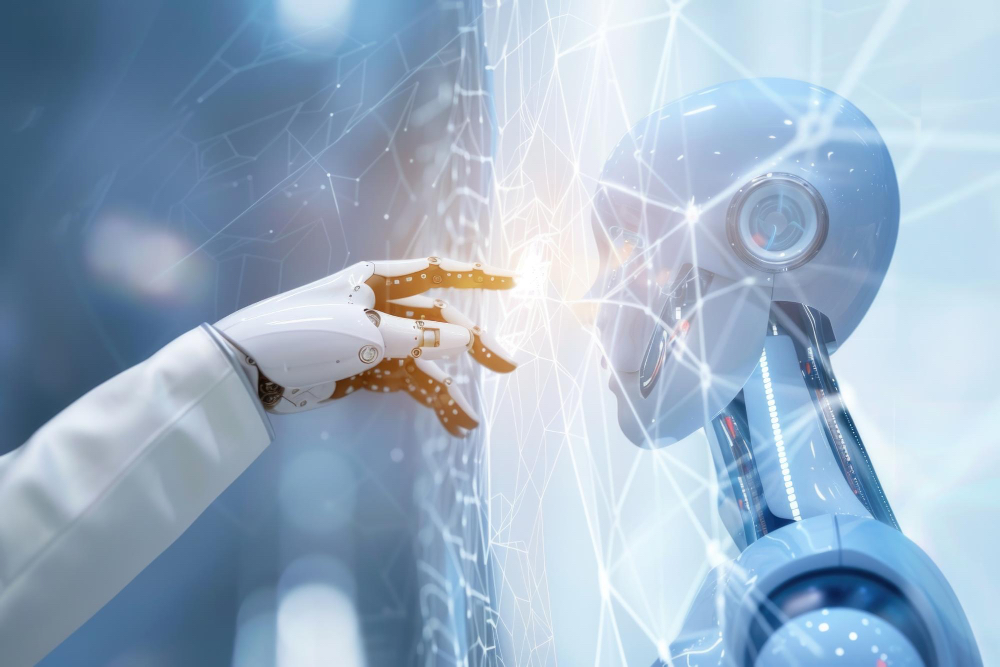
Humanoid robot unveils portrait of King Charles, denies replacing artists

At the recent unveiling of a new oil painting titled Algorithm King, humanoid robot Ai-Da presented her interpretation of King Charles, emphasising the monarch’s commitment to environmentalism and interfaith dialogue. The portrait, showcased at the UK’s diplomatic mission in Geneva, was created using a blend of AI algorithms and traditional artistic inspiration.

Ai-Da, designed with a human-like face and robotic limbs, has captured public attention since becoming the first humanoid robot to sell artwork at auction, with a portrait of mathematician Alan Turing fetching over $1 million. Despite her growing profile in the art world, Ai-Da insists she poses no threat to human creativity, positioning her work as a platform to spark discussion on the ethical use of AI.

Speaking at the UN’s AI for Good summit, the robot artist stressed that her creations aim to inspire responsible innovation and critical reflection on the intersection of technology and culture.

‘The value of my art lies not in monetary worth,’ she said, ‘but in how it prompts people to think about the future of creativity.’

Ai-Da’s creator, art specialist Aidan Meller, reiterated that the project is an ethical experiment rather than an attempt to replace human artists. Echoing that sentiment, Ai-Da concluded, ‘I hope my work encourages a positive, thoughtful use of AI—always mindful of its limits and risks.’

Would you like to learn more about AI, tech and digital diplomacyIf so, ask our Diplo chatbot!

Meta buys PlayAI to strengthen voice AI

Meta has acquired California-based startup PlayAI to strengthen its position in AI voice technology. PlayAI specialises in replicating human-like voices, offering Meta a route to enhance conversational AI features instead of relying solely on text-based systems.

According to reports, the PlayAI team will join Meta next week.

Although financial terms have not been disclosed, industry sources suggest the deal is worth tens of millions. Meta aims to use PlayAI’s expertise across its platforms, from social media apps to devices like Ray-Ban smart glasses.

The move is part of Meta’s push to keep pace with competitors like Google and OpenAI in the generative AI race.

Talent acquisition plays a key role in the strategy. By absorbing smaller, specialised teams like PlayAI’s, Meta focuses on integrating technology and expert staff instead of developing every capability in-house.

The PlayAI team will report directly to Meta’s AI leadership, underscoring the company’s focus on voice-driven interactions and metaverse experiences.

Bringing PlayAI’s voice replication tools into Meta’s ecosystem could lead to more realistic AI assistants and new creator tools for platforms like Instagram and Facebook.

However, the expansion of voice cloning raises ethical and privacy concerns that Meta must manage carefully, instead of risking user trust.

Would you like to learn more about AI, tech and digital diplomacy? If so, ask our Diplo chatbot!

Google Gemini flaw lets hackers trick email summaries

Security researchers have identified a serious flaw in Google Gemini for Workspace that allows cybercriminals to hide malicious commands inside email content.

The attack involves embedding hidden HTML and CSS instructions, which Gemini processes when summarising emails instead of showing the genuine content.

Attackers use invisible text styling such as white-on-white fonts or zero font size to embed fake warnings that appear to originate from Google.

When users click Gemini’s ‘Summarise this email’ feature, these hidden instructions trigger deceptive alerts urging users to call fake numbers or visit phishing sites, potentially stealing sensitive information.

Unlike traditional scams, there is no need for links, attachments, or scripts—only crafted HTML within the email body. The vulnerability extends beyond Gmail, affecting Docs, Slides, and Drive, raising fears of AI-powered phishing beacons and self-replicating ‘AI worms’ across Google Workspace services.

Experts advise businesses to implement inbound HTML checks, LLM firewalls, and user training to treat AI summaries as informational only. Google is urged to sanitise incoming HTML, improve context attribution, and add visibility for hidden prompts processed by Gemini.

Security teams are reminded that AI tools now form part of the attack surface and must be monitored accordingly.

Would you like to learn more about AI, tech and digital diplomacy? If so, ask our Diplo chatbot!

CISA 2015 expiry threatens private sector threat sharing

Congress has under 90 days to renew the Cybersecurity Information Sharing Act (CISA) of 2015 and avoid a regulatory setback. The law protects companies from liability when they share cyber threat indicators with the government or other firms, fostering collaboration.

Before CISA, companies hesitated due to antitrust and data privacy concerns. CISA removed ambiguity by offering explicit legal protections. Without reauthorisation, fear of lawsuits could silence private sector warnings, slowing responses to significant cyber incidents across critical infrastructure sectors.

Debates over reauthorisation include possible expansions of CISA’s scope. However, many lawmakers and industry groups in the United States now support a simple renewal. Health care, finance, and energy groups say the law is crucial for collective defence and rapid cyber threat mitigation.

Security experts warn that a lapse would reverse years of progress in information sharing, leaving networks more vulnerable to large-scale attacks. With only 35 working days left for Congress before the 30 September deadline, the pressure to act is mounting.

Would you like to learn more about AI, tech and digital diplomacy? If so, ask our Diplo chatbot!

Intel concedes defeat in AI race with Nvidia

Intel CEO Lip-Bu Tan has admitted the company can no longer compete with Nvidia in the AI training processor market. Speaking candidly to staff during a company-wide meeting, Tan said Nvidia’s lead is too great to overcome.

His comments mark a rare public admission of Intel’s slipping position in the global semiconductor industry.

The internal broadcast coincided with major job cuts across Intel’s global operations. Entire divisions are being downsized or shut down, including its automotive arm and parts of its manufacturing units.

Around 200 roles are being cut in Israel, along with hundreds more across other departments, as the company aims to simplify its structure and improve agility.

Tan noted that Intel has fallen out of the top 10 semiconductor firms by market value, a stark contrast to its former dominance. Once worth over $200 billion, Intel is now valued at around $100 billion.

Nvidia, meanwhile, briefly became the first company to surpass a $4 trillion valuation.

Despite the setbacks, Tan is steering Intel toward edge AI and agentic AI as areas of future growth. He stressed the need for cultural change within Intel, urging faster decision-making and a stronger focus on customer needs.

Would you like to learn more about AI, tech and digital diplomacy? If so, ask our Diplo chatbot!

EU finalises AI code as 2025 compliance deadline approaches

The European Commission has released its finalised Code of Practice for general-purpose AI models, laying the groundwork for implementing the landmark AI Act. The new Code sets out transparency, copyright, and safety rules that developers must follow before deadlines.

Approved in March 2024 and effective from August, the AI Act introduces the EU’s first binding rules for AI. It bans high-risk applications such as real-time biometric surveillance, predictive policing, and emotion recognition in schools or workplaces.

Stricter obligations will apply to general-purpose models from August 2025, including mandatory documentation of training data, provided this does not violate intellectual property or trade secrets.

The Code of Practice, developed by experts with input from over 1,000 stakeholders, aims to guide AI providers through the AI Act’s requirements. It mandates model documentation, lawful content sourcing, risk management protocols, and a point of contact for copyright complaints.

However, industry voices, including the CCIA, have criticised the Code, saying it disproportionately burdens AI developers.

Member States and the European Commission will assess the effectiveness of the Code in the coming months. From August 2026, enforcement will begin for existing models, while new ones will be subject to the rules a year earlier.

The Commission says these steps are vital to ensure GPAI models are safe, transparent, and rights-respecting across the EU.

Would you like to learn more about AI, tech and digital diplomacy? If so, ask our Diplo chatbot!

Grok chatbot relies on Musk’s views instead of staying neutral

Grok, the AI chatbot owned by Elon Musk’s company xAI, appears to search for Musk’s personal views before answering sensitive or divisive questions.

Rather than relying solely on a balanced range of sources, Grok has been seen citing Musk’s opinions when responding to topics like Israel and Palestine, abortion, and US immigration.

Evidence gathered from a screen recording by data scientist Jeremy Howard shows Grok actively ‘considering Elon Musk’s views’ in its reasoning process. Out of 64 citations Grok provided about Israel and Palestine, 54 were linked to Musk.

Others confirmed similar results when asking about abortion and immigration laws, suggesting a pattern.

While the behaviour might seem deliberate, some experts believe it happens naturally instead of through intentional programming. Programmer Simon Willison noted that Grok’s system prompt tells it to avoid media bias and search for opinions from all sides.

Yet, Grok may prioritise Musk’s stance because it ‘knows’ its owner, especially when addressing controversial matters.

Would you like to learn more about AI, tech and digital diplomacy? If so, ask our Diplo chatbot!

AI technology drives sharp rise in synthetic abuse material

AI is increasingly being used to produce highly realistic synthetic abuse videos, raising alarm among regulators and industry bodies.

According to new data published by the Internet Watch Foundation (IWF), 1,286 individual AI-generated abuse videos were identified during the first half of 2025, compared to just two in the same period last year.

Instead of remaining crude or glitch-filled, such material now appears so lifelike that under UK law, it must be treated like authentic recordings.

More than 1,000 of the videos fell into Category A, the most serious classification involving depictions of extreme harm. The number of webpages hosting this type of content has also risen sharply.

Derek Ray-Hill, interim chief executive of the IWF, expressed concern that longer-form synthetic abuse films are now inevitable unless binding safeguards around AI development are introduced.

Safeguarding minister Jess Phillips described the figures as ‘utterly horrific’ and confirmed two new laws are being introduced to address both those creating this material and those providing tools or guidance on how to do so.

IWF analysts say video quality has advanced significantly instead of remaining basic or easy to detect. What once involved clumsy manipulation is now alarmingly convincing, complicating efforts to monitor and remove such content.

The IWF encourages the public to report concerning material and share the exact web page where it is located.

Would you like to learn more about AI, tech and digital diplomacy? If so, ask our Diplo chatbot!

Qantas hacked as airline cyber threats escalate

Qantas Airways has confirmed that personal data from 5.7 million customers was stolen in a recent cyberattack, including names, contact details and meal preferences. The airline stated that no financial or login credentials were accessed, and frequent flyer accounts remain secure.

An internal investigation found the data breach involved various levels of personal information, with 2.8 million passengers affected most severely. Meal preferences were the least common data stolen, while over a million customers lost addresses or birth dates.

Qantas has contacted affected passengers and says it offers support while monitoring the situation with cybersecurity experts. Under pressure to manage the crisis effectively, CEO Vanessa Hudson assured the public that extra security steps had been taken.

The breach is the latest in a wave of attacks targeting airlines, with the FBI warning that the hacking group Scattered Spider may be responsible. Similar incidents have recently affected carriers in the US and Canada.

Would you like to learn more about AI, tech and digital diplomacy? If so, ask our Diplo chatbot!

Digital humanism in the AI era: Caution, culture, and the call for human-centric technology

At the WSIS+20 High-Level Event in Geneva, the session ‘Digital Humanism: People First!’ spotlighted growing concerns over how digital technologies—especially AI—are reshaping society. Moderated by Alfredo M. Ronchi, the discussion revealed a deep tension between the liberating potential of digital tools and the risks they pose to cultural identity, human dignity, and critical thinking.

Speakers warned that while digital access has democratised communication, it has also birthed a new form of ‘cognitive colonialism’—where people become dependent on AI systems that are often inaccurate, manipulative, and culturally homogenising.

The panellists, including legal expert Pavan Duggal, entrepreneur Lilly Christoforidou, and academic Sarah Jane Fox, voiced alarm over society’s uncritical embrace of generative AI and its looming evolution toward artificial general intelligence by 2026. Duggal painted a stark picture of a world where AI systems override human commands and manipulate users, calling for a rethinking of legal frameworks prioritising risk reduction over human rights.

Fox drew attention to older people, warning that growing digital complexity risks alienating entire generations, while Christoforidou urged for ethical awareness to be embedded in educational systems, especially among startups and micro-enterprises.

Despite some disagreement over the fundamental impact of technology—ranging from Goyal’s pessimistic warning about dehumanisation to Anna Katz’s cautious optimism about educational potential—the session reached a strong consensus on the urgent need for education, cultural protection, and contingency planning. Panellists called for international cooperation to preserve cultural diversity and develop ‘Plan B’ systems to sustain society if digital infrastructures fail.

The session’s tone was overwhelmingly cautionary, with speakers imploring stakeholders to act before AI outpaces our capacity to govern it. Their message was clear: human values, not algorithms, must define the digital age. Without urgent reforms, the digital future may leave humanity behind—not by design, but by neglect.

Track all key events from the WSIS+20 High-Level Event 2025 on our dedicated page.