The third UK-EU Cyber Dialogue was held in Brussels on 9 and 10 December 2025, bringing together senior officials under the UK-EU Trade and Cooperation Agreement to strengthen cooperation on cybersecurity and digital resilience.
The meeting was co-chaired by Andrew Whittaker from the UK Foreign, Commonwealth and Development Office and Irfan Hemani from the Department for Science, Innovation and Technology, alongside EU representatives from the European External Action Service and the European Commission.
Officials from Europol and ENISA also participated, reinforcing operational and regulatory coordination rather than fragmented policy approaches.
Discussions covered cyber legislation, deterrence strategies, countering cybercrime, incident response and cyber capacity development, with an emphasis on maintaining strong security standards while reducing unnecessary compliance burdens on industry.
Both sides confirmed that the next UK-EU Cyber Dialogue will take place in London in 2026.
Would you like to learn more aboutAI, tech and digital diplomacy? If so, ask our Diplo chatbot!
US credit reporting company 700Credit has confirmed a data breach affecting more than 5.6 million individuals after attackers exploited a compromised third-party API used to exchange consumer data with external integration partners.
An incident that originated from a supply chain failure after one partner was breached earlier in 2025 and failed to notify 700Credit.
The attackers launched a sustained, high-volume data extraction campaign starting on October 25, 2025, which operated for more than two weeks before access was shut down.
Around 20 percent of consumer records were accessed, exposing names, home addresses, dates of birth and Social Security numbers, while internal systems, payment platforms and login credentials were not compromised.
Despite the absence of financial system access, the exposed personal data significantly increases the risk of identity theft and sophisticated phishing attacks impersonating credit reporting services.
The breach has been reported to the Federal Trade Commission and the FBI, with regulators coordinating responses through industry bodies representing affected dealerships.
Individuals impacted by the incident are currently being notified and offered two years of free credit monitoring, complimentary credit reports and access to a dedicated support line.
Authorities have urged recipients to act promptly by monitoring their credit activity and taking protective measures to minimise the risk of fraud.
Would you like to learn more aboutAI, tech and digital diplomacy? If so, ask our Diplo chatbot!
Scientists at the Icahn School of Medicine at Mount Sinai have created an AI tool called Variant to Phenotype (V2P) that can identify genetic mutations and predict the diseases they may cause, bolstering the field of genetic diagnostics.
The V2P method is designed to accelerate diagnosis and facilitate the discovery of new treatments for complex and rare diseases by comprehensively interpreting genomic data, surpassing the limitations of traditional techniques that often focus solely on mutation detection without predicting phenotypic effects.
This innovation could enhance clinical decision-making by linking specific genetic variants directly to disease risk, helping clinicians prioritise variants for further study and informing patients about likely outcomes sooner.
The findings were published online in Nature Communications, marking a notable advancement in how AI can support precision medicine and research for rare diseases.
Would you like to learn more about AI, tech and digital diplomacy? If so, ask our Diplo chatbot!
Libraries Connected, supported by a £310,400 grant from the UK Government’s Digital Inclusion Innovation Fund administered by the Department for Science, Industry and Technology (DSIT), is launching Innovating in Trusted Spaces: Libraries Advancing the Digital Inclusion Action Plan.
The programme will run from November 2025 to March 2026 across 121 library branches in Newcastle, Northumberland, Nottingham City and Nottinghamshire, targeting older people, low-income families and individuals with disabilities to ensure they are not left behind amid rapid digital and AI-driven change.
Public libraries are already a leading provider of free internet access and basic digital skills support, offering tens of thousands of public computers and learning opportunities each year. However, only around 27 percent of UK adults currently feel confident in recognising AI-generated content online, underscoring the need for improved digital and media literacy.
The project will create and test a new digital inclusion guide for library staff, focusing on the benefits and risks of AI tools, misinformation and emerging technologies, as well as building a national network of practice for sharing insights.
Partners in the programme include Good Things Foundation and WSA Community, which will help co-design materials and evaluate the initiative’s impact to inform future digital inclusion efforts across communities.
Would you like to learn more about AI, tech and digital diplomacy? If so, ask our Diplo chatbot!
Local councillors have approved Google’s plans to build a large data centre campus at North Weald Airfield near Harlow, marking a major expansion of the company’s UK digital infrastructure.
The development is expected to create up to 780 local jobs, including approximately 200 direct roles, and contribute an estimated £79 million annually to the local economy and £319 million nationally.
The project involves demolishing existing buildings at the former RAF airfield and constructing two data centre facilities alongside offices, roads and parking.
While UK councillors largely welcomed the investment, the council acknowledged potential downsides, including a reduction in stalls at the long-running North Weald Market and pending Section 106 contributions to mitigate infrastructure impacts, such as upgrades to nearby transport links.
Would you like to learn more about AI, tech and digital diplomacy? If so, ask our Diplo chatbot!
The UK government has announced plans to bring cryptoassets firmly within the regulatory perimeter, aiming to support innovation while strengthening consumer protection and attracting long-term investment into the sector.
From 2027, cryptoasset firms will be regulated by the Financial Conduct Authority under rules similar to those governing traditional financial products, such as stocks and shares. The move is intended to provide legal clarity and increase confidence among consumers and businesses.
Ministers say that proportionate regulation will support innovation, ensure competitive markets, and strengthen the UK’s position as a global hub for digital assets. Enhanced oversight will boost transparency, aid sanctions enforcement, and help detect and tackle illicit activity.
The initiative forms part of a broader strategy to shape global crypto standards, including ongoing cooperation with the United States through the Transatlantic Taskforce, as the UK seeks to secure its role in the future of digital finance.
Would you like to learn more about AI, tech and digital diplomacy? If so, ask our Diplo chatbot!
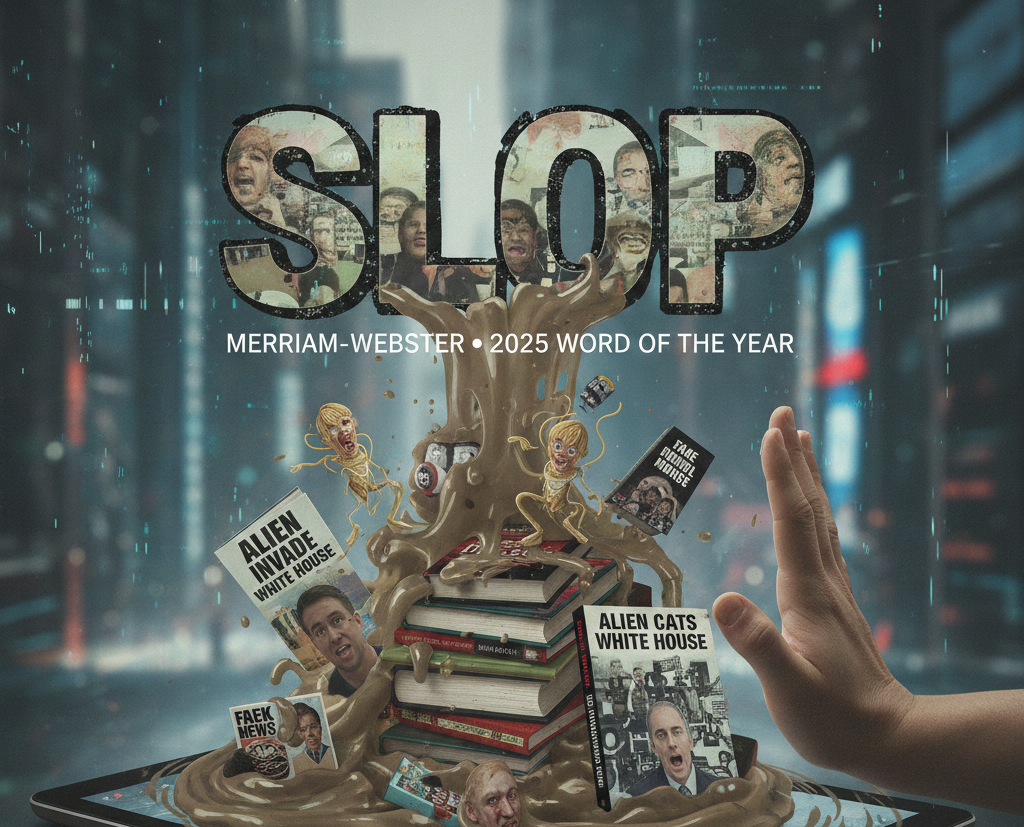
Merriam-Webster has chosen ‘slop’ as its 2025 word of the year, reflecting the rise of low-quality digital content produced by AI. The term originally meant soft mud, but now describes absurd or fake online material.
Greg Barlow, Merriam-Webster’s president, said the word captures how AI-generated content has fascinated, annoyed and sometimes alarmed people. Tools like AI video generators can produce deepfakes and manipulated clips in seconds.
The spike in searches for ‘slop’ shows growing public awareness of poor-quality content and a desire for authenticity. People want real, genuine material rather than AI-driven junk content.
AI-generated slop includes everything from absurd videos to fake news and junky digital books. Merriam-Webster selects its word of the year by analysing search trends and cultural relevance.
Would you like to learn more about AI, tech, and digital diplomacy? If so, ask our Diplo chatbot!
Musicians are raising the alarm over AI-generated tracks appearing on their profiles without consent, presenting fraudulent work as their own. British folk artist Emily Portman discovered an AI-generated album, Orca, on Spotify and Apple Music, which copied her folk style and lyrics.
Fans initially congratulated her on a release she had not made since 2022.
Australian musician Paul Bender reported a similar experience, with four ‘bizarrely bad’ AI tracks appearing under his band, The Sweet Enoughs. Both artists said that weak distributor security allows scammers to easily upload content, calling it ‘the easiest scam in the world.’
A petition launched by Bender garnered tens of thousands of signatures, urging platforms to strengthen their protections.
AI-generated music has become increasingly sophisticated, making it nearly impossible for listeners to distinguish from genuine tracks. While revenues from such fraudulent streams are low individually, bots and repeated listening can significantly increase payouts.
Industry representatives note that the primary motive is to collect royalties from unsuspecting users.
Despite the threat of impersonation, Portman is continuing her creative work, emphasising human collaboration and authentic artistry. Spotify and Apple Music have pledged to collaborate with distributors to enhance the detection and prevention of AI-generated fraud.
Would you like to learn more about AI, tech and digital diplomacy? If so, ask our Diplo chatbot!
Anatoly Aksakov, head of the State Duma Committee on the Financial Market, emphasised that all payments within Russia must be conducted in rubles, echoing the central bank’s long-standing stance against the use of cryptocurrencies in internal settlements.
At the same time, legislative proposals point to a more nuanced legal approach. A bill submitted by United Russia lawmaker Igor Antropenko seeks to recognise cryptocurrencies as marital property, classifying digital assets acquired during marriage as jointly owned in divorce proceedings.
The proposal reflects the growing adoption of cryptocurrency in Russia, where digital assets are increasingly used for investment and savings. It also aligns family law with broader regulatory shifts that permit the use of crypto in foreign trade under an experimental framework.
Would you like to learn more about AI, tech and digital diplomacy? If so, ask our Diplo chatbot!
Podcasts generated by AI are rapidly reshaping the audio industry, with automated shows flooding platforms such as Spotify, Apple Podcasts and YouTube.
Advances in voice cloning and speech synthesis have enabled the production to large volumes of content at minimal cost, allowing AI hosts to compete directly with human creators in an already crowded market.
Some established podcasters are experimenting cautiously, using cloned voices for translation, post-production edits or emergency replacements. Others have embraced full automation, launching synthetic personalities designed to deliver commentary, biographies and niche updates at speed.
Studios, such as Los Angeles-based Inception Point AI, have scaled the model to scale, producing hundreds of thousands of episodes by targeting micro-audiences and trending searches instead of premium advertising slots.
The rapid expansion is fuelling concern across the industry, where trust and human connection remain central to listener loyalty.
Researchers and networks warn that large-scale automation risks devaluing premium content, while creators and audiences question how far AI voices can replace authenticity without undermining the medium itself.
Would you like to learn more aboutAI, tech and digital diplomacy? If so, ask our Diplo chatbot!