The US tech giant, Google, has unveiled Gemini 3 Flash, a new frontier AI model designed for developers who need high reasoning performance combined with speed and low cost.
Built on the multimodal and agentic foundations of Gemini 3 Pro, Gemini 3 Flash delivers faster responses at less than a quarter of the price, while surpassing Gemini 2.5 Pro across several major benchmarks.
The model is rolling out through the Gemini API, Google AI Studio, Vertex AI, Android Studio and other developer platforms, offering higher rate limits, batch processing and context caching that significantly reduce operational costs.
Gemini 3 Flash achieves frontier-level results on advanced reasoning benchmarks while remaining optimised for large-scale production workloads, reinforcing Google’s focus on efficiency alongside intelligence.
Early adopters are already deploying Gemini 3 Flash across coding, gaming, deepfake detection and legal document analysis, benefiting from improved agentic capabilities and near real-time multimodal reasoning.
By lowering cost barriers while expanding performance, Gemini 3 Flash enhances Google’s competitive position in the rapidly evolving AI model market. It broadens access to advanced AI systems for developers and enterprises.
Would you like to learn more aboutAI, tech and digital diplomacy? If so, ask our Diplo chatbot!
UNESCO and UNDP have partnered to enhance judicial capacity on the ethical use of AI. A three-day Bangkok training, supported by the Thailand Institute of Justice, brought together 27 judges from 13 Asia-Pacific countries to discuss the impact of AI on justice and safeguards for fairness.
Expert sessions highlighted the global use of AI in court administration, research, and case management, emphasising opportunities and risks. Participants explored ways to use AI ethically while protecting human rights and judicial integrity, warning that unsupervised tools could increase bias and undermine public trust.
Trainers emphasised that AI must be implemented with careful attention to bias, transparency, and structural inequalities.
Judges reflected on the growing complexity of verifying evidence in the age of generative AI and deepfakes, and acknowledged that responsible AI can improve access to justice, support case reviews, and free time for substantive decision-making.
The initiative concluded with a consensus that AI adoption in courts should be guided by governance, transparency, and ongoing dialogue. The UNDP will continue to collaborate in advancing ethical, human rights-focused AI in regional judiciaries.
Would you like to learn more about AI, tech and digital diplomacy? If so, ask our Diplo chatbot!
South Korea will require advertisers to label AI-generated or AI-assisted advertising from early 2026, marking a shift in how the country governs AI in online commerce and consumer protection.
The measure responds to a sharp rise in deceptive ads using synthetic imagery and deepfakes, particularly in healthcare and financial promotions. Regulators say transparency at the point of content delivery is intended to reduce manipulation and restore consumer trust.
Authorities in South Korea acknowledge that mandatory labelling alone may not deter malicious actors, who can bypass rules through offshore hosting or rapidly changing content. Detection challenges and uneven enforcement capacity across platforms remain open concerns.
South Korea’s industry groups warn that the policy could have uneven economic effects within the country’s advertising ecosystem. Large platforms and agencies are expected to adapt quickly, while smaller firms may face higher compliance costs that slow experimentation with generative tools.
Policymakers argue the framework aligns with South Korea’s broader AI governance strategy, positioning the country between innovation-led and precautionary regulatory models as synthetic media becomes more widespread.
Would you like to learn more about AI, tech, and digital diplomacy? If so, ask our Diplo chatbot!
Google Labs has introduced CC, an experimental AI productivity agent designed to help users stay organised and improve daily efficiency. The agent connects with Gmail, Google Calendar, Google Drive, and the wider web to gain an understanding of each user’s day.
Each morning, CC delivers a ‘Your Day Ahead’ briefing to users’ inboxes, summarising schedules, key tasks, and updates. It can draft emails, generate calendar links, and highlight next steps, making it easier to manage appointments, bills, and other responsibilities.
Users can interact with CC directly by replying to emails or sending custom requests, allowing the AI to learn personal preferences, store ideas, and remember tasks. The interactive approach helps the AI agent become more tailored to individual workflows over time.
CC is available in early access for Google consumer accounts aged 18 and over in the US and Canada, initially for Google AI Ultra and paid subscribers. Those interested can join the waitlist via the Google Labs website to gain early access.
Would you like to learn more about AI, tech and digital diplomacy? If so, ask our Diplo chatbot!
Retailers face escalating cyber threats as hackers increasingly target customer data, eroding trust and damaging long-term brand value.
Deloitte warns that data breaches and ransomware attacks are becoming more frequent and costly, with some retailers facing losses reaching hundreds of millions, alongside declining consumer confidence.
The expansion of AI-driven personalisation has intensified privacy concerns, as customers weigh convenience against data protection.
While many shoppers accept sharing personal information in exchange for value, confidence depends on clear safeguards, transparent data use and credible security practices across digital channels.
Deloitte argues that leading retailers integrate cybersecurity into their core business strategy, rather than treating it as a compliance obligation.
Priorities include protecting critical digital assets, modernising security operations and building cyber-aware cultures capable of responding to AI-enabled fraud, preserving customer trust and sustaining revenue growth.
Would you like to learn more aboutAI, tech and digital diplomacy? If so, ask our Diplo chatbot!
Cybersecurity researchers are urging greater caution as Christmas approaches, warning that seasonal scams are multiplying rapidly. Check Point has recorded over 33,500 festive phishing emails and more than 10,000 deceptive social ads within two weeks.
AI tools are helping criminals craft convincing messages that mirror trusted brands and local languages. Attackers are also deploying fake e-commerce sites with AI chatbots, as well as deepfake audio and scripted calls to strengthen vishing attempts.
Smishing alerts imitating delivery firms are becoming more widespread, with recent months showing a marked rise in fraudulent parcel scams. Victims are often tricked into sharing payment details through links that imitate genuine logistics updates.
Experts say fake shops and giveaway scams remain persistent risks, frequently launched from accounts created within the past three months. Users are being advised to ignore unsolicited links, verify retailers and treat unexpected offers with scepticism.
Would you like to learn more about AI, tech and digital diplomacy? If so, ask our Diplo chatbot!
The third UK-EU Cyber Dialogue was held in Brussels on 9 and 10 December 2025, bringing together senior officials under the UK-EU Trade and Cooperation Agreement to strengthen cooperation on cybersecurity and digital resilience.
The meeting was co-chaired by Andrew Whittaker from the UK Foreign, Commonwealth and Development Office and Irfan Hemani from the Department for Science, Innovation and Technology, alongside EU representatives from the European External Action Service and the European Commission.
Officials from Europol and ENISA also participated, reinforcing operational and regulatory coordination rather than fragmented policy approaches.
Discussions covered cyber legislation, deterrence strategies, countering cybercrime, incident response and cyber capacity development, with an emphasis on maintaining strong security standards while reducing unnecessary compliance burdens on industry.
Both sides confirmed that the next UK-EU Cyber Dialogue will take place in London in 2026.
Would you like to learn more aboutAI, tech and digital diplomacy? If so, ask our Diplo chatbot!
US credit reporting company 700Credit has confirmed a data breach affecting more than 5.6 million individuals after attackers exploited a compromised third-party API used to exchange consumer data with external integration partners.
An incident that originated from a supply chain failure after one partner was breached earlier in 2025 and failed to notify 700Credit.
The attackers launched a sustained, high-volume data extraction campaign starting on October 25, 2025, which operated for more than two weeks before access was shut down.
Around 20 percent of consumer records were accessed, exposing names, home addresses, dates of birth and Social Security numbers, while internal systems, payment platforms and login credentials were not compromised.
Despite the absence of financial system access, the exposed personal data significantly increases the risk of identity theft and sophisticated phishing attacks impersonating credit reporting services.
The breach has been reported to the Federal Trade Commission and the FBI, with regulators coordinating responses through industry bodies representing affected dealerships.
Individuals impacted by the incident are currently being notified and offered two years of free credit monitoring, complimentary credit reports and access to a dedicated support line.
Authorities have urged recipients to act promptly by monitoring their credit activity and taking protective measures to minimise the risk of fraud.
Would you like to learn more aboutAI, tech and digital diplomacy? If so, ask our Diplo chatbot!
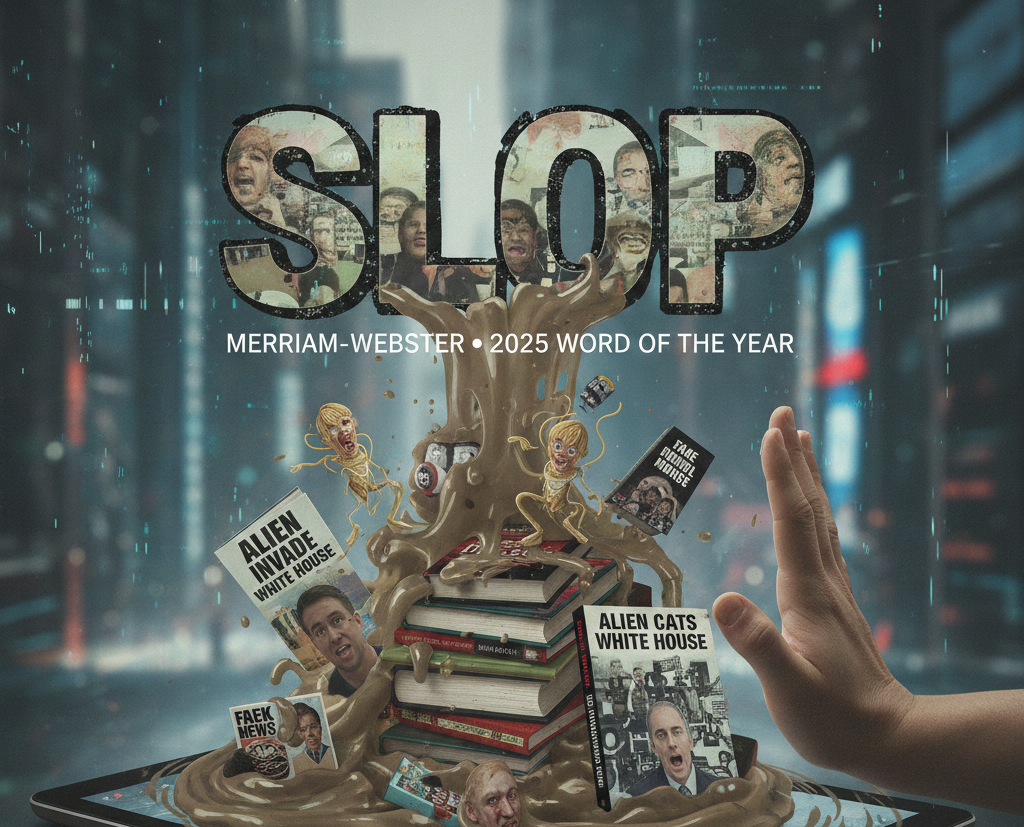
Merriam-Webster has chosen ‘slop’ as its 2025 word of the year, reflecting the rise of low-quality digital content produced by AI. The term originally meant soft mud, but now describes absurd or fake online material.
Greg Barlow, Merriam-Webster’s president, said the word captures how AI-generated content has fascinated, annoyed and sometimes alarmed people. Tools like AI video generators can produce deepfakes and manipulated clips in seconds.
The spike in searches for ‘slop’ shows growing public awareness of poor-quality content and a desire for authenticity. People want real, genuine material rather than AI-driven junk content.
AI-generated slop includes everything from absurd videos to fake news and junky digital books. Merriam-Webster selects its word of the year by analysing search trends and cultural relevance.
Would you like to learn more about AI, tech, and digital diplomacy? If so, ask our Diplo chatbot!
Musicians are raising the alarm over AI-generated tracks appearing on their profiles without consent, presenting fraudulent work as their own. British folk artist Emily Portman discovered an AI-generated album, Orca, on Spotify and Apple Music, which copied her folk style and lyrics.
Fans initially congratulated her on a release she had not made since 2022.
Australian musician Paul Bender reported a similar experience, with four ‘bizarrely bad’ AI tracks appearing under his band, The Sweet Enoughs. Both artists said that weak distributor security allows scammers to easily upload content, calling it ‘the easiest scam in the world.’
A petition launched by Bender garnered tens of thousands of signatures, urging platforms to strengthen their protections.
AI-generated music has become increasingly sophisticated, making it nearly impossible for listeners to distinguish from genuine tracks. While revenues from such fraudulent streams are low individually, bots and repeated listening can significantly increase payouts.
Industry representatives note that the primary motive is to collect royalties from unsuspecting users.
Despite the threat of impersonation, Portman is continuing her creative work, emphasising human collaboration and authentic artistry. Spotify and Apple Music have pledged to collaborate with distributors to enhance the detection and prevention of AI-generated fraud.
Would you like to learn more about AI, tech and digital diplomacy? If so, ask our Diplo chatbot!