


3 July – 10 July 2026
HIGHLIGHT OF THE WEEK
Geneva takes centre stage in global AI governance
Geneva has long been one of the places where global digital governance is translated into dialogue, institutions and practical cooperation. This week, that role became especially visible as WSIS Forum 2026, the inaugural Global Dialogue on AI Governance and AI for Good Global Summit 2026 brought governments, UN agencies, technical experts, companies, civil society and the research community into the same diplomatic ecosystem.
The concentration of events mattered because AI governance is reaching a point where principles are no longer enough. Countries are still facing very different levels of access to data, infrastructure, skills, compute, standards and regulatory capacity, while the technology is moving faster than many institutions can respond. Therefore, the matter is no longer whether AI should be safe, inclusive and human-centred, but how those commitments can be turned into working governance.

The timing matters. WSIS remains one of the longest-running multistakeholder processes in digital governance, rooted in the idea that digital technologies should support development, inclusion and public interest goals. Two decades after the original WSIS process began, the agenda is no longer only about connectivity or access to ICTs. It now includes AI, data governance, digital public infrastructure, online safety, labour markets, human rights, cybersecurity, digital divides and the future of the Internet Governance Forum.
At WSIS Forum 2026, that broader picture was visible across sessions on the IGF’s role in the WSIS era, youth mental health online, and AI’s impact on work and digitalisation. The discussion on the IGF focused on how a permanent mandate should translate into stronger government engagement, year-round collaboration and better links between global discussions and national and regional initiatives. Other WSIS sessions showed why that matters, linking digital governance to young people’s online lives, education, mental health, labour markets, skills and institutional adaptation.
The Global Dialogue on AI Governance added a different layer. Unlike WSIS, which has a long history of development and digital cooperation, the Global Dialogue is a newer mechanism created through the Global Digital Compact to support more inclusive international cooperation on AI. Its inaugural meeting in Geneva placed governments and stakeholders in direct conversation over AI’s opportunities, risks, divides, safety, trustworthiness and human rights implications.
The presentation of the first assessment by the Independent International Scientific Panel on AI was especially important because it brought an evidence-based layer into the political discussion. The panel warned that AI capabilities are advancing rapidly, while scientific understanding, regulatory systems and institutional capacity are struggling to keep pace. That gap affects who can evaluate AI systems, who can regulate them, who can benefit from them, and who may be exposed to risks without having enough voice in shaping the rules.
Why is this happening? AI governance is becoming too broad for any single forum, ministry, regulator or technical community to manage alone. It touches education, labour, health, defence, competition, human rights, energy, infrastructure, media, development and public administration. At the same time, countries do not enter the discussion from equal positions. Some are building frontier models and data centres, while others are still working to close connectivity gaps, develop local skills, secure public-sector capacity and participate meaningfully in global standard-setting.
That is why the AI divide is becoming one of the central questions in global governance. Access to AI is not only about whether people can use a chatbot. It is also about whether countries have the data, languages, compute, cloud access, regulatory expertise and institutional confidence needed to shape AI systems around their own priorities. If the global AI conversation focuses only on safety risks in advanced economies, it may miss the development, capacity and inclusion questions that determine whether AI reinforces old inequalities or helps reduce them.
AI for Good Global Summit 2026 provided the third part of Geneva’s AI week. While WSIS carried the development and multistakeholder legacy, and the Global Dialogue focused on AI governance at the UN level, AI for Good was built around practical applications, partnerships and the sustainable development goals. Its relevance lies in connecting AI governance to concrete use cases, standards, technical communities and implementation challenges.
What does this mean? The centre of gravity in AI governance is shifting from principles to institutional design. But, how to build mechanisms that make those principles operational: scientific assessments, capacity-building, standards, regulatory cooperation, accountability tools, rights protections, public-sector readiness and channels for countries with fewer resources to influence decisions.
Geneva’s strength has always been its diverse ecosystem: UN agencies, technical bodies, humanitarian organisations, diplomats, civil society, companies, standards experts and researchers. AI governance needs precisely that kind of ecosystem, because the technology does not fit neatly into one policy box. Yet bringing everyone into the room is only the first step. The real test is whether those conversations produce continuity, coordination and practical support after the summits end.
Wrapping up, the week showed why Geneva matters in the next phase of AI governance. WSIS connected AI to the long arc of digital development. The Global Dialogue placed AI risks, benefits and divides in a new UN process. AI for Good linked the debate to practical applications and the SDGs. Together, they showed that AI governance is no longer a side discussion within digital policy. It is becoming one of the main tests of whether global cooperation can respond to technological change without leaving most countries behind.
The question is whether Geneva can help turn a crowded AI governance conversation into a more coherent system of cooperation, accountability and practical support. If AI is becoming a general-purpose technology for economies, public services and societies, then global governance will be judged not by how many principles it produces, but by whether countries and communities have the tools, capacity and voice to shape how those principles are applied.
Diplo at Global Dialogue on AI governance, WSIS and AI for Good
Diplo maintained an active presence throughout the week at the Global Dialogue on AI Governance, the WSIS Forum, and the AI for Good Global Summit through high-level discussions, thematic sessions, side events, and exhibition booths that showcased its work on AI governance, digital diplomacy, and capacity development.
Diplo and GIP at the Global Dialogue on AI Governance
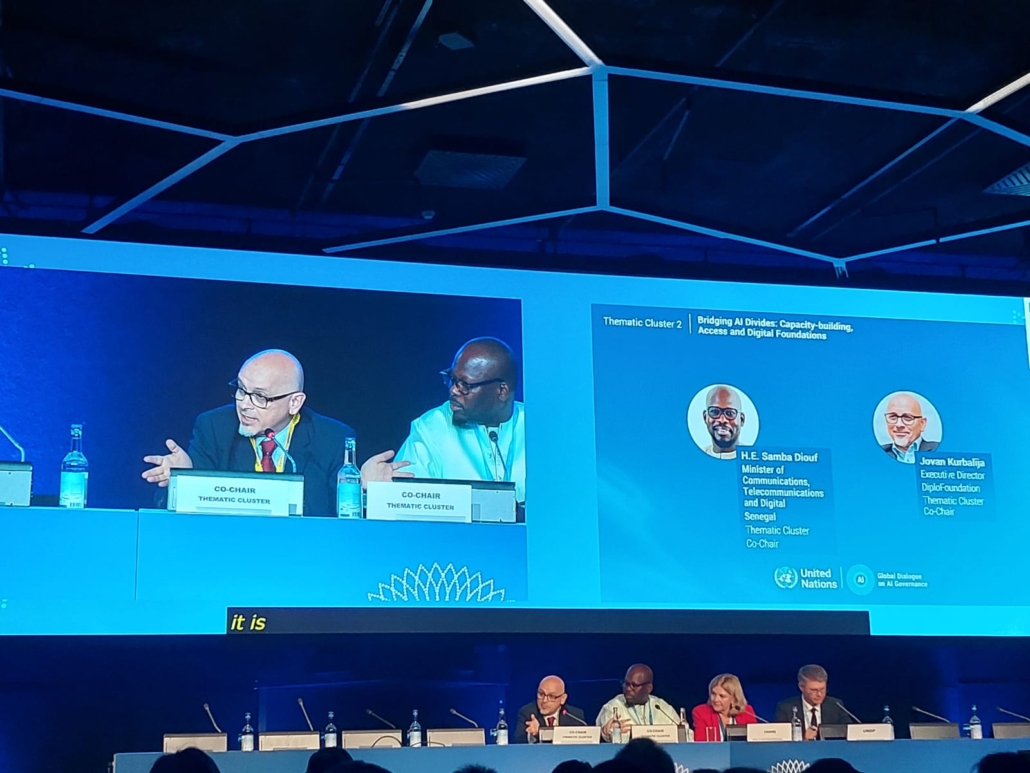
At the inaugural Global Dialogue on AI Governance, Dr Jovan Kurbalija, Executive Director of DiploFoundation and Head of the Geneva Internet Platform, co-chaired the thematic discussion on bridging AI divides, along with H.E. Samba Diouf, Minister of Communications, Telecommunications and Digital of Senegal. The session served as a structured multistakeholder exchange to share perspectives, experiences, and practical insights on bridging AI divides.
Diplo also co-organised a session with Coursera on Innovative approaches to future workforce development, where Diplo showcased its AI apprenticeship methodology, a hands-on approach that enables professionals in digital governance and diplomacy to build their own AI agents while exploring institutional questions such as knowledge ownership.
Diplo and GIP at WSIS Forum 2026
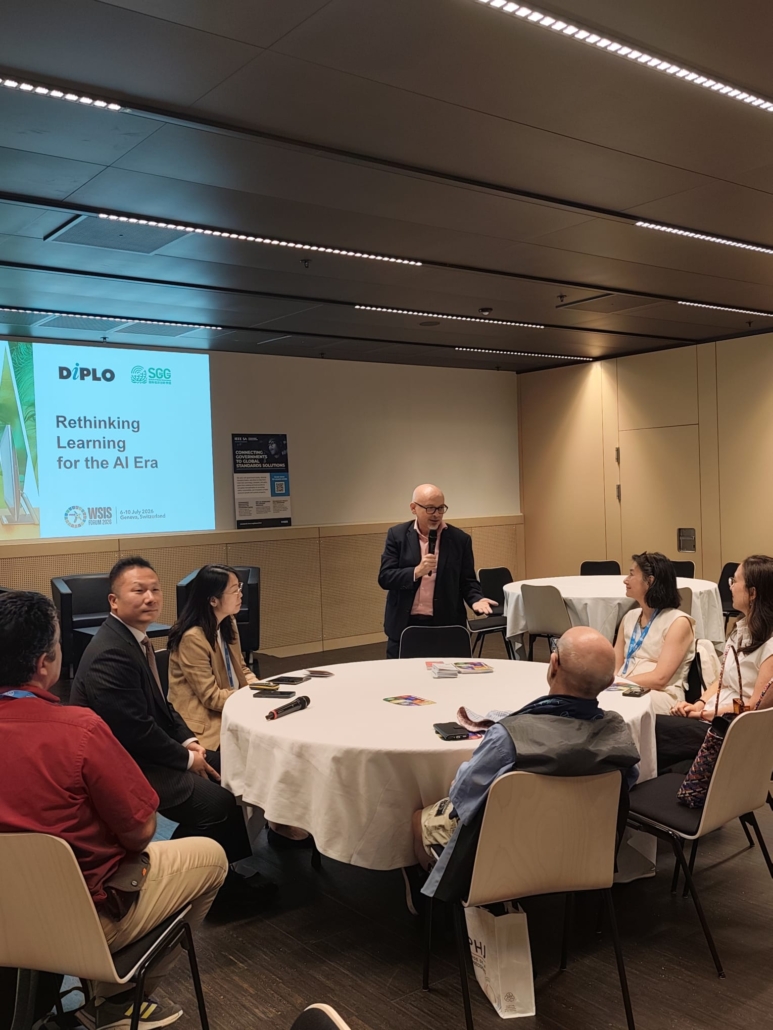
At WSIS Forum 2026, Diplo and the GIP co-organised a session with the Beijing Institute of Technology on Thursday, 9 July, exploring practical approaches for learning in the AI era. Drawing on both Chinese and European educational traditions, the discussion examined how AI is reshaping knowledge production, teaching, and learning, prompting a shift from education centred on knowledge transmission to mentoring, facilitation, and new curricula and assessment approaches. Participants also considered how AI apprenticeships and other learning-by-doing models can strengthen AI literacy by enabling learners to build and critically evaluate AI systems. The role of narrative, dialogue, and AI-supported personalised learning in fostering reflection, inquiry, and deeper understanding was also considered.
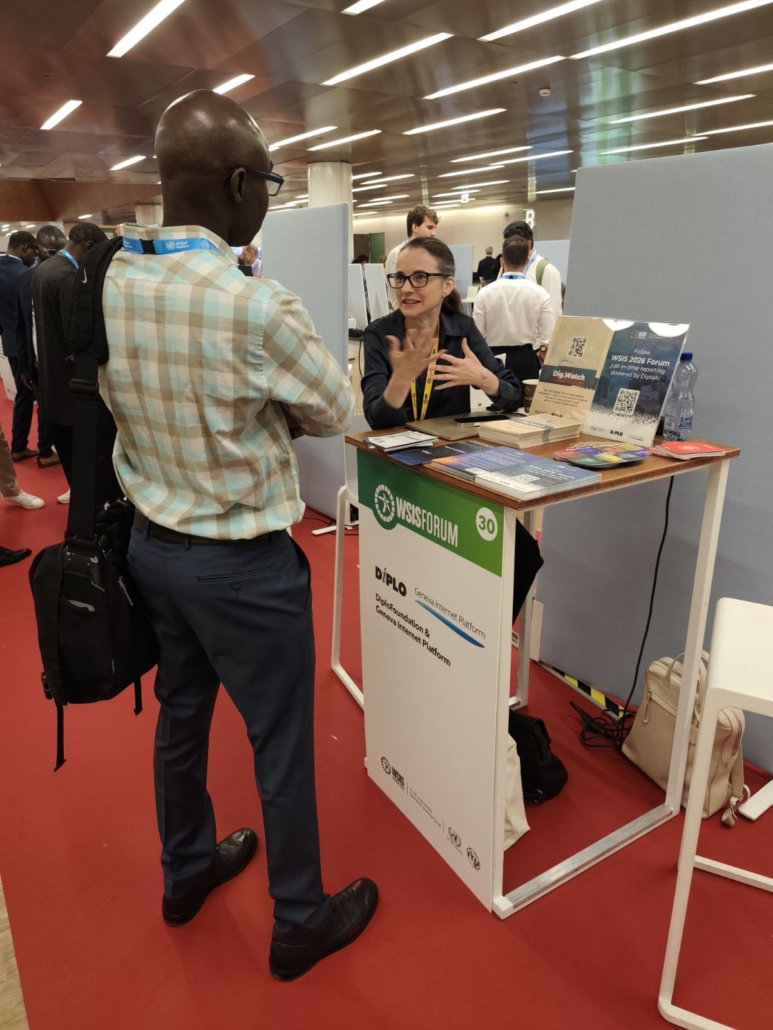
Diplo and GIP also had a booth at the WSIS exhibition space, where we showcased publications and initiatives, including EspriTech de Genève and just-in-time reporting from the WSIS 2026 Forum through the Digital Watch observatory.
Diplo and GIP at AI for Good Summit 2026
At AI for Good Summit 2026, Diplo and GIP participated in various sessions. Diplo’s Director of Partnerships, Tereza Horejsova, moderated one roundtable during the session, AI in education, research and skills development on Tuesday, 7 July 2025. The roundtable brought together high-level representatives of leading universities, industry actors, and international stakeholders to explore how AI is transforming higher education.
Diplo participated in the annual meeting of AI Skills Coalition partners, where the AI Skills Coalition community – representatives of international organisations, industry, academia, and the public sector – connected, shared priorities, and explored opportunities to scale impact through coordinated action.
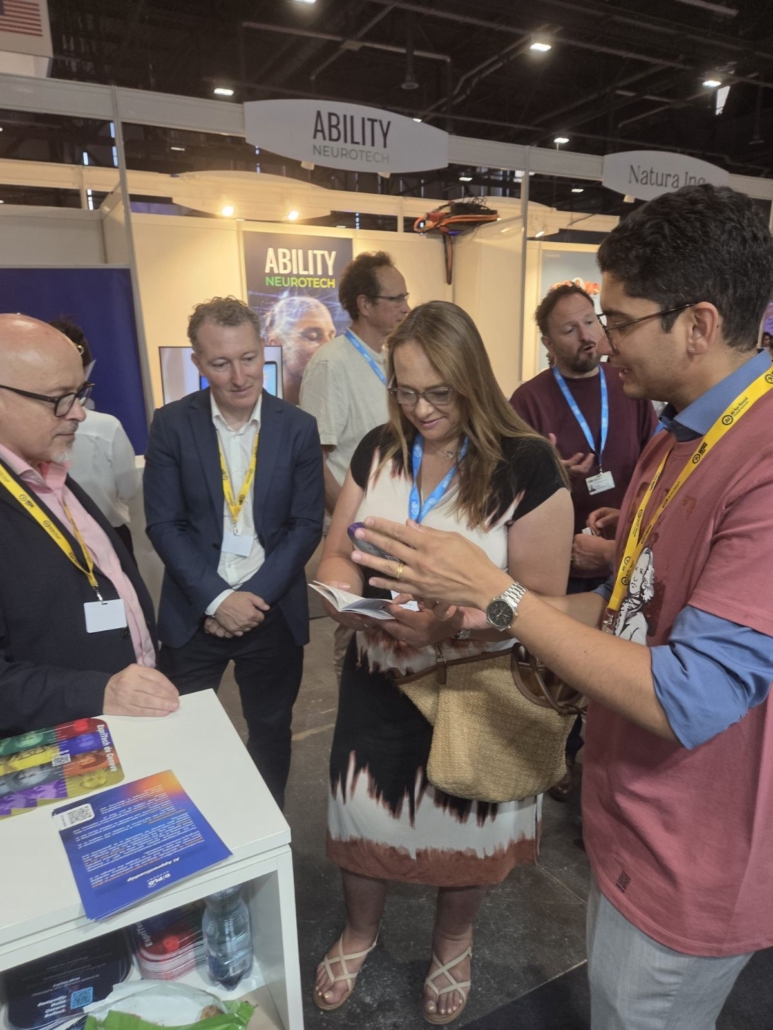
Diplo and the GIP were also present at the Canton of Geneva space, showcasing our work on AI technology, policy, governance, and capacity development.
IN OTHER NEWS LAST WEEK
AI governance
The UN. UN Secretary-General António Guterres used the inaugural Global Dialogue on AI Governance in Geneva to call for global AI rules that are inclusive, safe and worthy of public trust. The discussions placed AI’s opportunities, risks, divides and human rights implications at the centre of the UN agenda, while the Independent International Scientific Panel on AI warned that scientific understanding and governance capacity are struggling to keep pace with rapid advances in AI capabilities.
Spain. Spain called for a UN-backed coalition to protect children from AI-related risks, warning that minors face growing exposure to synthetic content, manipulation, exploitation and harmful design features. The proposal, supported by France, the EU and Kenya, aims to bring governments, companies, civil society and international organisations together around stronger safeguards for children in the AI era.
Japan. Japan announced plans to establish a new AI council to drive national AI adoption and coordinate policy across government, industry and society. The initiative is expected to support AI use in public administration, healthcare, education and other sectors, while also addressing demographic pressures, workforce shortages and the need to review legal frameworks as AI becomes more widely deployed.
Portugal. Portugal launched AMALIA, its first open AI language model for European Portuguese, as part of a wider effort to strengthen linguistic and digital sovereignty. The model is designed to support public services, education, research and business use cases, while helping ensure that Portuguese-language users are not dependent only on systems trained primarily on larger global languages.
Germany. Germany launched an Agentic AI Hub for public administration, aiming to explore how autonomous and semi-autonomous AI systems could support government services. The initiative reflects growing interest in using AI agents to improve administrative efficiency, but also raises questions about oversight, accountability, procurement and the limits of automation in public decision-making.
European Commission launches AI cyber defence strategy
The European Commission presented an Action Plan on Cybersecurity and Artificial Intelligence to strengthen Europe’s response to AI-related cyber risks. The plan aims to help member states, businesses and public authorities use AI safely while addressing the risks created by advanced AI models.
The Commission said AI can help detect vulnerabilities, prevent cyberattacks and protect critical infrastructure. It also warned that malicious actors can use AI to automate attacks, identify weaknesses and carry out cyber operations at greater speed and scale.
The strategy focuses on the safe use of advanced AI, stronger EU cyber resilience and Europe’s AI capabilities for cybersecurity. The Commission will work with ENISA on a European Blueprint for secure access to advanced AI systems for cybersecurity purposes. A secure testing platform will support critical sectors, including energy, transport, health, finance, and public administration, while an EU Grand Challenge on AI for cybersecurity will support new AI-powered cybersecurity solutions.
Chinese AI models narrow the gap with US systems
Chinese AI models are moving closer to leading US systems in coding, reasoning and agent-based tasks, according to an analysis by the Center for Strategic and International Studies. CSIS said recent releases from Z.ai, Moonshot, DeepSeek and Alibaba-backed Qwen show that China’s rapid AI progress was not limited to DeepSeek-R1, but reflects a broader pattern of technical catch-up.
The analysis argues that Chinese models are now only months, rather than years, behind US frontier systems in several practical areas. It identifies knowledge distillation, open-weight research communities and efficiency-driven engineering as key factors behind this progress, while US chip export controls have pushed Chinese labs towards more efficient training and inference strategies.
Why does it matter? AI competition is no longer only about which country has the strongest frontier model. Chinese open-weight models are becoming capable, affordable and easier to deploy through third-party hosts or local infrastructure, which could shape global adoption among governments, startups and developers that cannot afford or do not want to depend entirely on US closed-model providers.
Europol denies bypassing EU data protection rules
Europol rejected allegations that it operated a ‘secret’ or ‘shadow’ database outside the EU data protection rules, saying recent reports misrepresented two long-established operational environments used to support digital investigations and online information analysis.
The agency said its Computer Forensic Network is used to analyse complex digital evidence securely. At the same time, its Internet-Facing Operational Environment collects and triages publicly available online information before relevant material is moved into Europol’s operational systems.
The dispute highlights the tension between law enforcement’s need to process large volumes of digital evidence and the privacy safeguards required under EU law. It also shows why transparency about investigative infrastructure matters for public trust, especially as law enforcement agencies modernise their data-processing capabilities for cybercrime, terrorism and serious organised crime investigations.
Illinois adopts AI safety law
Illinois Governor JB Pritzker signed the Artificial Intelligence Safety Measures Act, introducing new transparency and accountability requirements for large AI developers. The law requires qualifying developers to create risk mitigation frameworks, report potential large-scale harms and undergo annual independent third-party audits.
Why does it matter? The law shows how US states are moving ahead on AI safety in the absence of a comprehensive federal framework. By requiring independent audits, Illinois is pushing AI governance beyond company self-reporting and towards external verification. The approach could add pressure for national standards, but it may also deepen regulatory fragmentation if states continue to develop different AI safety rules.
Australia’s child social media ban faces enforcement delay
Australian Prime Minister Anthony Albanese criticised senators for delaying amendments to the country’s under-16 social media ban, after the proposal was referred to an eight-week Senate inquiry. The amendments would expand the powers of the eSafety Commissioner by allowing her to request documents, not only information, from platforms and third-party age-verification providers.
Why does it matter? The delay shows that child online safety rules increasingly depend on enforcement design, not only headline bans. Australia has moved further than many countries in restricting children’s access to major platforms. However, regulators still need evidence, platform cooperation and workable age-assurance mechanisms to turn legal obligations into practical protection.
LOOKING AHEAD


The first substantive session of the Global Mechanism on developments in the field of ICTs in the context of international security and advancing responsible State behaviour in the use of…


READING CORNER

Geneva’s centuries-old traditions of dialogue, inclusion, and compromise continue to offer valuable guidance for governing AI, as explored in a Diplo interview with Executive Director Jovan Kurbalija.

Digital resilience becomes increasingly important following Claude Fable 5 and its security implications.
DON’T MISS

Follow the road to the 2027 Geneva AI Summit, a global journey shaping AI’s future. Bookmark the page and register for updates to stay informed and involved every step of the way to Geneva 2027.