
UN chief urges global rules for AI governance
Guterres called for an AI Child Safety Pledge to protect children from unregulated systems.
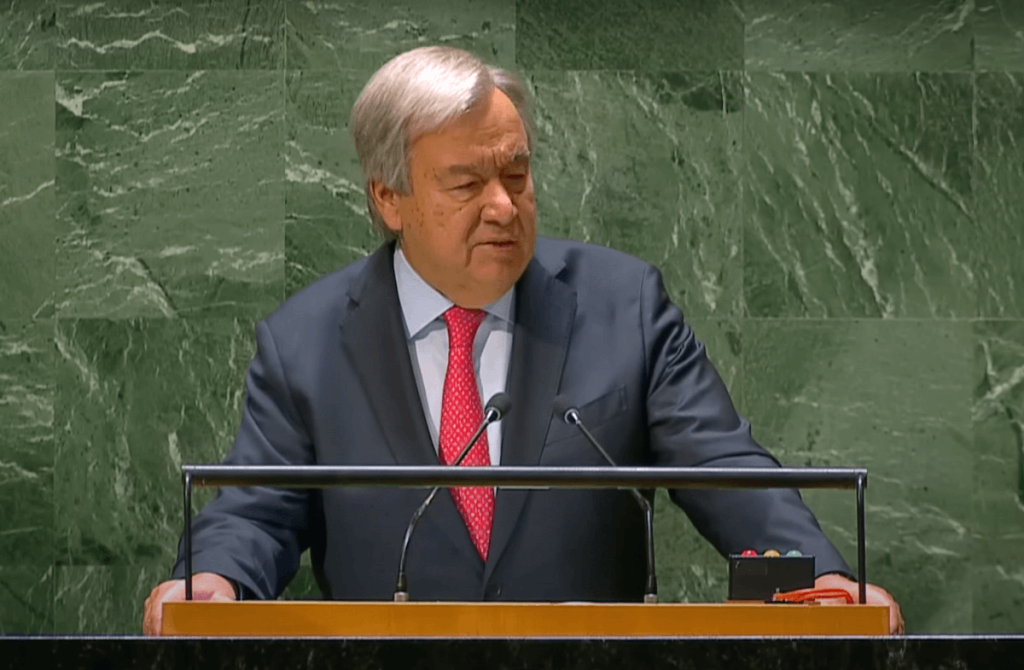
UN Secretary-General António Guterres has urged governments, companies and civil society to move faster on global AI governance, warning that the technology is already reshaping economies, security and human rights. Speaking at the inaugural UN Global Dialogue on AI Governance in Geneva, he said any future agreement must be ‘worthy of global trust’ and place safety at its centre.
Guterres said AI ‘sits at the heart of our common future’, but stressed that humans must remain responsible for critical decisions. In high-risk areas such as justice, healthcare and policing, he warned that ‘machines can inform, but humans must decide, and answer’.
He also said that AI rules must be aligned internationally, adding: ‘When countries align on how to test systems, measure risk and assign responsibility, safety travels with the technology.’ Without such alignment, he warned, ‘a patchwork of incompatible rules raises costs, divides the world – and protects no one.’
Children’s safety was presented as a central concern. Guterres called for an AI Child Safety Pledge, saying: ‘No child should be a guinea pig for unregulated AI…We do not let medicine reach a child until it is proven safe. We test every toy; yet AI has reached our children – their learning, their friendships, their most private questions, before anyone asked what it would do to them.’
Track all key moments from the WSIS Forum 2026 on our dedicated WSIS page.
He also said that when a child shows signs of distress, ‘the system must stop and connect them to real human support’, and added: ‘When a child is harmed, the answer must never be “the algorithm did it,”’.
The UN chief also warned that unequal access to AI could deepen global divides. Used well and shared widely, he said, AI ‘could compress decades of development into years’ and become ‘the great equalizer of the 21st century’. However, he cautioned: ‘We cannot allow the digital divide to harden into an AI divide and the AI divide to become a development gap, a security gap, and a sovereignty gap.’
Environmental impact was another major focus. Guterres called on major AI companies to disclose the carbon, water and land footprint of their systems and to power all data centres with renewable energy by 2030. ‘AI may feel intangible – but its footprint is not,’ he said, warning that data centres already consume more electricity than most countries and could soon place even greater pressure on power and water systems.
Would you like to learn more about AI, tech and digital diplomacy? If so, ask our Diplo chatbot!