
Europe’s AI future increasingly depends on electricity and power infrastructure
AI infrastructure growth is reshaping Europe’s energy and industrial priorities.
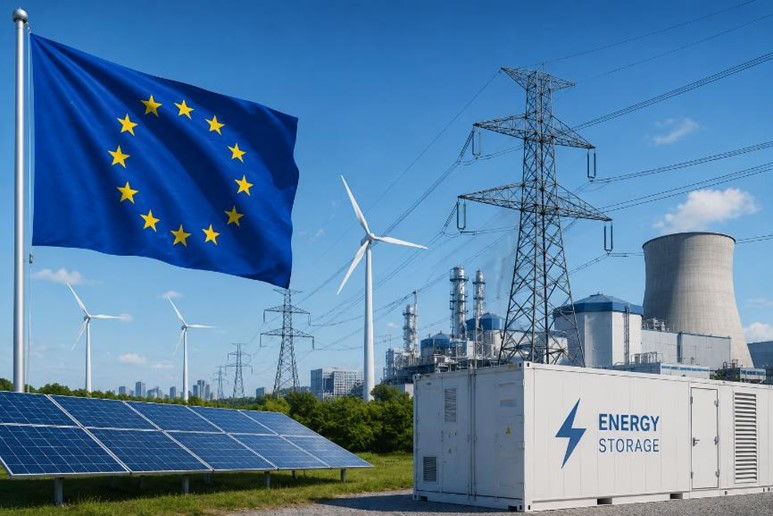
A new opinion piece published by the World Economic Forum argues that the global AI race is rapidly shifting from software and models towards electricity generation, power infrastructure, and compute capacity.
The analysis by Lucy Yu, CEO for Centre for Net Zero, suggests that Europe’s future competitiveness in AI may depend less on research talent and more on whether the region can deliver clean and reliable energy fast enough to support expanding AI infrastructure.
The article highlights how the US and China continue to dominate the global AI ecosystem through massive investments in data centres, cloud infrastructure, and semiconductor capacity. Europe, meanwhile, faces growing concerns over digital dependence, particularly because US hyperscalers control most of the European cloud market while China maintains a leading position in AI patent filings and industrial deployment.
One of the central concerns involves the speed of infrastructure deployment. Grid connection timelines in some European markets can reportedly stretch close to a decade, while energy prices remain significantly higher than in the USA.
Such delays are already affecting investment decisions, with some operators reportedly bypassing congested electricity networks through direct links to gas-fired power plants, despite Europe’s broader net-zero objectives.
One more argument is that Europe’s challenge is not necessarily a shortage of renewable energy resources, but rather the inability to coordinate energy generation, electricity demand, and infrastructure deployment efficiently.
Offshore wind in the North Sea, southern European solar generation, and Scandinavian hydropower are identified as major strategic assets that remain underutilised because of fragmented infrastructure planning.
Large-scale data centres may help stabilise electricity systems by creating predictable demand patterns capable of improving grid utilisation and spreading infrastructure costs across greater consumption volumes.
Flexible AI data centres, battery systems, distributed energy resources, and AI-powered energy management systems are presented as possible solutions capable of reducing network strain and supporting cleaner electricity integration.
Lucy Yu’s analysis concludes that Europe still has an opportunity to compete in the next phase of AI development, but warns that the window is narrowing quickly. Without faster regulatory coordination, grid modernisation, and energy infrastructure reform, AI investment could increasingly shift towards regions capable of delivering power and compute capacity more rapidly.
Why does it matter?
The debate reflects a major structural shift in the global AI economy. Instead of competing only on algorithms and talent, countries are increasingly competing on access to electricity, semiconductor infrastructure, and data centre capacity. Decisions taken during the next few years could determine whether Europe becomes a major AI infrastructure hub or remains dependent on foreign cloud providers and external compute ecosystems.
Would you like to learn more about AI, tech and digital diplomacy? If so, ask our Diplo chatbot!