
UN member states adopt WSIS+20 outcome document
Adopted at the UN General Assembly, the WSIS+20 outcome document makes the Internet Governance Forum permanent and reinforces commitments to close persistent digital divides.
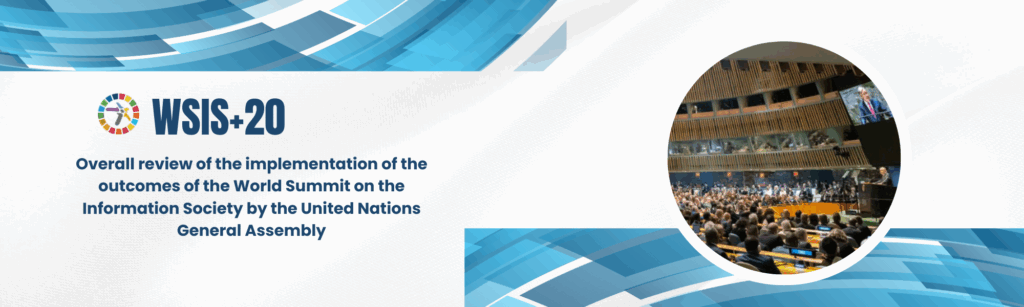
The WSIS+20 review process – dedicated to reviewing progress made in the implementation of outcomes of the World Summit on the Information Society, 20 years after their adoption – finalised in New York, with the adoption of an outcome document at the end of a dedicated high-level meeting of the General Assembly. Following several months of consultations and negotiations, the document takes stock of progress made towards the WSIS vision of a people-centred, inclusive, and development-oriented information society, while identifying areas where further efforts and strengthened cooperation remain necessary.
The outcome document contains several provisions on the WSIS architecture, reaffirming existing mechanisms and introducing some adjustments aimed at strengthening implementation, coherence, and follow-up. One significant decision made as part of the WSIS+20 process concerns the Internet Governance Forum (IGF). Established in 2005 with a time-bound mandate that was renewed in 2010 and 2015, the IGF is now made a permanent forum of the United Nations. This decision reflects broad support among member states and was widely welcomed by non-governmental stakeholders as well.
In addition to making the IGF permanent, the outcome document introduces several measures intended to enhance its functioning and impact. The IGF is called upon to improve its work modalities and to broaden participation, particularly by governments and stakeholders from developing countries and underrepresented communities. It is invited to reinforce intersessional work, strengthen support for national and regional IGF initiatives, and apply innovative, inclusive, transparent, and agile collaboration methods.
The document also calls for the strengthening of the IGF Secretariat and requests the Secretary-General to submit a proposal to the General Assembly to ensure sustainable funding for the Forum. The IGF is further requested to report annually on progress to the Commission on Science and Technology for Development (CSTD) and to report its outcomes to relevant UN entities and processes, with a call for the UN Group on the Information Society (UNGIS), action line facilitators, the WSIS Forum, and other relevant bodies to take IGF outcomes into account in their work.
One interesting point negotiated among member states concerned the establishment of a governmental segment at the IGF. Some member states viewed this track as an important element towards fostering more dialogue among governments on digital governance issues (for some, it was also a response to the call for enhanced cooperation in the Tunis Agenda).
Others were concerned that such a segment would shift away from the IGF’s multistakeholder nature (despite the fact that the IGF, at the moment, has dedicated tracks for various groups such as parliamentarians). The final text is meant to be a compromise: The Forum is called upon to work on ‘establishing and facilitating a dialogue among Governments with the participation of all stakeholders’.
Beyond the IGF, member states agreed that the WSIS Forum should continue to be held on an annual basis and invited the UNGIS to enhance its agility, efficiency, and effectiveness, as well as to expand its membership.
Additional provisions aim to strengthen coherence across UN digital processes. Action line facilitators are requested to develop targeted implementation roadmaps linking WSIS action lines with relevant Sustainable Development Goal targets and Global Digital Compact (GDC) commitments. Furthermore, UNGIS is requested to prepare a joint implementation roadmap to strengthen coherence between WSIS and the GDC, to be presented to CSTD in 2026. The Secretary-General is requested to submit a biennial report on WSIS implementation progress, to be considered by CSTD and ECOSOC, and the General Assembly is requested to convene a further high-level review of WSIS outcomes in 2035.
Throughout the WSIS+20 process, many discussions focused on the interplay between WSIS and GDC processes and the need to avoid duplication and enhance synergies. This is recognised in the outcome document, and several provisions – in particular those related to the implementation roadmaps, coupled with other elements describing roles for the UN Secretary-General, CSTD, the Economic and Social Council, and the General Assembly – offer important pathways in this regard. Moving forward, the key will be in how these provisions are implemented.
Substantively, the outcome document places the closure of digital divides at the core of the WSIS+20 agenda. It addresses multiple and intersecting dimensions of digital exclusion, including accessibility and equal access, inclusion of people in vulnerable situations and those in underserved, rural, and remote areas, affordability and quality of connectivity, multilingualism, cultural diversity, and the commitment to connect all schools to the Internet. The document emphasises that digital inclusion requires more than connectivity alone and must be supported by skills development, enabling environments, and respect for human rights.
The document also underscores the importance of fostering an open, fair, and non-discriminatory environment for digital development, including in the context of the digital economy. It highlights the need for predictable and transparent policy, legal, and regulatory frameworks, calls for technical assistance and technology transfer to developing countries on mutually agreed terms, and reiterates the call for states to refrain from unilateral economic measures not in line with international law. Environmental sustainability is also covered, with commitments to leverage digital technologies for sustainability while addressing energy use, critical mineral resources, e-waste management, and the development of international standards for sustainable digital products.
Human rights and ethical considerations are reaffirmed as foundational to the information society. The outcome document reiterates that the same rights apply online and offline, commits to safeguards to prevent and address adverse human rights impacts of digital technologies, and calls on the private sector to respect human rights throughout the technology lifecycle. It addresses concerns related to violence, hate speech, discrimination, misinformation and disinformation, cyberbullying, and child sexual exploitation and abuse, while emphasising information integrity, media freedom, privacy, freedom of expression, and the need to refrain from internet shutdowns and unlawful surveillance practices.
Capacity development and financing are treated as enablers of implementation. The document highlights the need to strengthen digital skills, policy and technical expertise, and institutional capacity, including in relation to emerging technologies such as AI. It invites the International Telecommunication Union – as Secretariat of UNGIS, and working with WSIS Action Line facilitators and other group members – to establish an internal task force to assess gaps and challenges in financial mechanisms for digital development and to report recommendations to CSTD in 2027.
It also calls on the Inter-Agency Working Group on Artificial Intelligence to map existing UN capacity-building initiatives, identify gaps, and address them, including through the establishment of an AI capacity-building fellowship for government officials and research programmes. These elements were subject to substantive discussions during the negotiations, with some members supporting them as important for building more capacities in AI, and others expressing concerns over potential duplication with existing work.
The outcome document reinforces the importance of monitoring and measurement, requesting a systematic review of existing ICT indicators and methodologies; the Partnership on Measuring ICT for Development is requested to conduct this review, in cooperation with action line facilitators and with the support of the Statistical Commission, and to report to CSTD in 2027. Finally, the document reaffirms the role of CSTD, ECOSOC, and the General Assembly in overall WSIS follow-up and review.
Read more: