
RightsX Summit 2025: Governing technology through human rights
Human rights are no longer abstract ideals but living principles shaping how AI, data, and digital governance influence everyday life, power structures, and the future of human dignity in an increasingly technological world.

Human Rights Day takes place on 10 December each year to commemorate the Universal Declaration of Human Rights (UDHR), adopted by the UN in 1948. It functions as a reminder of shared international commitments to dignity, equality and freedom, and seeks to reaffirm the relevance of these principles to contemporary challenges.
In 2025, the theme ‘Human Rights: Our Everyday Essentials’ aimed to reconnect people with how rights shape daily life, emphasising that rights remain both positive and practical foundations for individual and collective well-being.

Human Rights Day also serves as a moment for reflection and action. In a world shaped by rapid technological change, geopolitical instability and social inequalities, the day encourages institutions, governments and civil society to coordinate on priorities that respond to contemporary threats and opportunities.
In this context, the RightsX Summit was strategically scheduled. By centring discussions on human rights, technology, data and innovation around Human Rights Day, the event reinforced that digital governance issues are central to rights protection in the twenty-first century. The alignment elevated technology from a technical topic to a political and ethical concern within human rights debates.
The RightsX Summit 2025

The summit brought together governments, the UN system, civil society, private sector partners and innovators to explore how technology can advance human rights in the digital age. Its aim was to produce practical insights, solution-focused dialogues and discussions that could inform a future human rights toolbox shaped by technology, data, foresight and partnerships.
Central themes included AI, data governance, predictive analytics, digital security, privacy and other emerging technologies. Discussions analysed how these tools can be responsibly used to anticipate risks, improve monitoring, and support evidence-based decision-making in complex rights contexts.
The summit also examined the challenge of aligning technological deployment with internationally recognised human rights norms, exploring the mechanisms by which innovation can reinforce equity, justice and accountability in digital governance.
The summit emphasised that technological innovation is inseparable from global leadership in human rights. Aligning emerging tools with established norms was highlighted as critical to ensure that digital systems do not exacerbate existing inequalities or create new risks.
Stakeholders were encouraged to consider not only technical capabilities but also the broader social, legal and ethical frameworks within which technology operates.
The 30x30x30 Campaign
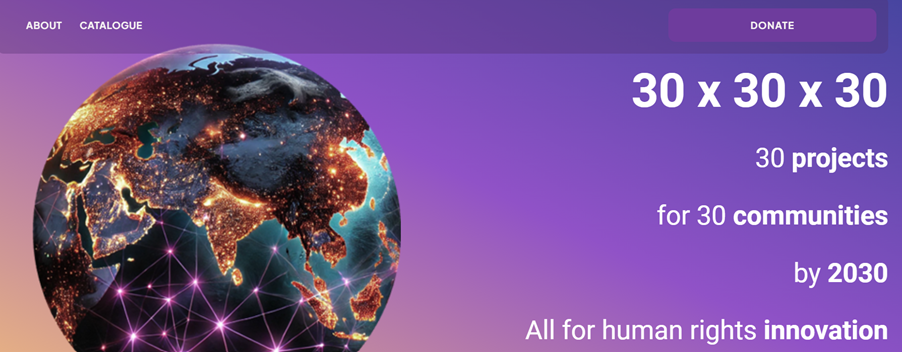
The 30x30x30 initiative represents an ambitious attempt to operationalise human rights through innovation. Its objective is to deliver 30 human rights innovations for 30 communities by 2030, aligned with the 30 articles of the UDHR.
The campaign emphasises multistakeholder collaboration by uniting countries, companies and communities as co-creators of solutions that are both technologically robust and socially sensitive. A distinctive feature of 30x30x30 is its focus on scalable, real-world tools that address complex rights challenges.
Examples include AI-based platforms for real-time monitoring, disaster tracking systems, digital storytelling tools and technologies for cyber peace. These tools are intended to serve both institutional responders and local communities, demonstrating how technology can amplify human agency in rights contexts.
The campaign also highlights the interdependence of innovation and human rights. Traditional approaches alone cannot address multidimensional crises such as climate displacement, conflict, or systemic inequality, and innovation without human-rights grounding risks reinforcing existing disparities.
‘Innovation is Political’

Volker Türk, UN High Commissioner for Human Rights, emphasised that ‘innovation is political’. He noted that the development and deployment of technology shape who benefits and how, and that decisions regarding access, governance and application of technological tools carry significant implications for equity, justice and human dignity.
This framing highlights the importance of integrating human rights considerations into innovation policy. By situating human rights at the centre of technological development, the summit promoted governance approaches that ensure innovation contributes positively to societal outcomes.
It encouraged multistakeholder responsibility, including governments, companies and civil society, to guide technology in ways that respect and advance human rights.
Human Rights Data Exchange (HRDx)
HRDx is a proposed global platform intended to improve the ethical management of human rights data. It focuses on creating systems where information is governed responsibly, ensuring that privacy, security and protection of personal data are central to its operation.
The platform underlines that managing data is not only a technical issue but also a matter of governance and ethics. By prioritising transparency, accountability and data protection, it aims to provide a framework that supports the responsible use of information without compromising human rights.
Through these principles, HRDx highlights the importance of embedding ethical oversight into technological tools. Its success relies on maintaining the balance between utilising data to inform decision-making and upholding the rights and dignity of individuals. That approach ensures that technology can contribute to human rights protection while adhering to rigorous ethical standards.
Trustworthy AI in human rights

AI offers significant opportunities to enhance human rights monitoring and protection. For example, AI can help to analyse large datasets to detect trends, anticipate crises, and identify violations of fundamental freedoms. Predictive analytics can support human rights foresight, enabling early interventions to prevent conflicts, trafficking, or discrimination.
At the same time, trust in AI for decision-making remains a significant challenge. AI systems trained on biassed or unrepresentative data can produce discriminatory outcomes, undermine privacy and erode public trust.
These risks are especially acute in applications where algorithmic decisions affect access to services or determine individual liberties. That requires governance frameworks that ensure transparency, accountability and ethical oversight.
In the human rights context, trustworthy AI means designing systems that are explainable, auditable and accountable. Human oversight remains essential, particularly in decisions with serious implications for individuals’ rights.
The Summit highlighted the importance of integrating human rights principles such as non-discrimination, equality and procedural fairness into AI development and deployment processes.
Ethics, Accountability and Governance

Aligning technology with human rights necessitates robust ethical frameworks, effective governance, and transparent accountability. Digital systems must uphold fairness, transparency, inclusivity, and human dignity throughout their lifecycle, from design to deployment and ongoing operation.
Human rights impact assessments at the design stage help identify potential risks and guide responsible development. Engaging users and affected communities ensures technologies meet real needs.
Continuous monitoring and audits maintain compliance with ethical standards and highlight areas for improvement.
Effective governance ensures responsibilities are clearly defined, decisions are transparent, and corrective actions can be taken when rights are compromised. By combining ethical principles with robust governance and accountability, technology can actively protect and support human rights.
Future pathways for rights-centred innovation

The integration of human rights into technology represents a long-term project. Establishing frameworks that embed accountability, transparency and ethical oversight ensures that emerging tools enhance freedom, equality and justice.
Digital transformation, when guided by human rights, creates opportunities to address complex challenges. RightsX 2025 demonstrated that innovation, governance and ethical foresight can converge to shape a digital ecosystem that safeguards human dignity while fostering progress.
Would you like to learn more about AI, tech, and digital diplomacy? If so, ask our Diplo chatbot!
About author

Reyhan Dalaman
Reyhan Dalaman is based in Geneva and works at the United Nations Office of the High Commissioner for Human Rights (OHCHR) and the United Nations Development Programme (UNDP). She is interested in using data, AI, and technology to make information more useful and to support research and global initiatives.