
China calls for greater self-reliance in science and technology
Scientific innovation becomes central to China’s long term economic competitiveness and AI ambitions.
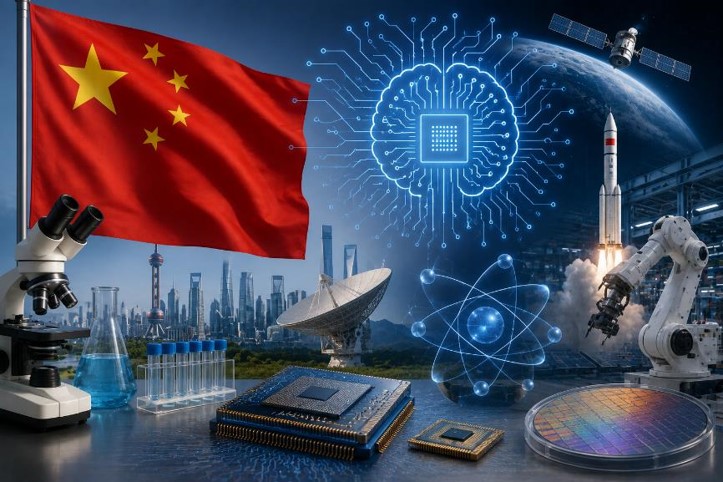
Chinese President Xi Jinping has called for faster progress towards high-level scientific and technological self-reliance, arguing that innovation should become the primary driver of China’s modernisation.
Speaking at the national science and technology conference in Beijing, Xi described the 2026–2030 period as critical to achieving China’s goal of becoming a global science and technology leader by 2035.
Xi highlighted China’s recent advances in AI, quantum technology, advanced manufacturing, robotics, pharmaceuticals and space exploration. At the same time, he acknowledged persistent challenges, including gaps in original innovation, inefficient research investment and shortages of high-quality scientific talent.
He called for stronger coordination of national research priorities, greater support for technology transfer, improved intellectual property protection and a financial system better aligned with scientific and technological innovation.
Xi also emphasised the importance of frontier technologies, calling for greater investment in AI, quantum technologies, life sciences, integrated circuits, and strategic areas including deep-sea, deep-space and deep-earth exploration.
He argued that scientific research should become more application-oriented while industry should play a greater role in scientific discovery, strengthening links between research institutions and commercial innovation.
Alongside investment, Xi stressed that technological development must remain secure, ethical and people-centred. He called for stronger governance of AI and other emerging technologies, clearer ethical standards, improved security risk monitoring and greater support for young scientific talent.
China also honoured 258 scientific projects and researchers during the conference, underscoring the country’s continued emphasis on innovation as a strategic national priority.
Why does it matter?
The speech reinforces China’s long term strategy of reducing dependence on foreign technologies while accelerating domestic innovation in critical fields such as AI, semiconductors and quantum computing. It also illustrates how Beijing increasingly views scientific leadership as a foundation of economic competitiveness, national security and geopolitical influence.
By linking research policy, industrial development and AI governance, China is pursuing a coordinated model in which technological innovation is treated as a strategic state priority. That approach is likely to shape global competition in emerging technologies as countries race to build sovereign capabilities in frontier sectors.
Would you like to learn more about AI, tech and digital diplomacy? If so, ask our Diplo chatbot!