


27 March – 3 April 2026
HIGHLIGHT OF THE WEEK
UN kicks off Global Mechanism on ICT security, road ahead murky
After almost three decades of stop-start cybersecurity negotiations at the UN, the long-anticipated Global Mechanism on ICT security has finally kicked off.
It is the first permanent forum of its kind since discussions on ICT security began back in 1998, and its mere existence says a lot about how far those talks have come.
But if the launch felt like a breakthrough, the organisational session quickly brought things back down to earth. Beyond what was already sketched out in Annex C and the OEWG’s Final Report, it remained unclear how the mechanism would actually function in practice.
When the member states agreed to establish the Global Mechanism in July 2025, they also envisioned that the mechanism would meet in plenary and have dedicated thematic groups (DTGs). These groups are intended to enable more in-depth discussions and build on the outcomes of the plenary. The practicalities of how the dedicated thematic groups should be set up and administered were hotly contested at the organisational session, as they will influence what gets on the agenda, who drives it, and whether this new system can deliver real outcomes over time. No decision was made in any of these matters.
A long-standing point of contention and possibly the most politically-charged was the role of non-governmental actors in the groups. Is it a possibility rather than a standard feature? Does inviting external briefers require member-state agreement on a case-by-case basis? How this is resolved will directly determine the degree of access the private sector, technical community, and civil society organisations have to the DTG process in practice.
The mechanism inherited many unresolved substantive debates from its predecessors. On international law, there is widespread agreement that considerable work remains to be done, but little agreement on how to carry it out. A broad majority of states expressed support for ensuring that the mechanism remains action-oriented, with a strong focus on practicality and the implementation of agreed frameworks on international law, norms, CBMs, and capacity-building. Many delegations, primarily from developing countries, urged the Global Mechanism to prioritise the operationalisation of the UN Voluntary Fund, which was tabled but left unresolved by the OEWG.
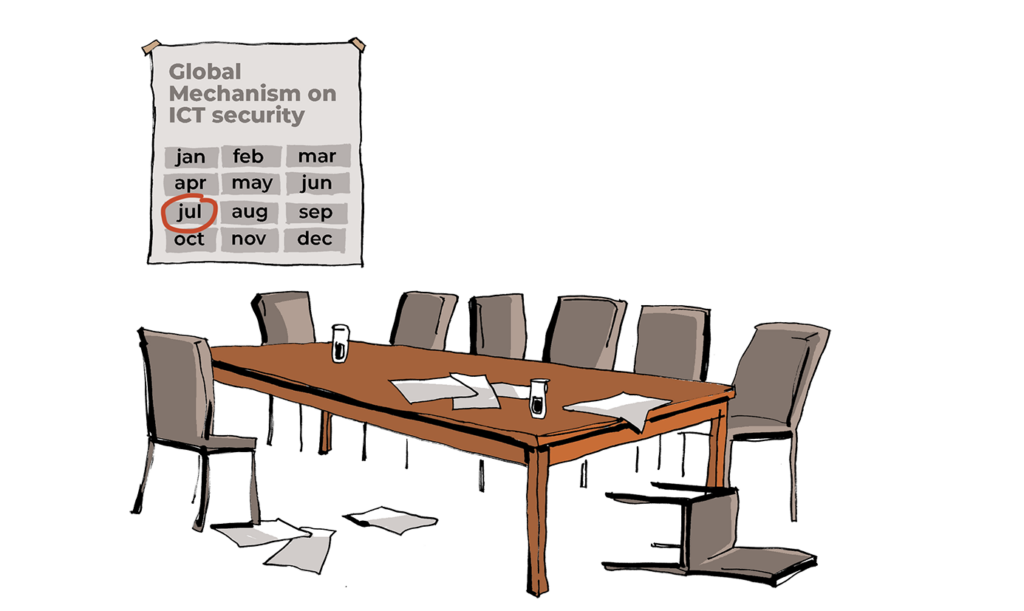
What now? The session closed without resolution on any of its most consequential questions. The Chair will convene informal intersessional consultations to resolve outstanding issues before July, when the mechanism will hold its first substantive session, during which it is expected to discuss substantive matters.
We’ll be monitoring the process closely on our dedicated Digital Watch Observatory web page.epresent isolated outcomes or the beginning of a broader legal shift.
IN OTHER NEWS LAST WEEK
Anthropic scores a temporary win against the US government
A California judge has temporarily blocked the US government from enforcing the ‘supply chain risk’ designation against Anthropic, finding that the company’s actions do not meet the legal definition under Section 3252 of the Title 10 United States Code.
That law defines a supply chain risk as the potential for an adversary to sabotage, maliciously interfere with, or subvert a covered system—covert acts, not public or negotiated positions. The court rejected the notion that questioning or resisting contract terms automatically makes a vendor an adversary.
The ruling emphasises procedural requirements: even when Section 3252 allows bypassing standard debarment processes, the government must document risk assessments, consult relevant agencies, and consider less restrictive alternatives. The court found these safeguards were likely ignored in Anthropic’s case.
Additionally, the judge noted that the designation appeared to be influenced by Anthropic’s public statements and its refusal to support certain government AI uses, raising First Amendment concerns. Anthropic was likely denied due process, receiving neither adequate notice nor a meaningful chance to respond before facing substantial economic and reputational consequences.
The court also found that Anthropic demonstrated irreparable harm, including immediate loss of contracts, damaged business relationships, and reputational impact, supporting the temporary block on the government’s enforcement of the designation.
The Court questioned whether the scope of the government’s special national security authorities was appropriate in these circumstances, emphasising that such powers are generally intended for clear and serious risks.
The verdict, for now. Anthropic’s request for a preliminary injunction in this lawsuit against the administration was granted. The injunction does not resolve the case on the merits; it temporarily stops the contested measures.
What happens next? The administration has appealed, and the appellate court, the US Court of Appeals for the Ninth Circuit, will ultimately decide on the matter. However, a final verdict in this case could be months away.
Meanwhile, the government is also facing another lawsuit from Anthropic, filed in Washington, D.C. In that case, the company is challenging its supply chain designation before a three-judge panel at the D.C. Circuit Court of Appeals, specifically contesting the legal authority invoked under the Federal Acquisition Supply Chain Security Act (FASCA).
Why does it matter? The case highlights broader issues regarding the limits of federal power over private technology companies and the protection of constitutional rights, with potential implications for future government interactions with the tech industry.
Iran issues warning to major US tech firms
Iran’s Revolutionary Guard has issued a statement warning that major US technology companies, including Apple, Google, Meta, Intel, Oracle and Nvidia, could face retaliatory action if further Iranian leaders are killed in targeted assassinations.
‘These companies, starting from 8:00 pm (1630 GMT) Tehran time on Wednesday, April 1, should expect the destruction of their relevant units in exchange for every assassination in Iran.’
The group alleges that these firms are the ‘main element in designing and tracking assassination targets.’
Iran also claimed to have conducted drone strikes against communications and industrial sites in Israel.
Reining in social media for minors as trust in platforms erodes
The first country to introduce a social media ban for minors is now assessing how that ban is working. Early results released by Australia’s eSafety Commissioner show significant action by platforms to prevent users under 16 from holding accounts, but also ongoing challenges in fully enforcing the restrictions. By mid-December 2025, around 4.7 million accounts were removed or restricted, with more than 300,000 additional accounts blocked by March 2026. Despite these reductions, many children continue to retain accounts, create new ones, or pass age assurance checks. Regulators identified several compliance concerns, including platforms that allow repeated attempts at age verification and encourage some users to update their ages. Reporting systems for underage accounts were often difficult to access, particularly for parents.
Indonesia is also checking on progress: its social media restrictions for under-16s went into effect last week, and already Meta and Google have been found non-compliant. Indonesia’s Communication and Digital Minister noted that the two companies were summoned on Monday to undergo checks. Failure to implement the curbs, the ministry has noted, may result in sanctions or even a block on the platform in the country.
Australia’s social media ban for minors has inspired many countries to follow suit. One of them is France, which is moving toward restricting social media use for children under 15, as its Senate approved a plan that differs from an earlier, stricter version passed by the National Assembly. While the National Assembly has backed a strict approach, requiring platforms to delete existing accounts and block new under-15 users, the Senate has proposed a more flexible, two-tier system that would limit only harmful platforms and allow access to others with parental consent. The two versions must now be reconciled, meaning the final shape of the law remains uncertain. Key questions—particularly around how age verification will work—are still unresolved and tied to ongoing EU-level discussions, pushing any real implementation to at least 2027.
The MP that introduced the bill warned that this is a matter of public health, noting that ‘When similar questions arose with products like alcohol or tobacco, we collectively chose to prohibit them, because we considered them public health issues.’
Austria’s government also announced plans to ban under-14s from using social media. The government plans to present a draft law by the end of June. ‘We will no longer stand by as these platforms make our children addicted and, in many cases, ill,’ the Vice Chancellor noted.
After a US jury found Meta and YouTube liable in a social media addiction case, the concept of ‘social media addiction’ is likely to gain more legal and policy traction. In Italy, senators have introduced a draft law that directly targets the role of platforms in shaping user behaviour, proposing limits on default profiling and greater transparency around how algorithms curate content. Backed by the opposition Democratic Party, the proposal shifts responsibility toward platform design itself, arguing that recommendation systems are not neutral tools but deliberate corporate choices with real-world consequences.
It’s therefore unsurprising that a new survey in Switzerland revealed a widespread mistrust of big tech, with a large majority of respondents viewing these companies as primarily profit-driven. Concerns range from the impact on children and growing dependence on foreign tech firms to fears about the broader effects of digitalisation on democracy.
Deadlock at WTO: Moratorium lapse meets plurilateral momentum
At the 14th Ministerial Conference of the World Trade Organization (MC14) in Yaoundé, Cameroon, digital trade dominated the agenda through two parallel tracks—each pointing in a different direction and illustrating both the limits and evolution of the multilateral system.
The moratorium on customs duties on electronic transmissions. The long-standing moratorium—renewed every two years since 1998—expired on 31 March after members failed to reach consensus on the length of a new extension, with differing views among members preventing a deal.
Some members, including the USA, pushed for a longer-term solution, while others, led during the talks by Brazil, favoured shorter renewals to preserve regulatory flexibility in light of rapid technological change, including AI and 3D printing.
In parallel, however, a different dynamic unfolded. A coalition of 66 WTO members announced they would move forward with implementing the plurilateral Agreement on Electronic Commerce concluded in 2024 by the Joint Statement Initiative on e-commerce (JSI), through interim arrangements.
Why does it matter? The lapse does not automatically trigger tariffs, but it creates policy space for countries to impose them. The outcome also meant that a broader set of discussions on WTO reform, which had been politically linked to the approval of the moratorium, remained unresolved.
What’s next for e-commerce discussions? Discussions on the moratorium, the WTO reform, and the future of the Work Programme on e-commerce (WPEC) are expected to continue at the next General Council meeting in May in Geneva. In the meantime, JSI members will continue to seek inclusion of the Agreement under the WTO legal architecture.
For a deeper understanding of MC14 outcomes and implications, join the 14 April webinar ‘WTO deadlock, AI boom: Unpacking MC14 and looking ahead’ co-organised by Diplo, the Digital Trade and Data Governance Hub, and the Geneva Internet Platform. Registrations for the event are open.
China launches World Data Organization
The World Data Organization (WDO) was formally established in Beijing, presenting itself as the first international, non-governmental platform dedicated specifically to global data development and governance.
Conceived as a multistakeholder forum, the organisation aims to facilitate dialogue, rule-making, and cooperation, with a stated focus on bridging the global data divide, unlocking the value of data, and supporting the digital economy.
Its inaugural assembly adopted the organisation’s charter, appointed leadership, and set out priorities around capacity building, regulatory exchange, and technological collaboration.
Why does it matter? There is currently no single global body exclusively dedicated to data governance as a whole—covering economic value, governance rules, development, security, and cross-border flows in an integrated manner. The emergence of the World Data Organization (WDO) is significant because it seeks to occupy that space, positioning itself as a dedicated platform for data governance coordination.
At the same time, it reflects broader geopolitical dynamics: China is not only participating in rule-making but actively building platforms that could influence how digital governance evolves, particularly for developing countries seeking alternatives or complements to existing frameworks.
LAST WEEK IN GENEVA

Last Monday and Tuesday (30 and 31 March), ITU held a two-day workshop on ‘Trustable and Interoperable Digital Identities for Human and Agentic AI’ in Geneva. It brought together stakeholders from governments, industry, academia, and standards bodies to examine technical approaches related to trust frameworks, trust management, security, and interoperability; and to investigate actionable recommendations and consolidated insights to advance standardisation work in the field.
The 2026 Global Digital Economy Conference held its Geneva branch event on Tuesday (31 March), gathering political leaders, business executives, and academics to discuss the development of the global digital economy under the theme ‘Digital Intelligence Without Boundaries: Friendship and Win-Win.’ The event featured high-level dialogues, the launch of the Geneva Office of the Global Digital Economy City Alliance, industry insights on China-Europe cooperation, and targeted networking to foster partnerships.
The Inter-Parliamentary Union (IPU) hosted a webinar on ‘Building AI Literacy in Parliaments‘ on Wednesday, (1 April), to explore how parliaments can develop training and resources to support AI literacy among members, parliamentary staff, and IT teams. The webinar highlighted the IPU Guidelines for AI in parliaments, emphasising that AI literacy should reach all roles within parliaments.
To prepare for the 2027 Geneva AI Summit, the Swiss Government invited ICT4Peace to organise and host a launch event at GenAI Zürich yesterday (2 April). The event brought together 40 participants from government, business, academia, and civil society to begin shaping the Summit’s objectives and exploring potential concrete outcomes. Participants discussed a set of guiding questions to shape the focus and outcomes of the 2027 summit. These included identifying areas where international dialogue and cooperation are needed, defining potential political and practical outcomes, and exploring Switzerland’s strengths in facilitating multistakeholder engagement. The discussions also addressed identifying potential partners, resolving areas of disagreement around specific policy objectives, and developing concrete tools and solutions to present as Swiss contributions at the summit.
READING CORNER
Beijing hosted the founding assembly of the first international organisation dedicated specifically to data governance and development.

As diplomacy migrates from the deliberate silence of morning cables to the relentless vertical scroll of TikTok, explore the new privatisation of statecraft.