
UN kicks off Global Mechanism on ICT security, road ahead murky
The long-awaited Global Mechanism has finally launched, creating the UN’s first permanent forum on ICT security—but its inaugural session left many questions about how it will actually work. Here’s why it matters and what to watch as the Mechanism takes shape.
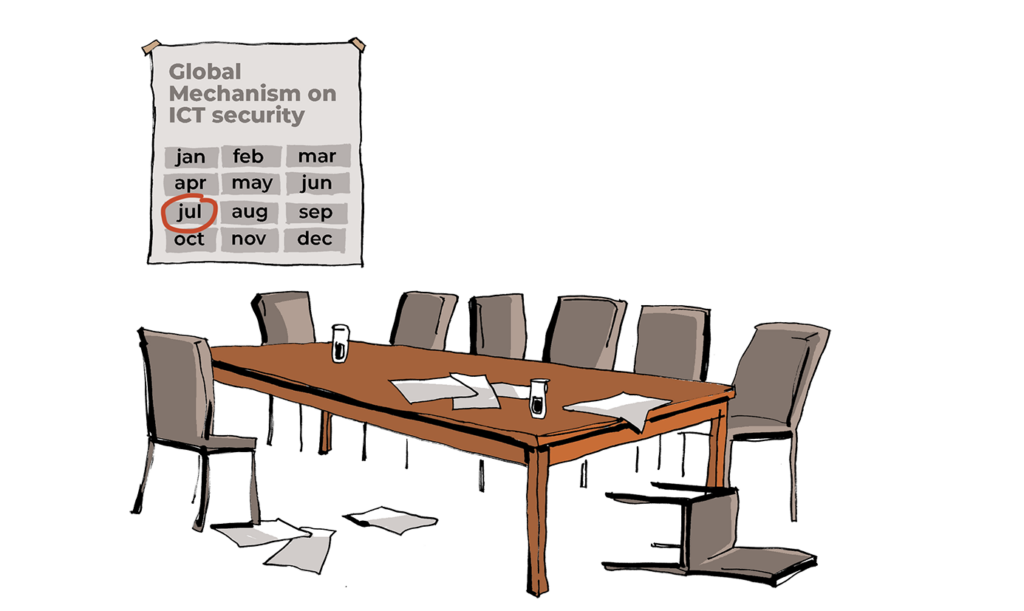
After almost three decades of stop-start cybersecurity negotiations at the UN, the long-anticipated Global Mechanism on ICT security has finally kicked off.
It is the first permanent forum of its kind since discussions on ICT security began back in 1998, and its mere existence says a lot about how far those talks have come.
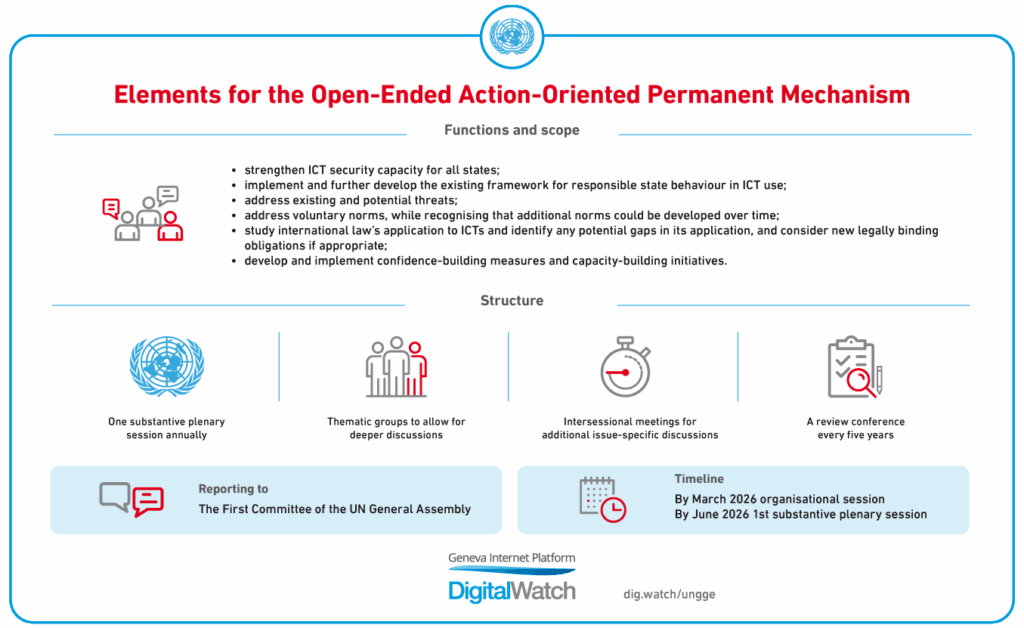
But if the launch felt like a breakthrough, the organisational session quickly brought things back down to earth. Beyond what was already sketched out in Annex C and the OEWG’s Final Report, it remained unclear how the Mechanism would actually organise itself in practice.
The session raised plenty of questions—about structure, priorities, and process—but offered few real answers, leaving the sense that while the Mechanism now exists, what it will do and how it will do it is still very much up for grabs.
A new body, a new mandate, and a newly elected Chair, Egriselda López of El Salvador, injected renewed optimism into the Global Mechanism’s first organisational session. Yet, within minutes, it became evident that the Global Mechanism did not start with a blank slate, but rather inherited the OEWG’s long list of disagreements.
Russia opened the discussion by disputing the legitimacy of the Chair nomination, which they claimed was guided solely by the UNODA and thus limited state participation in the process. They used this opportunity to stress that all decisions under the new process must be based on consensus and be completely intergovernmental.
The substantive issues on the agenda
For the provisional agenda of the mechanism’s July session, the Chair circulated a draft agenda organised around the five pillars of the framework for responsible state behaviour in the use of ICTs. However, Iran and Russia argued that the wording of agenda item 5 did not precisely reflect paragraph 9 of Annex C of the OEWG final report and called for correction at this session. The EU and Canada rejected this, arguing the draft already referenced all relevant documents and that isolating one paragraph would itself constitute renegotiation. The USA reserved its position entirely, preferring that the July plenary adopt its own agenda. No consensus was reached, and the Chair will continue consultations before July.
The mechanism inherited many unresolved substantive debates from its predecessors.
On international law, there is widespread agreement that considerable work remains to be done, but little agreement on how to carry it out. The majority of delegations have shown clear support for strengthening the existing normative framework and reaffirming the UN Charter’s application to cyberspace.
A broad majority of states expressed support for ensuring that the mechanism remains action-oriented, with a strong focus on practicality and the implementation of agreed frameworks on international law, norms, CBMs, and capacity-building (Chile, Nauru, Portugal, Switzerland, the United Kingdom, Estonia, Italy, Australia, the Democratic Republic of the Congo, Antigua and Barbuda, Sudan, Vanuatu, Albania, Vietnam, India, Greece, Rwanda, the Dominican Republic, North Macedonia, Kiribati).
In particular, some delegations advocated for applying the framework to concrete scenarios as a way to stimulate implementation (Japan, the Netherlands, the United Kingdom, Sudan). China was the only delegation to emphasise that further development of the framework is equally important alongside its implementation.
The EU highlighted the norm checklist, a hotly debated issue in the previous mechanism, as an area for further improvement.
However, to many states, a fundamental concern remains. Capacity building initiatives risk stalling without reliable funding, so many delegations, primarily from developing countries, urged the Global Mechanism to prioritise the operationalisation of the UN Voluntary Fund, which was tabled but left unresolved by the OEWG.
Dedicated thematic groups: Who, what and how
The often broad agenda and long-winded statements of delegations in OEWG plenary sessions left little room for technical depth, leaving many delegations frustrated with the gap between consensus language and concrete action.
The Dedicated thematic groups (DGTs) were created to address this issue precisely by setting up an informal, technical forum to advance practical initiatives already agreed on, such as the Global ICT Security Cooperation and Capacity Building Portal. However, the practicalities on how they should be set up and administered are going to be hotly contested as it will influence what gets on the agenda, who drives it, and whether this new system is capable of delivering real outcomes over time.
Who will lead DTGs?
The dominant and most contested question of the session was who would appoint the co-facilitators for the two Dedicated Thematic Groups. The Chair proposed appointing two co-facilitators per DTG: one from a developed country, one from a developing country, drawing on GA practice, under which the Chair appoints co-facilitators for intergovernmental processes. She indicated her intention to hold broad informal consultations before making appointments, and committed to geographic balance, gender parity where practicable, and relevant technical expertise as selection criteria.
Who ends up in these roles matters considerably: the co-facilitators will steer the DTG discussions, shape their agendas, and channel recommendations to the plenary.
A broad coalition of states supported the Chair’s approach, including the EU, speaking on behalf of its member states and several aligned countries such as France, Germany, Australia, the United Kingdom, the Netherlands, Switzerland, Japan, Egypt, Senegal, Nigeria, Malaysia, Moldova, and others. Egypt and Senegal were among the most direct, noting that delays in operationalising the mechanism would waste the intersessional period and erode its credibility, particularly for developing countries eager to move from procedure to substance.
Another group of states, led by Russia and supported by Iran, China, Belarus, Nicaragua, and Cuba, argued that co-facilitator appointments must be approved by member states by consensus rather than made unilaterally by the Chair. Russia contended that DTG co-facilitators handle substantive political matters and therefore constitute officials whose appointment requires a collective agreement. Russia also raised a geographic argument: assigning one developed-country and one developing-country co-facilitator per DTG still disproportionately favours developed states, which represent less than one-fifth of UN membership. Iran added that the early OEWG draft text had explicitly authorised the Chair to appoint DTG facilitators, but that this provision was deliberately removed during negotiations, signalling a lack of agreement on the matter.
The Chair affirmed her intention to consult all member states informally before presenting candidates and called on delegations to show flexibility given the urgency of getting the mechanism’s work underway. Russia subsequently stated its understanding that candidates would be determined through broad consultation, followed by consensus-based approval, but the Chair neither confirmed nor rejected this interpretation.
The question is effectively deferred to the intersessional period, meaning the composition of the DTG leadership teams remains unresolved and will require continued diplomatic engagement before July.
What will DTGs discuss?
A closely related debate concerned who decides what the DTGs will actually discuss. Several Western and like-minded delegations (e.g., Germany, France, Canada, the United Kingdom, and Australia) highlighted that it is a prerogative of the Chair and co-facilitators, to be exercised in close consultation with states. These delegations proposed ransomware and critical infrastructure protection as natural starting points, citing their frequency across national statements and OEWG discussions.
Iran and Russia emphasised that topics must be determined by consensus among all member states. Argentina argued that the plenary should maintain control over the agenda rather than ceding too much responsibility to the co-facilitators.
Morocco instead advocated a bottom-up model in which DTGs define their own priority subtopics from the start, based on member states’ expressed preferences to maintain regional balance and ownership.
In this sense, the DTGs’ credibility hinges on a delicate balance, having to be ambitious enough to move conversations into action but also focused enough on issues with broad support so that their outputs survive in plenary.
No decision was taken. For industry and civil society organisations with specific thematic priorities, this remains an active opening: states are currently receptive to input on which topics the DTGs should prioritise.
Colombia put forward a process proposal that drew broadly positive reactions across delegations. It recommended that:
- DTG mandates be time-limited with clearly defined and measurable outputs;
- DTG 1 addresses specific rotating subjects rather than its entire mandate simultaneously, and
- DTG outputs systematically distinguish between recommendations on which consensus exists and those still under development.
Senegal made a complementary point: reports should document both areas of agreement and divergence, preserving a record of discussions even when no consensus was reached. Both proposals reflect a wider concern that, without structured outputs and clear timelines, the mechanism risks reproducing the open-ended deliberation of the OEWG without generating implementable results.
How will DTGs feed into the plenary?
Another issue discussed was how DGT work feeds into plenary work. Brazil made it clear that without a defined protocol for elevating DTG reports to the plenary and formally accepting their recommendations, the groups risk becoming talking shops that are disconnected from the mechanism’s official conclusions. Their proposed solution, which still has to achieve support, is to keep DGT conversations primarily informal but include a short formal section for decision-making.
Stakeholder participation
A long-standing point of contention and possibly the most politically-charged was the role of non-governmental actors in the groups. The effective participation of interested stakeholders remains uncertain.
Some delegations adopted a more accommodating stance, recognising that stakeholders can enhance the quality of deliberations (Sudan, Antigua and Barbuda) and contribute to more practical outcomes (Vietnam, Dominican Republic), while underscoring the importance of preserving the intergovernmental nature of the process (Sudan, Vietnam).
Canada and like-minded states argued that the July 2025 consensus clearly provides for states to nominate experts for DTG briefings and for the wider stakeholder community to participate throughout DTG discussions.
Iran contested this, asserting that stakeholder modalities agreed for the mechanism apply equally to DTGs. Russia also argued that expert briefings from external stakeholders are a possibility rather than a standard feature, and that inviting external briefers requires member-state agreement on a case-by-case basis.
How this is resolved will directly determine the degree of access the private sector, technical community, and civil society organisations have to the DTG process in practice.
What’s next?
The session closed without resolution on its two most consequential questions: co-facilitator appointments and the provisional plenary agenda. The Chair will convene informal intersessional consultations on both and issue a programme of work document before July in all UN languages.
The Secretariat will open an annual stakeholder accreditation window in the coming weeks; stakeholders wishing to participate in plenary sessions and review conferences can monitor the Digital Watch Observatory web page, where we track the process, for details.
The broader tension remains unresolved, and how it is managed in the intersessional period will largely determine whether the July plenary can open with the mechanism’s operational foundations in place.
The Chair also confirmed the two key dates for 2026:
- the substantive plenary session scheduled for 20-24 July, and
- the DTG meetings scheduled for 7-11 December, both at UN Headquarters in New York
For stakeholders tracking or seeking to contribute to these discussions, these are the dates to plan around.
About author

DW Team
The GIP Digital Watch Observatory team, consisting of over 30 digital policy experts from around the world, excels in the fields of research and analysis on digital policy issues. The team is backed by the creative prowess of Creative Lab Diplo and the technical expertise of the Diplo tech team.