
UN Global Mechanism on ICT security shifts focus to implementing international law in cyberspace
The UN’s permanent cyber mechanism focused on the practical application of international law in cyberspace, with member states broadly prioritising implementation, legal capacity building, and scenario-based discussions over negotiating new legal obligations.
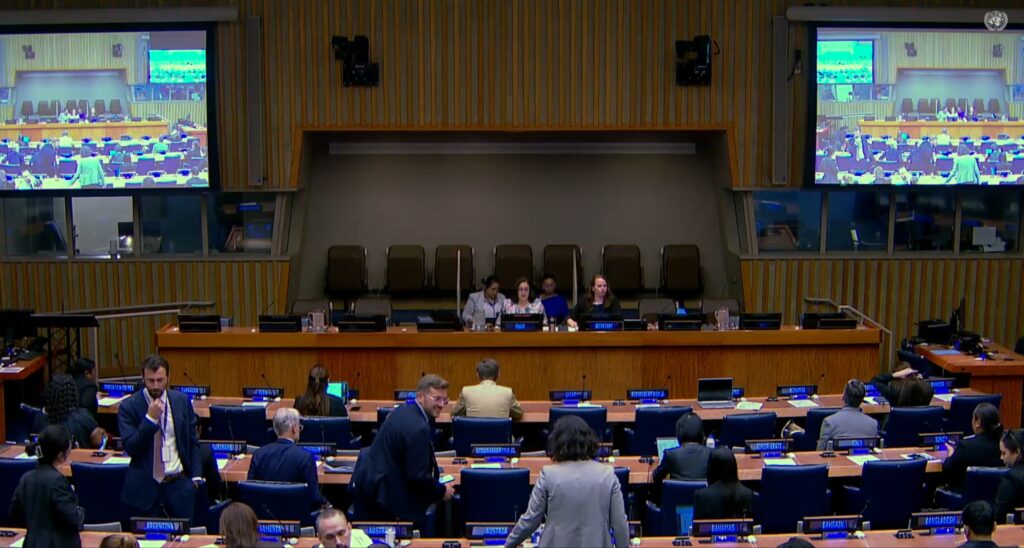
The UN’s permanent cyber mechanism continued its substantive work by focusing on how international law should be applied in cyberspace, with member states broadly agreeing that the priority is no longer whether international law applies, but how to translate that consensus into practical implementation.
During the fifth substantive plenary session of the Global Mechanism on Developments in the Field of ICTs in the Context of International Security, delegations reaffirmed that international law, including the UN Charter, applies to state conduct in cyberspace. Discussions instead centred on deepening common understanding through scenario-based exchanges, legal capacity development, and practical implementation within the mechanism’s Dedicated Thematic Groups (DTGs).
While some states continued to advocate for new legally binding international instruments, the prevailing view was that the immediate priority should be strengthening the implementation of the existing legal framework and helping all countries participate meaningfully in its development.
From legal principle to practical application
A broad cross-regional coalition led by Switzerland argued that the mechanism should focus on clarifying how international law applies in practice rather than revisiting questions already settled through previous UN processes.
The group identified five priority areas for future discussions, such as sovereignty and non-intervention, state responsibility and due diligence, the prohibition of the use of force and self-defence, international humanitarian law (IHL), and international human rights law. It also encouraged scenario-based discussions examining issues such as cyber operations targeting hospitals, water systems, and energy infrastructure.
The Pacific Islands Forum, represented by Tonga, similarly reaffirmed that international law applies to cyberspace while stressing that legal capacity development should become a cross-cutting priority before discussions turn to new legally binding obligations. The Forum proposed regional workshops, peer exchanges, expert briefings, and practical exercises to help states develop national legal positions.
Practical implementation takes centre stage
The European Union, Australia and several cross-regional coalitions argued that the mechanism should build on the work already undertaken through successive UN Groups of Governmental Experts (GGEs) and Open-ended Working Groups (OEWGs).
Delegations highlighted the growing number of national and regional statements explaining how countries interpret the application of international law in cyberspace, describing these as important confidence-building measures that improve transparency and reduce the risk of misunderstanding.
Many speakers also identified the DTGs as the most appropriate venue for examining practical legal questions through realistic case studies, expert briefings, and exchanges of national experience.
Legal capacity emerges as a central issue
One of the session’s strongest themes was the need to ensure that all states can participate effectively in discussions on international law.
Kiribati offered a particularly candid account of the resource constraints facing many small developing countries, explaining that international law represents their principal means of protection despite having limited legal and technical capacity.
The delegation argued that legal capacity building is not a secondary issue but a prerequisite for meaningful participation, advocating practical, scenario-based exercises to help governments translate legal principles into operational understanding.
This emphasis was echoed by the African Group, Mauritius, Malawi, Singapore, Botswana, Vanuatu, and many other delegations, which called for tailored capacity-building programmes, regional cooperation, and support for the development of national positions on international law.
International humanitarian law remains an important focus
The applicability of international humanitarian law to cyber operations featured prominently throughout the debate.
Numerous delegations argued that recognising IHL in cyberspace does not legitimise cyberwarfare or militarise cyberspace, but instead ensures that civilians and protected infrastructure continue to benefit from established legal protections during armed conflict.
Several countries nevertheless argued that cyberspace presents unique legal challenges requiring greater caution or the future development of additional international rules, reflecting one of the principal areas of continuing disagreement.
Diverging views on future legal instruments
Although there was broad agreement on the applicability of international law, member states remained divided over whether additional legally binding instruments were needed.
Russia, China, Iran, Cuba, and Venezuela argued that the distinctive characteristics of cyberspace justify the development of new international legal frameworks alongside existing commitments. By contrast, a larger group of states, including the European Union, the Pacific Islands Forum, the Republic of Korea, Canada, Ireland, France, and New Zealand, maintained that existing international law provides an adequate foundation, with efforts better directed towards improving common understanding and implementation.
Despite these differences, the discussion revealed broad convergence around the practical direction of the Global Mechanism. Delegations consistently supported greater transparency through national legal positions, stronger legal capacity development, and scenario-based discussions that enable governments to apply international law to real-world cyber incidents.
As the session concluded, the Chair confirmed that discussions on international law would continue before the mechanism moved to its next agenda item on confidence-building measures.
Track all key moments from the First substantive session of the UN Global Mechanism on cybersecurity on our dedicated page.
Would you like to learn more about AI, tech and digital diplomacy? If so, ask our Diplo chatbot!