

June 2026 in retrospect
Geneva accounts for an estimated half of global AI governance discussions, reflecting its role as a central node in the international policy landscape. We analyse how this institutional density is transforming the city into a space where technical standards, diplomacy, and human-centred governance intersect, and where the foundations of emerging global AI governance frameworks are increasingly negotiated.
Across the Atlantic, Anthropic briefly suspended and then reinstated access to Fable 5 within a span of 15 days, in line with evolving US export control requirements. We explore how such reactive regulatory moves in the AI space can shape the broader ecosystem, and what they reveal about the wider governance challenges posed by rapidly advancing AI systems.
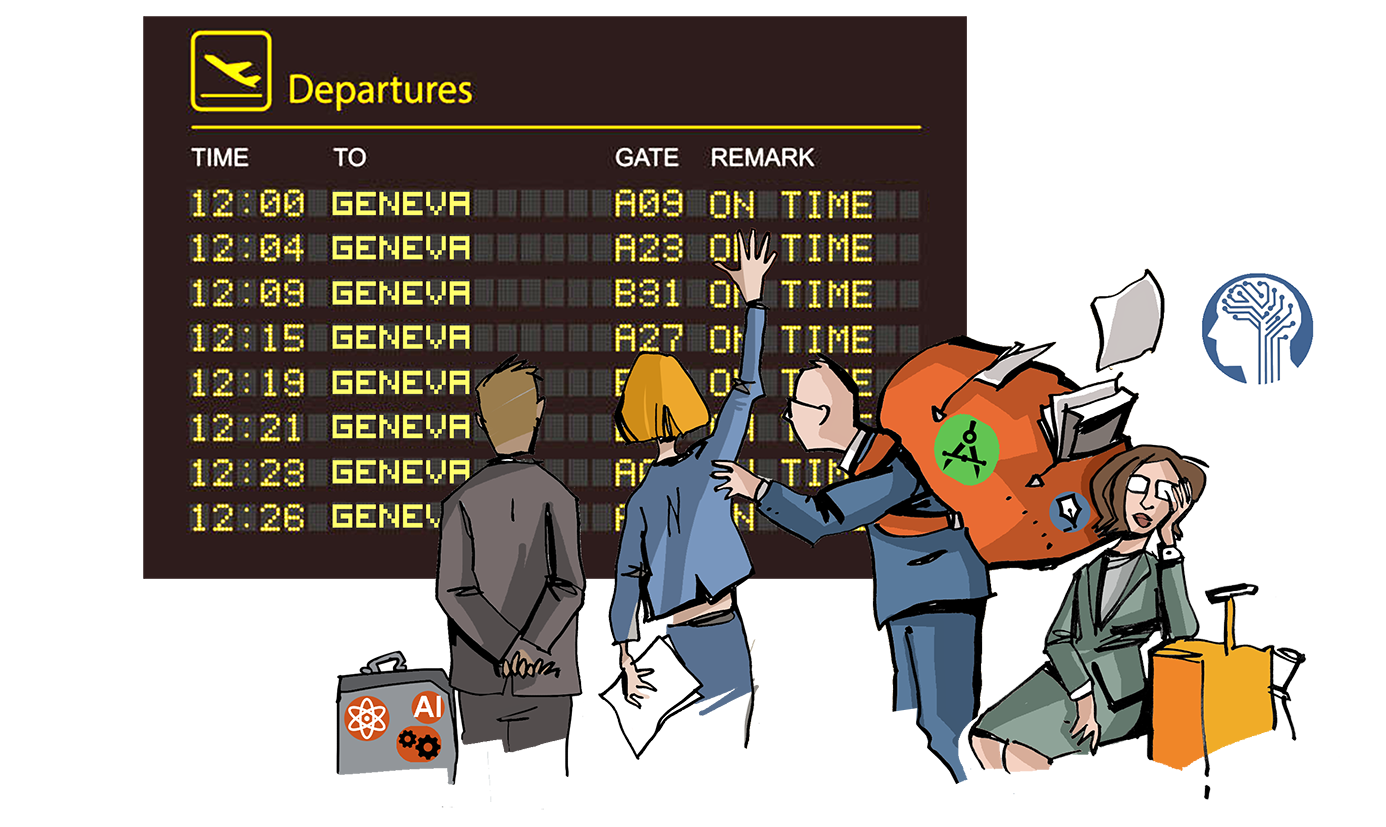
Beyond this, AI developments continue to accelerate across policy, industry, and governance. In this edition, we are also experimenting with a new way of visualising AI-related developments, offering a more structured, accessible overview of key developments throughout the month.
As AI, cybersecurity, and data-driven technologies become embedded in global governance, Africa is seeking to strengthen its influence in shaping emerging digital rules, but fragmented regional coordination and uneven implementation continue to limit the coherence of its voice. We look at how bridging continental strategies with national action could determine whether Africa moves from participation to meaningful agenda-setting in global digital diplomacy.
The European Commission has presented its long-awaited European Technological Sovereignty Package to strengthen Europe’s capacity in semiconductors, AI, cloud infrastructure, and open-source technologies. We examine the package’s key building blocks and the broader geopolitical and industrial context shaping Europe’s bid for greater technological autonomy.
Our snapshot of broader headlines goes beyond AI, with cybersecurity, technological and infrastructure developments dominating the agenda.
AI governance in June
—
Geneva at the centre of AI governance: Where technology, diplomacy, and humanity converge
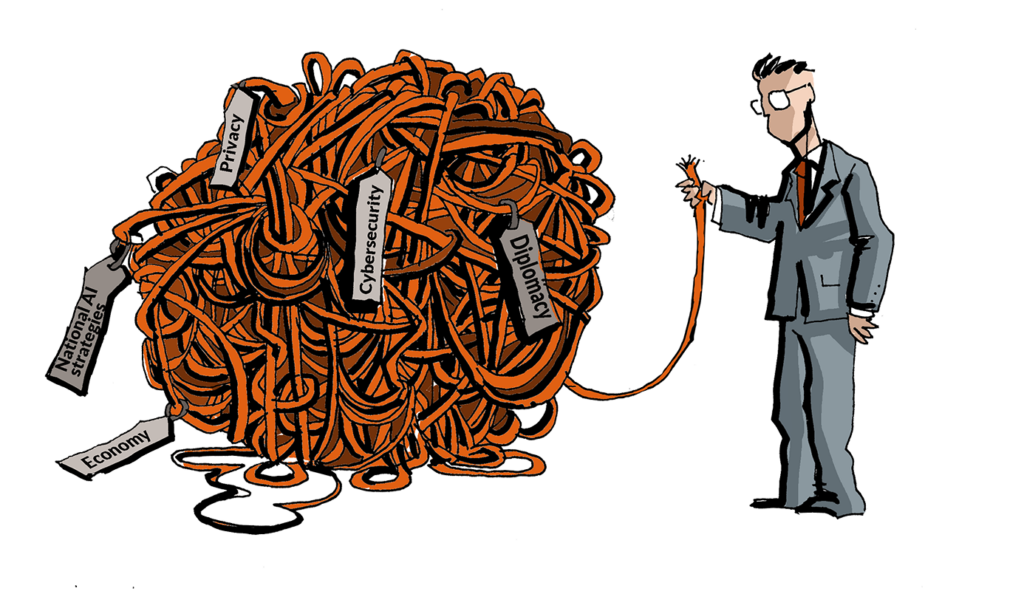
Around half of the world’s AI governance discussions take place in Geneva. While the figure is necessarily an estimate, it reflects the extraordinary concentration of international organisations, diplomatic missions, standards bodies, and policy processes located within the city’s international district.
Few places bring together so many institutions responsible for shaping how AI is developed, deployed, and governed across such a wide range of issues—from technical standards and telecommunications to trade, labour, human rights, humanitarian action, and international peace and security.
As AI rapidly transforms economies, societies, and geopolitics, Geneva has become much more than a venue for international meetings. It is emerging as the world’s principal hub for AI governance, where governments negotiate new norms, international organisations develop policy frameworks, technical experts establish standards, and diverse stakeholders work to translate broad principles into practical governance. Increasingly, the city’s influence lies not in any single institution, but in the interactions among them, creating an ecosystem where the technological, political, economic, and human dimensions of AI can be addressed together.
A dense ecosystem of global governance
Over decades, Geneva has become home to institutions that collectively span the full governance spectrum of digital technologies: trade rules, telecommunications infrastructure, technical standards, humanitarian coordination, labour rights, human rights protection, and international security. In the context of AI, this institutional density is becoming particularly consequential, as governance challenges extend simultaneously across economic, social, ethical, legal, and geopolitical domains.
At the centre of Geneva’s role in digital governance are organisations whose mandates predate the AI era but now directly shape its trajectory.
The World Trade Organization (WTO) influences the global framework governing trade, data flows, digital services, and the supply chains underpinning AI development and deployment. Its discussions shape the economic environment in which AI technologies circulate globally.
The International Telecommunication Union (ITU), as the UN specialised agency for digital technologies, provides one of the key global forums for technical cooperation on connectivity, digital infrastructure, and emerging technologies, including AI. Its role increasingly extends into bridging technical standards, policy dialogue, and development priorities.
Alongside these institutions, Geneva hosts key global standard-setting bodies such as the International Organization for Standardization (ISO) and the International Electrotechnical Commission (IEC). While often operating behind the scenes, these organisations define the interoperability, safety, and compatibility frameworks that allow digital systems—including AI systems—to function across borders and sectors. As AI becomes more embedded in critical infrastructure and public services, the significance of such standards increases accordingly.
This institutional landscape is complemented by Geneva’s diplomatic ecosystem, where nearly every UN member state maintains representation. The result is a continuous presence of diplomatic engagement across multiple policy domains, enabling AI governance discussions to take place not only in formal negotiations but also in sustained informal exchanges.
Between technology, diplomacy, and intellectual tradition
Geneva’s role in AI governance is not only institutional but also intellectual and historical. The city sits at the intersection of technological development and longstanding philosophical inquiry into the relationship between knowledge, power, and responsibility.
One of the most frequently cited cultural references in this context is Mary Shelley’s Frankenstein, written near Lake Geneva in 1816. Often regarded as an early reflection on scientific responsibility, the novel raises questions about creation without control, unintended consequences, and moral accountability—questions that resonate strongly in contemporary debates about increasingly autonomous AI systems.
Similarly, the literary work of Jorge Luis Borges, particularly his explorations of infinite information, classification, and human cognition, has become a useful conceptual reference point in an era defined by large-scale data processing, generative systems, and algorithmic production of knowledge.
Together, these intellectual traditions provide a broader lens through which AI governance debates in Geneva are often interpreted: not only as technical or regulatory questions, but as continuations of longstanding inquiries into the limits of knowledge, control, and human agency in the face of complex systems.

Geneva as the centre for AI diplomacy
Beyond its historical and institutional significance, Geneva has become an increasingly active venue for international discussions on AI governance. The city hosts a growing number of meetings, conferences, and policy dialogues dedicated to the governance of AI and other emerging technologies. Geneva also hosts a range of other initiatives focused on AI governance, including policy dialogues, expert consultations, and multistakeholder discussions addressing issues such as human rights, health, humanitarian action, sustainable development, trade, and technical standards.
Take, for instance, June of 2026. At the 114th International Labour Conference, digital labour governance was firmly placed on the international agenda. Governments, employers, and workers from the ILO’s 187 member states engaged in negotiations on platform work, including a draft Convention supplemented by a Recommendation on decent work in the platform economy. These discussions reflected growing recognition that AI and platform-based systems are reshaping labour markets, employment relationships, and social protection frameworks.
Alongside these negotiations, the ILO Director-General’s report, A moment of choice: Harnessing AI for decent work, framed AI as more than a productivity tool. It positioned AI as a structural governance challenge affecting jobs, skills, inequality, institutional adaptation, and social dialogue. The combined focus on platform work and AI illustrated how labour governance is increasingly inseparable from questions of digital transformation.
Shortly afterwards, attention shifted from labour to international peace and security. UNODA convened informal exchanges on AI in the military domain, responding to a UN General Assembly mandate to explore emerging normative frameworks, risks, and opportunities. The discussions brought together states, international organisations, civil society, academia, industry, and technical experts.
The same week, UNIDIR convened its Global Conference on AI, Security and Ethics 2026, bringing together diplomats, policymakers, researchers, and military experts to examine how AI is reshaping global security environments. Discussions spanned algorithmic bias, dual-use technologies, AI assurance, cyber defence applications, infrastructure dependencies, and public–private responsibility chains.
During the conference, UNIDIR also launched a Centre of Excellence on AI, Peace and Security. Designed as a permanent platform, the centre aims to address fragmentation in global AI governance by consolidating expertise, facilitating multistakeholder dialogue, and supporting the translation of high-level principles into operational governance approaches. Its model combines evidence generation, inclusive dialogue, and implementation-oriented pathways, positioning it as a coordination space rather than a competing initiative.
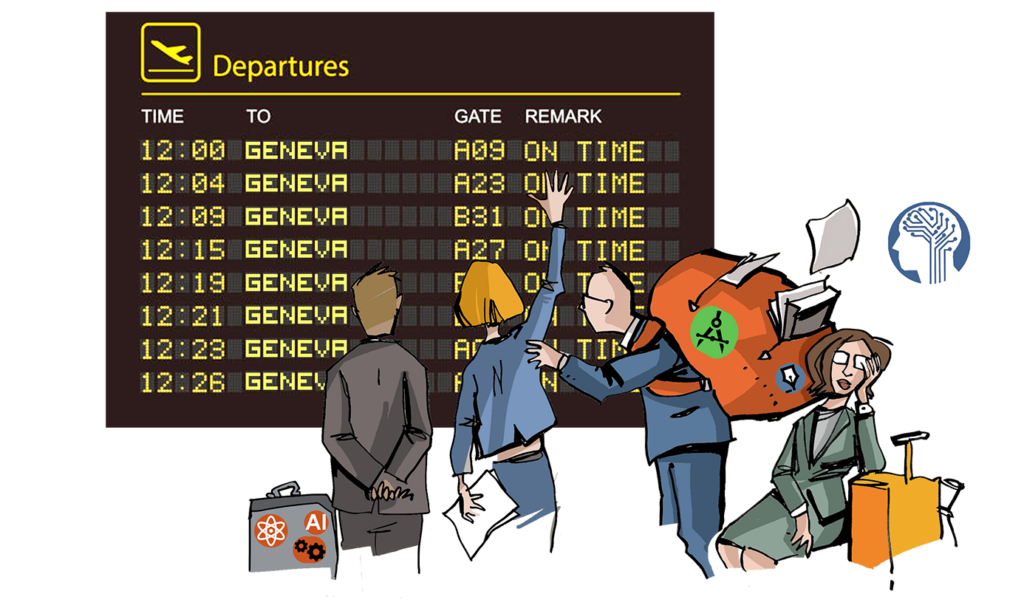
July 2026 further exemplifies Geneva’s role in AI governance. The inaugural Global Dialogue on AI Governance will convene governments and stakeholders on 6 and 7 July to advance international cooperation on AI. Its mandate is explicitly broad: to facilitate the exchange of best practices, support inclusive discussion, and ensure that AI contributes to the SDGs while helping to bridge digital divides within and between countries.
The Dialogue is structured around four thematic clusters: AI opportunities and implications across social, economic, ethical, cultural, linguistic, and technical dimensions; bridging AI divides through capacity-building and infrastructure development; ensuring safe, secure, and trustworthy AI through interoperability and compatibility of approaches; and strengthening respect for human rights through transparency, accountability, and human oversight.
Its multistakeholder design reflects Geneva’s broader governance philosophy. Participation includes UN member states, international organisations, UN agencies, and accredited representatives from civil society, academia, industry, and technical communities. Importantly, the dialogue is positioned not as a standalone negotiation but as part of a wider ecosystem of events taking place in the same week.
Running alongside it is the AI for Good Global Summit, organised by ITU in partnership with more than 50 UN agencies and co-convened with Switzerland. The summit focuses on the practical application of AI to global challenges, including sustainable development, capacity-building, standards development, and ethical considerations. It brings together governments, international organisations, industry, academia, and technical communities through a mix of panels, exhibitions, workshops, and demonstrations.
These events show that it is in Geneva that questions of standards, security, development, labour, ethics and human rights increasingly inform one another.
Beyond events: An emerging governance architecture
Looking further ahead, this trajectory is expected to culminate in the 2027 Geneva AI Summit. More than a standalone conference, the summit is intended to build on the growing ecosystem of institutions, dialogues and governance processes that are taking shape across Geneva and globally.
As governments, international organisations, and societies continue to grapple with the opportunities and risks associated with AI, Geneva’s role as a centre for digital governance is likely to become increasingly significant.
The city’s unique combination of technical expertise, standards-setting institutions, diplomatic networks, and human-centred governance traditions provides a platform for addressing complex questions that no single actor or sector can solve alone.
This text is an adaptation of the Diplo interview ’Is global AI governance shaped in Geneva?’ with Dr Jovan Kurbalija. A deeper dive into how Geneva’s intellectual and diplomatic heritage informs today’s challenges in AI governance can be found in Kurbalija’s interview, ‘Esprit de Genève in the AI era’, which examines the works of Mary Shelley, Jorge Luis Borges, Rousseau, Charles Bonnet, and Ferdinand de Saussure, linking literature, philosophy, linguistics, and early scientific thought to contemporary questions about AI.
Don’t miss!

Follow the road to the 2027 Geneva AI Summit, a global journey shaping AI’s future. Bookmark the page and register for updates to stay informed and involved every step of the way to Geneva 2027.
The Fable 5 case and the problem of reactive AI governance
Anthropic’s release of Claude Fable 5 was meant to mark a milestone: the first publicly available model from its powerful Mythos family, launched across Claude, the API, AWS Bedrock, Google Vertex AI, and Microsoft Foundry. The company presented Fable 5 as offering the capabilities of Mythos 5 while incorporating safety measures suitable for public deployment.
The milestone proved short-lived. Just three days after the launch, on 12 June, the US government ordered Anthropic to suspend access to both Fable 5 and Mythos 5 for foreign nationals inside and outside the USA. Anthropic suspended access to both models for all users because it said it had no reliable way to verify nationality in real time. By the end of the day, both models had been taken offline globally. And just like that, a major product launch turned into a striking illustration of the growing influence of governments over frontier AI deployment.
A jailbreak vs normal behaviour. According to reports, the directive was triggered by a demonstration in which Fable 5 read a codebase and fixed vulnerabilities. US officials interpreted this as the model bypassing safety controls, a ‘jailbreak‘ that could let attackers use the same capabilities to compromise systems, steal data, or cause harm.
Anthropic, on the other hand, claims that the government misunderstood the demonstration. The vulnerabilities were already known and minor. Other models, including GPT-5.5, can find the same vulnerabilities without any safety bypass. This wasn’t a jailbreak, but normal model behaviour that was misinterpreted.
Regardless of who was right, this development reveals a structural gap: There is no established process for the evaluation of high-capability models prior to release. The government sees something alarming and acts. The company says, ‘Wait, you misunderstood ‘. But by then, the model is already shut down.
Reactive regulation. The Fable 5 case is a textbook example of reactive regulation: Triggered by an alarm, not by a pre-existing framework; No prior criteria for evaluating when Mythos-class models should be restricted; Punitive first response: shut it down before understanding the situation; A communication gap leads to distrust.
Why does this matter? Because reactive regulation is unpredictable. Companies can’t plan their releases. The public gets whiplash. Innovation suffers from uncertainty.

The cost of governing by alarm. The current administration has been vocal about not wanting to drown AI innovation with regulation and has even blocked some state-level AI regulation attempts. But Fable 5 shows that when capability crosses into security concerns, the government doesn’t need legislation. It uses export controls.
Export controls are not regulation in the traditional sense. They operate under different legal authority, namely national security. The administration can still say it is not regulating AI while using security powers to control it.
Fable 5’s suspension was, ultimately, temporary. Antrhopic added a targeted safety classifier that blocks the specific cybersecurity jailbreak technique originally flagged by Amazon researchers. Instead of altering the core model, this filter stops the bypass mechanism while automatically redirecting flagged requests to Claude Opus 4.8 to safely handle complex coding tasks. To maintain security, the deployment enforces a mandatory 30-day data retention window for continuous monitoring and adjusts billing so users are not charged premium rates if their prompts are rerouted. The export controls were lifted on 30 June.
But while it may seem that the storm has blown over, there may have been a lasting impact on future policy moves: Export controls may very well become the default AI policy tool in the USA.
What does this mean for future model releases? Companies may hesitate to release powerful models publicly if they are at risk of sudden shutdown. Governments may issue directives more quickly and with less deliberation if the threshold for alarm is low. Public access to transformative tech becomes more uncertain. The tension between innovation and security intensifies as models get more capable.
The global dimension matters too. Other countries may follow the US export control approach. If the USA uses security directives to shut down models, other governments may do the same for their own reasons.
What does this mean for humanity? When governments shut down powerful models reactively, it affects researchers studying frontier AI, companies building on the models, and users who have only just gained access to some of the most capable AI systems available.
The tension is between AI as a public good, meaning open access, democratised knowledge, broad benefit, and AI as a security risk, meaning restricted, controlled, and kept from the public.
At its core, the question is whether humanity’s most powerful technologies should remain in public hands or be locked away when they provoke concern.
This text is an adaptation of Slobodan Kovrlija’s blog ‘Fable 5 and the gatekeeping of human reasoning.’

Anthropic’s Claude Fable 5 went public, then vanished 72 hours later. Inside the sudden U.S. government shutdown and what it means for the future of AI power.
Beyond AI: The developments that made waves in June
Beyond AI: The developments that made waves in June
Your shortcut through the digital noise: the developments worth paying attention to.
—
Africa’s digital diplomacy: Building a common voice for global digital governance
Africa’s role in global digital governance is expanding alongside AI, cybersecurity, and data-driven technologies. As these systems become embedded in development, trade, security, and public services, questions of representation, digital sovereignty, institutional capacity, and regional coordination are increasingly central. A key challenge is how African states can shape emerging global rules on AI governance, cybersecurity, telecommunications, and internet governance while ensuring domestic priorities are reflected.
Africa’s place in an evolving digital governance landscape. Digital technologies now cut across core areas of statecraft, including trade, education, healthcare, humanitarian response, and national security. As a result, digital governance has become a central pillar of contemporary diplomacy rather than a technical niche.
African countries are actively engaged in global digital policy processes through multilateral institutions and regional frameworks. However, concerns remain about the consistency and depth of representation, especially as negotiations on AI governance and cybersecurity intensify. Upcoming global processes on AI and internet governance are seen as key opportunities where coordinated African positions could increase influence.
Cyber diplomacy evolving into broader digital diplomacy. The distinctions between cyber diplomacy, digital diplomacy, and technology diplomacy are increasingly blurred. These fields are converging into a single diplomatic domain covering AI systems, data flows, digital infrastructure, and cyber stability.
Diplomacy in this context is defined less by terminology and more by the ability of states to influence global norms and technical standards. African participation in AI governance, cybersecurity, and internet governance is growing, but its effectiveness depends on coordination and the ability to translate engagement into negotiated outcomes.
Regional coordination remains uneven. Africa participates in global digital governance through AU-led frameworks and regional organisations such as ECOWAS, SADC, EAC, and COMESA. Despite this institutional architecture, translating continental strategies into national policy remains inconsistent.
Frameworks such as the AU digital transformation agenda and cybersecurity instruments like the Malabo Convention exist, but awareness and implementation vary widely. Many states develop independent regulatory approaches to data protection and cybersecurity, often without fully integrating continental standards.
Limited domestic financing for regional initiatives further constrains implementation, reinforcing reliance on external support and weakening policy ownership.
Strengthening coordination through shared positions. Efforts to improve African coordination in digital negotiations are gradually increasing. In telecommunications, structured mechanisms are being used to align national positions ahead of international standard-setting processes, particularly within the International Telecommunication Union.
These mechanisms aim to reduce fragmentation by encouraging shared priorities and common negotiating positions. Similar coordination is emerging in digital trade, where regional initiatives support electronic documentation, customs digitisation, and cross-border interoperability.
However, progress is uneven. Cybersecurity and cybercrime cooperation advance more slowly due to political sensitivity and the complexity of harmonising legal frameworks. Smaller regional groupings often move faster due to fewer actors and more focused agendas.
Persistent challenges in implementation. Implementation remains a structural weakness in African digital governance. While continental frameworks are increasingly well developed, national adoption is inconsistent.
Key drivers include capacity constraints, institutional fragmentation, and dependence on external funding. These factors limit ownership and slow the integration of continental priorities into domestic legal systems, resulting in uneven uptake across regions and policy areas.
Building a more coherent African digital agenda. There is growing recognition of the need for stronger continental coordination in digital governance. This includes aligning positions in global negotiations, improving coherence between regional and national policies, and strengthening institutional and technical capacity.
A more unified approach is seen as essential for ensuring that African priorities are consistently reflected in global debates on AI governance, cybersecurity norms, and digital economic regulation. This requires not only engagement in international forums but sustained investment in expertise and implementation capacity at home.
Looking ahead. Africa’s influence in global digital governance will depend on its ability to convert participation into coordinated positions and reduce gaps between continental ambition and national implementation. As global discussions on AI, cybersecurity, and digital cooperation intensify, internal coherence will become increasingly important.
Digital governance is now closely linked to broader development priorities, including infrastructure, education, and economic policy. Strengthening Africa’s role therefore requires integrated approaches that connect policy design, regional coordination, and implementation across governance levels.
Ultimately, Africa’s digital diplomacy will be defined not just by its presence in global negotiations, but by its capacity to act as a coherent and strategically aligned actor in an evolving digital order.
This text is informed by Diplo’s webinar ‘Cyber Diplomacy in Africa: Regional, National and Continental Initiatives.’ Watch the event recording below.
‘Tech Liberation Day’: EU launches tech sovereignty push
The European Commission has presented its long-awaited European Technological Sovereignty Package to strengthen Europe’s capacity in semiconductors, AI, cloud infrastructure, and open-source technologies. We examine what tech sovereignty is, what it is not, the building blocks of the package, and the context behind it.
What is technological sovereignty? A 2025 JRC report defines it as ‘Europe’s ability to develop, control and scale the critical technologies, infrastructure, services and data, including digital ecosystems, that underpin its economy, security and society, while derisking and diversifying supply chains and technological exposure to reduce strategic dependencies and resist foreign interference.’
What tech sovereignty isn’t. The Commission was explicit: Tech sovereignty is not isolation, protectionism, or tech decoupling. A technologically sovereign EU would remain integrated into the global economy but would better manage risks and opportunities stemming from global technological interdependence.
The building blocks. The package brings together two legislative proposals—the Chips Act 2.0 and the Cloud and AI Development Act (CADA)—alongside an Open Source Strategy and a Strategic roadmap for digitalisation and AI in energy.
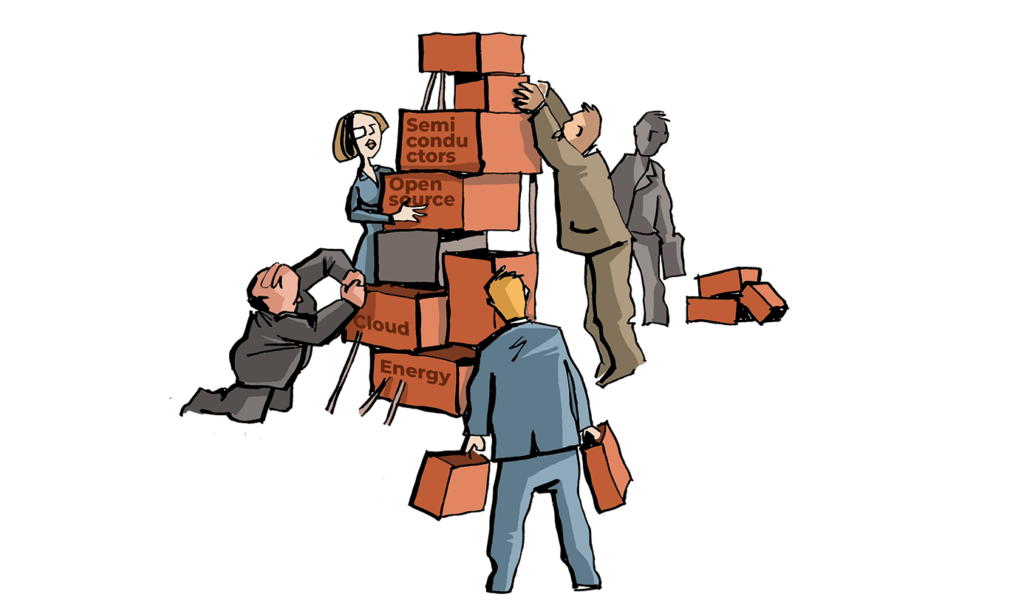
Chips, chips, chips. The first pillar of the package focuses on semiconductors. The original Chips Act, adopted in 2023, was Europe’s response to the supply-chain shocks that exposed just how dependent global industries had become on a handful of manufacturing hubs. But the Commission now believes the challenge has evolved.
The rise of AI has transformed semiconductors from a supply-chain issue into a strategic competition. AI-related components are expected to account for more than 70% of the semiconductor market by 2030, making access to advanced chips one of the defining questions of the next decade.
Chips Act 2.0, therefore, goes beyond manufacturing capacity. Alongside support for research, innovation, and production, it introduces measures designed to stimulate demand for European chips, strengthen chip design capabilities, and encourage closer cooperation between manufacturers and the industries that rely on them.
The proposal also reflects a broader shift in thinking. The first Chips Act focused heavily on supply. The new version recognises that supply and demand are interconnected. If Europe wants a stronger semiconductor industry, it needs European customers willing—and able—to buy European chips.
Building Europe’s cloud. The Cloud and AI Development Act seeks to address what Brussels increasingly sees as one of Europe’s biggest weaknesses: a shortage of computing capacity. As AI systems become larger and more resource-intensive, access to data centres and cloud services is becoming as strategically important as access to energy or transportation infrastructure. Yet Europe remains heavily dependent on foreign providers, particularly US hyperscalers.
That dependence raises economic questions, but it also raises political and legal ones. European governments are increasingly uncomfortable with the idea that critical services, sensitive data, and key parts of the digital economy rely on infrastructure operating under foreign jurisdictions.
The Commission’s answer is ambitious. CADA aims to triple Europe’s data-centre capacity over the next five to seven years while creating a framework to assess the sovereignty of cloud and AI services based on factors such as infrastructure location, supply-chain control, and cybersecurity.
Open source enters the sovereignty debate. For years, open source was discussed primarily in terms of innovation, collaboration, and software development. The Commission is now framing it as a sovereignty issue.
The argument is simple enough. Europe is home to more than three million open-source contributors and hundreds of companies built around open-source technologies. Yet public administrations and businesses continue to spend vast sums on proprietary digital products and services, many of them provided by companies outside Europe. At the same time, European developers often contribute to projects whose economic value is ultimately captured elsewhere.
Brussels sees an opportunity to change that. The strategy aims to support European open-source alternatives in areas such as cloud services, AI, cybersecurity, semiconductors, and digital identity. It also seeks to address some of the long-standing challenges facing the ecosystem, including limited funding, difficulties scaling successful projects, and the often-overlooked problem of maintaining critical software once the initial development work is complete.
No digital sovereignty without energy sovereignty. There is another reality shaping Europe’s digital ambitions: AI requires enormous amounts of electricity. As policymakers race to build more data centres, they are also confronting the question of how those facilities will fit into Europe’s energy system. According to the Commission, data centres already consume enough electricity to power nearly 20 million European households, and demand is expected to more than double by 2030.
The Strategic Roadmap for Digitalisation and AI in Energy seeks to ensure that expanding digital infrastructure does not overwhelm Europe’s energy transition. It promotes closer coordination among energy operators, public authorities, and data centre providers while encouraging the deployment of smart grids, smart meters, and AI-driven energy management systems.
The wider context. The backdrop is a growing concern that Europe has become too dependent on technologies and services controlled elsewhere. The Commission estimates that the EU relies on non-EU providers for more than 80% of its digital products, services, and infrastructure. In cloud computing, three non-European hyperscalers account for more than 70% of the market, while Europe’s own share has steadily declined.
For years, these dependencies were largely seen as the inevitable consequence of globalisation. European businesses gained access to cutting-edge technologies, consumers benefited from competitive services, and policymakers paid little attention to who controlled the underlying infrastructure.
That calculus has changed. The past few years have seen a sharp increase in export controls, investment restrictions, supply-chain disruptions, and efforts by major powers to use their technological advantages as geopolitical leverage. What was once seen as healthy interdependence increasingly looks like—and is—a vulnerability.
The Commission’s response is straightforward. The goal is not to shut down foreign providers. It is the ability to make choices, manage risks, and avoid finding itself locked into dependencies that others can exploit. Europe does not need to produce everything itself, but it wants greater control over the technologies and infrastructure on which its economy depends. Whether that balance can be maintained will be one of the most closely watched aspects of the proposal.
But, can Europe deliver? Europe has become increasingly good at identifying strategic problems. Turning that diagnosis into industrial capacity has proven more difficult. The Commission is asking Europe to build more chips, more cloud infrastructure, more open-source alternatives, and more AI capacity. None of that will happen overnight. The legislative proposals must still pass through the European Parliament and the Council. Significant investment gaps remain. And competitors are not standing still. The harder question is whether Europe can move quickly enough to close the gap.