
FIFA World Cup 2026 faces growing AI and cybersecurity threats
Cybercriminals are targeting fans and organisers throughout the FIFA World Cup 2026.
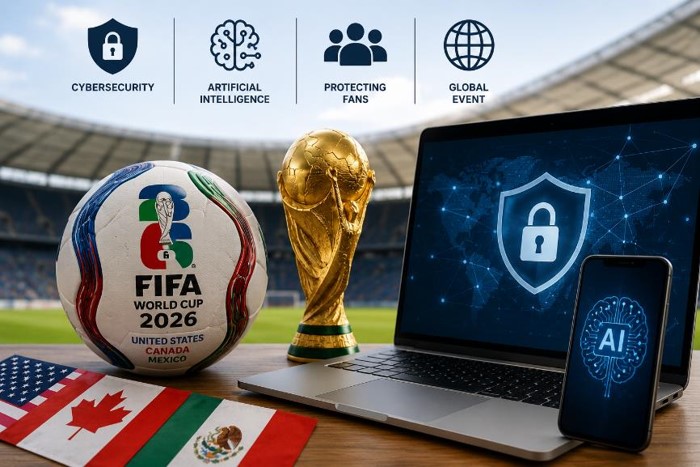
The FIFA World Cup 2026 is not only a football tournament. It is one of the largest digital security tests ever associated with a global public event.
With 48 teams, 104 matches and 16 host cities spread across the USA, Canada and Mexico, the ongoing tournament creates a vast network of stadium systems, ticketing platforms, broadcasters, hotels, transport providers, mobile applications, public Wi-Fi networks, payment systems, and connected devices.
The scale of digital interconnection is unprecedented in the history of international sport.
The Canadian Centre for Cyber Security has warned that the event will almost certainly attract cybercriminals, state-sponsored actors and other threat groups because of its visibility, infrastructure complexity, and broad supplier ecosystem.
Similar concerns have been raised by cybersecurity researchers, government agencies and intelligence analysts, all of whom view the tournament as a high-value target.

What makes the World Cup 2026 particularly significant is the growing role of AI.
AI will support crowd management, threat detection, cybersecurity operations, content moderation, logistics planning, and fan engagement. Ironically, the same technologies will provide attackers with powerful new tools to automate phishing campaigns, generate convincing deepfakes, conduct fraud operations and spread disinformation at an unprecedented scale.
Perhaps paradoxically, the result is a tournament where AI functions simultaneously as a defensive capability and an offensive weapon.
The largest entertainment attack surface in history
Cybersecurity experts have described the FIFA World Cup 2026 as the ‘largest global entertainment attack surface in history’. The description reflects not only the size of the tournament but also the complexity of its digital ecosystem.
Every match involves interactions between permanent stadium infrastructure, temporary commercial suppliers, cloud service providers, telecommunications operators, transportation networks, emergency services, broadcasters, and millions of fans. Unlike previous tournaments, many of these systems are deeply integrated through digital platforms and real-time data exchanges.
Researchers have noted that the attack surface extends far beyond FIFA’s own networks. Airlines, hotels, payment processors, media organisations, local authorities, ride-sharing platforms and tourism providers all become part of the broader security environment. A successful attack on any of these entities could create disruption that affects the tournament itself.
The Center for Strategic and International Studies (CSIS) has divided the World Cup attack surface into three layers. The first includes direct tournament infrastructure such as stadiums, ticketing systems, and broadcasting operations.

The second includes supporting infrastructure such as telecommunications networks, transportation systems and cloud providers. The third consists of millions of individual devices belonging to players, officials, journalists, sponsors and supporters.
Consequently, a cyber incident does not need to compromise FIFA directly to have significant consequences. A ransomware attack affecting a hotel chain, a denial-of-service attack against a transportation provider, or a breach of a ticketing partner could undermine public confidence and create operational disruption in multiple host cities.
AI-driven cybercrime and financial fraud
The most immediate threat facing supporters is financially motivated cybercrime. Major sporting events have historically attracted fraud schemes, but AI significantly increases their sophistication and reach.
Criminal groups are expected to exploit public interest through phishing campaigns, social engineering operations, fake ticket sales, fraudulent travel packages, malicious mobile applications and counterfeit livestreaming services.
The Canadian Centre for Cyber Security highlighted research indicating that more than 4,300 suspicious World Cup-related domains had already been identified by August 2025.
Generative AI allows attackers to produce convincing communications in multiple languages within seconds. Emails can imitate official FIFA announcements, airline notifications, hotel confirmations or ticketing updates with remarkable accuracy. AI-generated text can eliminate many of the grammatical errors that have traditionally exposed phishing attempts.
The personalisation capabilities of AI further increase effectiveness. Information gathered from social media profiles can be used to create tailored messages targeting specific individuals.
A supporter who has publicly discussed attending a World Cup match may receive a realistic-looking email containing details of a stadium, flight, or accommodation booking.
Cybersecurity researchers also warn about AI-powered chatbots designed to engage victims in extended conversations, gradually building trust before directing them towards malicious websites or fraudulent payment portals.
Such attacks represent an evolution beyond traditional phishing because they can adapt dynamically to the victim’s responses.
Deepfakes, disinformation and information warfare
One of the most significant AI-related concerns surrounding the World Cup is the potential use of deepfake technology and synthetic media.
Deepfakes can generate highly realistic audio, video, and images depicting events that never occurred. During a tournament watched by billions of people, such content could spread rapidly before verification mechanisms have time to respond.
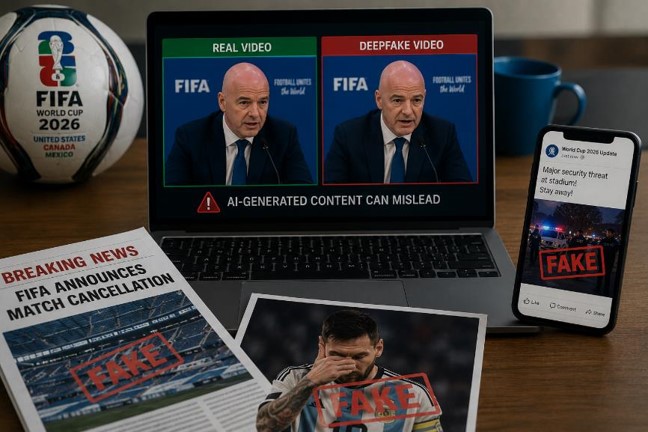
A fabricated video appearing to show a national team manager criticising players, a fake government announcement warning of security threats, or an AI-generated recording supposedly involving FIFA officials could create confusion and damage reputations.
Even brief circulation of false information may influence public perception, financial markets, or security decisions.
Threat actors are very likely to employ AI-generated articles, images and videos during the World Cup tournament. Furthermore, state-sponsored influence operations remain possible, particularly if geopolitical tensions involving participating nations intensify.
The risk is not limited to political manipulation. Criminal groups may use deepfakes to support fraud operations, impersonate public figures or create fake emergency announcements designed to generate panic.
The speed of modern social media platforms means that misleading content can reach millions of users before fact-checking efforts can become effective.
The World Cup, therefore, represents a major test for digital information resilience. Governments, media organisations and technology platforms will need rapid verification capabilities to distinguish authentic content from increasingly sophisticated synthetic media.
Critical infrastructure and operational technology risks
The World Cup’s dependence on critical infrastructure creates another layer of cybersecurity concern.
Electricity grids, water systems, telecommunications networks, transportation infrastructure and emergency communications all support tournament operations. Any disruption affecting these systems could have consequences extending far beyond football matches.
Security researchers have warned that operational technology environments often remain less protected than traditional information technology networks. Many infrastructure systems were designed decades ago, long before cybersecurity became a primary concern.
As digital connectivity expands, vulnerabilities within such systems become increasingly attractive targets.
A cyber-attack on public transportation networks could delay tens of thousands of supporters travelling to World Cup matches. Disruptions affecting telecommunications systems could interfere with emergency coordination, media coverage and public communications.
Attacks targeting stadium access systems could create safety concerns if spectators are unable to enter or exit venues efficiently.
The multinational structure of the tournament further increases its complexity. The US, Canada and Mexico operate under different legal frameworks, cybersecurity standards and regulatory environments.
Effective protection, therefore, requires unprecedented levels of coordination between public authorities and private sector partners in the three countries.
Protecting fan data and digital identities
The FIFA World Cup generates enormous volumes of personal data. Ticket purchases, accommodation bookings, transportation arrangements, mobile applications, loyalty programmes and payment systems all collect information about supporters.
Such datasets are highly attractive to cybercriminals. Personal information can be used for identity theft, financial fraud, account takeovers or targeted phishing campaigns. The concentration of large numbers of international visitors further increases the value of collected data.
Digital ticketing systems present both opportunities and risks. While electronic tickets reduce certain forms of fraud and improve operational efficiency, they also create new attack vectors. Compromised accounts, stolen credentials and fake ticket marketplaces can all exploit digital ticketing ecosystems.
The use of biometric technologies introduces additional challenges. Facial recognition systems may be employed for security screening, venue access or identity verification. Although such technologies can improve efficiency and security, they also raise questions about privacy, consent, data retention, and oversight.
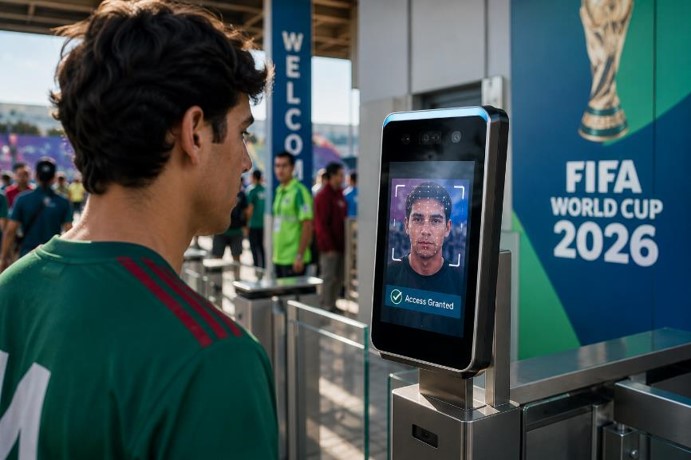
Maintaining public trust requires transparency regarding how personal information is collected, stored, and protected. Strong cybersecurity measures must be accompanied by clear governance frameworks and accountability mechanisms.
Online abuse and AI moderation
Cybersecurity during the World Cup extends beyond technical attacks. Online abuse, harassment and hate speech represent significant digital risks affecting players, officials and supporters.
Experience from previous tournaments illustrates the scale of the problem. FIFA reported that one in five players participating in the 2023 Women’s World Cup experienced online abuse. Through the Social Media Protection Service, nearly 117,000 comments were hidden or blocked during the competition. Almost half of the abusive messages were classified as sexist, sexual, or homophobic.
The scale of online interaction surrounding the men’s World Cup is expected to be substantially larger. Social media platforms, therefore, face significant pressure to prevent abuse while preserving legitimate expression.
Ofcom has already warned platforms about their responsibilities under the UK Online Safety Act. The regulator expects companies to maintain effective reporting systems, sufficient moderation resources and rapid responses to illegal content.

AI will play a central role in content moderation efforts.
Machine learning systems can analyse vast quantities of user-generated content and identify harmful material much faster than human moderators alone. However, AI moderation remains imperfect. Algorithms may struggle with sarcasm, cultural context, local languages or rapidly evolving forms of abuse.
Balancing safety and freedom of expression will remain one of the most challenging governance issues during the World Cup.
AI as a cybersecurity enabler
Despite the risks, AI has become an essential component of modern cybersecurity strategies.
Security operations centres generate enormous volumes of alerts, logs and threat intelligence data. Human analysts alone cannot process this information effectively. AI enables organisations to identify patterns, prioritise risks, and respond more rapidly to emerging threats.
Machine learning systems can detect unusual network behaviour that may indicate malicious activity. AI tools can analyse phishing campaigns, identify fraudulent domains and uncover relationships between seemingly unrelated attacks.
Automated systems can isolate compromised devices and block suspicious traffic before significant damage occurs.
AI is also becoming increasingly important for threat intelligence. Security teams use machine learning models to analyse information from global threat feeds, identify emerging attack techniques and predict potential risks. During an event as large as the FIFA World Cup, such capabilities may provide critical advantages.
Beyond cybersecurity, AI supports broader security operations. Computer vision systems can monitor crowd movement, identify congestion points, and assist with emergency planning. Predictive analytics can help authorities allocate resources more effectively and improve incident response capabilities.
Nevertheless, AI should be viewed as a force multiplier rather than a replacement for human expertise. Automated systems can produce false positives, miss novel attack methods or be manipulated through adversarial techniques. Human oversight remains essential, particularly when decisions affect public safety and civil liberties.
International cooperation and long-term implications
The cybersecurity challenge facing the World Cup cannot be addressed by FIFA alone. Effective protection requires collaboration among governments, intelligence agencies, law enforcement organisations, cloud providers, telecommunications companies, stadium operators, and cybersecurity firms.
Information sharing will be particularly important. Threat intelligence must move rapidly across organisations and national borders. Attack indicators identified in one host city may become relevant to another within minutes.
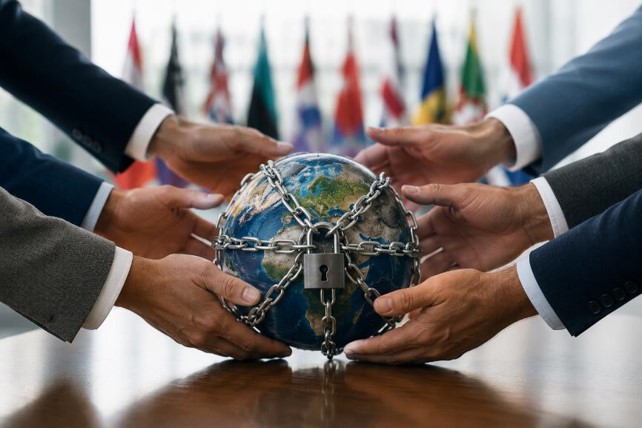
The World Cup also serves as a preview of the future challenges facing large-scale public events. As AI becomes increasingly integrated into infrastructure, transportation, communications and security operations, future tournaments will become even more dependent on digital technologies.
The lessons learned from 2026 are therefore likely to influence cybersecurity planning for future Olympic Games, continental championships, political summits and other international gatherings.
Conclusion
The FIFA World Cup 2026 demonstrates how deeply sport has become intertwined with the digital world. Football remains the centrepiece of the tournament, but its success depends equally on cybersecurity, AI governance and operational resilience.
AI will help protect infrastructure, support threat detection, improve crowd management, and strengthen cyber defence capabilities. At the same time, it will enable more sophisticated phishing campaigns, more convincing deepfakes, more effective disinformation operations and increasingly personalised fraud schemes.
The central challenge is not whether AI should be used. The challenge is how it can be deployed responsibly, securely and transparently within one of the most complex public events ever organised.
Success will depend on balancing innovation with security, automation with human oversight and efficiency with public trust.
The real test for FIFA, host governments and technology providers will be resilience. Cyber incidents are almost inevitable given the scale and visibility of the tournament. What will matter most is the ability to detect threats quickly, limit disruption, recover effectively and maintain public confidence.
Ultimately, the FIFA World Cup 2026 may be remembered as the first truly AI-era World Cup, where cybersecurity, misinformation and digital resilience have become as important as events on the pitch.
As citizens, supporters and digital users, we each have a role to play in protecting the integrity of the information and technologies that increasingly shape our lives.
Would you like to learn more about AI, tech and digital diplomacy? If so, ask our Diplo chatbot!
About author

Ilias Dimou
Mr Ilias Dimou is a political scientist with a strong academic background, holding master's degrees in Ethics and Political Philosophy, as well as in Philosophy of Law. His research experience includes work at the Aristotle University of Thessaloniki, where he focused on electoral behaviour.