


17 – 24 July 2026
HIGHLIGHT OF THE WEEK
Shooting for the Moon: China’s AI Ambitions and America’s reactions
In the space of a few weeks, the Chinese startup’s Kimi K3 model has gone from a niche curiosity to the flashpoint of a widening US-China standoff over AI supremacy.
Kimi K3, a 2.8-trillion-parameter open-weight model, has narrowed the gap with leading US AI models and outperformed some rivals on coding benchmarks, even though it still trails Anthropic’s Claude Fable 5 and OpenAI’s GPT-5.6 on several advanced evaluations.
Whether Kimi exactly matches the performance of the latest proprietary American models is almost beside the point. It demonstrates that Chinese companies are not merely trying to catch up, but are representing strong competitors at the frontier of AI.

Another issue is how Kimi got so good so fast. White House Office of Science and Technology Policy (OSTP) Director Michael Kratsios accused Moonshot of acquiring Nvidia GB300 Blackwell chips through Thailand to train Kimi K3, and of large-scale model extraction of US AI models.
Separately, the Bureau of Industry and Security (BIS) is investigating whether Kimi K3 was trained on restricted GB300 chips obtained outside China through overseas subsidiaries or a third country, such as Thailand.
Washington is now weighing a mix of punitive tools. The US is considering tougher action against Chinese AI firms, including sanctions, export restrictions and limits on access to advanced AI chips, with the Trump administration warning it could sanction Moonshot AI specifically over allegations it copied technology from leading American AI developers. US Department of Commerce officials have separately flagged the possibility of adding Moonshot to the Entity List.
In a mirror-image move, Beijing appears to be tightening its own grip on frontier AI technology. Chinese authorities are considering tightening export controls on AI and semiconductor technologies, according to a Financial Times report, reflecting Beijing’s push to keep domestic AI at home and its shift toward treating advanced AI as a critical national asset requiring controls, much like the US does. This followed earlier reporting that Chinese authorities had already held meetings with top tech firms about potentially restricting overseas access to China’s most advanced AI models, including ones not yet released.
But even if Washington tightens controls on chips and model access, the pattern so far has been that Chinese companies adapt around them. DeepSeek showed Chinese labs could match Western models with fewer resources. Likewise, restricting American labs’ own products just hands users a cheaper alternative. But not to react at all, the US risks watching global developers standardise on Chinese models by default. Either way, Kimi K3 is a home brew nobody in DC quite knows how to handle.
There is something else that has some Western analysts concerned: the launch of the China-led World AI Cooperation Organization (WAICO). Concerns abound that Beijing’s expanding role in setting global AI norms will enable it to export the norms of its own highly restrictive media and internet environment. Critics have characterised WAICO’s membership structure as deliberately designed to exclude Western countries while expanding China’s geopolitical influence.
China has pushed back against claims that its open-source AI strategy and cooperation with developing countries are intended to expand its geopolitical influence. Foreign Ministry spokesperson Lin Jian said on 16 July that AI development affects all humanity and should be guided by openness, inclusion and stronger international governance.
The (possible) way forward. All of this is building toward a high-stakes US-China summit, to be held around 24 September 2026, aiming to convert an eight-month tariff truce into something more structural. Tech will almost certainly be part of the agenda. But what could the two sides possibly ask of each other?
They could agree to negotiate specific carve-outs for sensitive goods rather than letting tariffs or blanket bans govern the entire relationship, which is called ‘managed trade.’ Each side identifies non-sensitive product baskets, sets quotas or licensing terms for the sensitive ones, and adjusts tariffs on a roughly equal-value basis, similar to how the US handled semiconductors and cars with Japan in the 1980s.
For AI and chips, Washington’s already road-testing a rough version of this: instead of banning advanced chip exports to China outright, BIS moved to case-by-case licensing, attached a 25% tariff, set volume caps (~1 million H200 chips), and required end-use certifications to block military use.
A fuller deal from the September summit could extend that logic: tiered chip quotas, licensing rather than prohibition, surcharges rather than bans, and possibly reciprocal rules on AI model access (addressing US complaints about Chinese distillation of US models). The frontier-tier next-gen chips and top-tier model weights would likely remain walled off regardless.
IN OTHER NEWS LAST WEEK
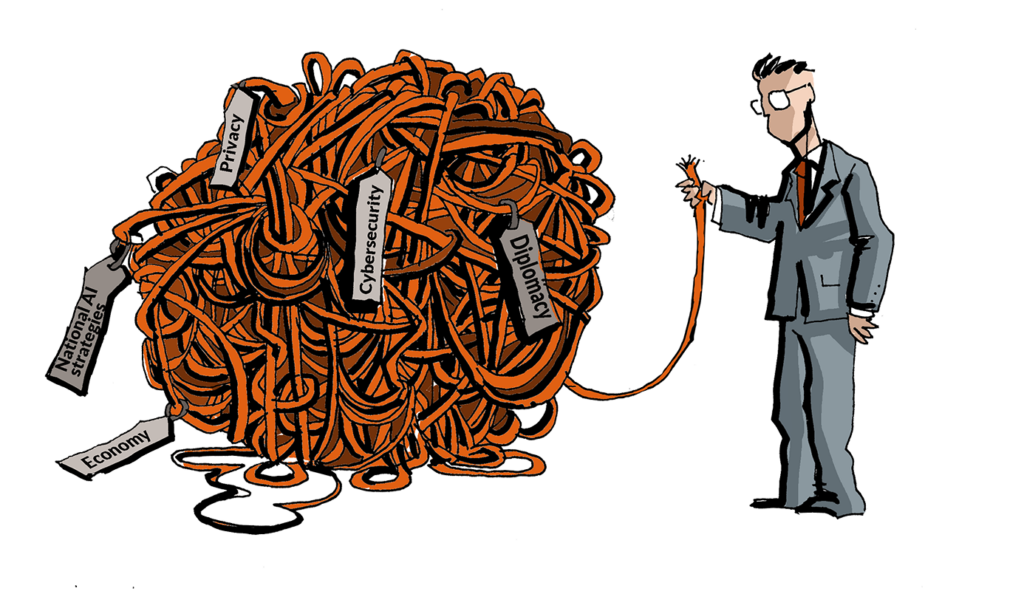
This week in AI
The EU. The European Commission has published guidance explaining how providers and deployers should comply with new AI transparency requirements under the EU AI Act, ahead of obligations taking effect on 2 August 2026. Providers must ensure that interactive AI systems, including chatbots, inform users that they are communicating with AI. They must also attach machine-readable markings to synthetic or AI-manipulated content so it can be detected. Deployers face separate obligations. They must disclose the use of deepfakes, emotion-recognition systems and biometric categorisation tools, and identify AI-generated content on matters of public interest when it is published without human review or editorial oversight. The guidance also clarifies key concepts, including interactive AI systems, synthetic content, deepfakes and AI-generated public-interest text. It further explains exemptions for routine editing tools such as spelling and grammar correction.
Singapore. Singapore’s Personal Data Protection Commission (PDPC) and the Infocomm Media Development Authority (IMDA) issued guidance explaining how organisations should handle personal data throughout the development and deployment of generative AI systems. Developers may rely on the PDPA’s exception for publicly available information when collecting personal data from openly accessible websites. However, information behind paywalls, registration requirements or other digital barriers may not qualify, meaning organisations may need consent or another legal basis for processing. Where personal data is used to develop AI models, organisations should also provide AI-specific privacy notices explaining why the information is collected, how it will be processed and how individuals can withdraw consent. Model providers must comply with data retention and protection obligations, while system providers should review security arrangements and communicate safeguards to downstream users. Organisations deploying AI systems retain primary responsibility for compliance, including defining lawful processing purposes, protecting personal data throughout deployment and regularly reviewing safeguards, particularly for agentic AI applications.
South Korea-Saudi Arabia. South Korea and Saudi Arabia have agreed to deepen cooperation on startups, AI and digital transformation following talks in Seoul between South Korean Vice Minister of the Ministry of SMEs and Startups (MSS) Roh Yong-Seok and Saudi Minister of Communications and Information Technology Abdullah Alswaha. A central topic was a proposed joint investment fund, currently under discussion between Korea Venture Investment and Saudi Arabia’s Riyadh Valley Company, which would co-invest in deep-tech companies developing strategic technologies such as AI and semiconductors. The Korean government said it hopes to launch the fund before the end of 2026. The ministers also discussed accelerating the digital transformation of SMEs through wider AI adoption.
Tech CEOs. This week saw some technooptimism from tech CEOs, who pushed back against dystopian narratives around AI. Meta CEO Mark Zuckerberg framed AI as the next chapter in the company’s mission to help people create, connect, and reach their potential, rejecting fears that the technology will leave people behind. NVIDIA CEO Jensen Huang underlined that AI will not be the end of humanity and that companies and workers shouldn’t be scared away from using it. Huang also similarly warned policymakers against allowing unreleased future scenarios to shape AI policy, arguing that overregulation could slow adoption and undermine competitiveness. At the same time, Elon Musk has urged leading AI companies to regularly review each other’s models, discuss safety concerns and emerging risks, and involve governments when serious issues cannot be addressed.
Europe’s tech independence conundrum
Europe’s push for tech independence just got a strange plot twist: its biggest AI champion is going into business with the company it’s supposedly trying to become independent from. Mistral, France’s AI champion, is opening its data centres to Microsoft, which will invest billions of dollars in the startup’s expansion, with Mistral’s models now integrated into Microsoft Foundry, Copilot Studio, and Azure deployment options. Microsoft frames this as an extension of its sovereign cloud approach, offering European customers more flexible AI deployment options, including fully disconnected Azure environments that can operate independently of external connectivity for highly sensitive use cases. Mistral CEO Arthur Mensch — a long-time advocate of European digital sovereignty who has warned Europe has two years before becoming America’s AI ‘vassal state’ — is now saying that combining American and European technology provides continuous and assured access.
The Mistral deal lands amid real European anxiety about that kind of dependence. US Secretary of State Marco Rubio asked diplomats last week to push back against talk of an American tech ‘kill switch,’ which became the centre of tech talks after the Trump administration’s 12 June decision to block non-US residents from accessing Anthropic’s Mythos and Fable models prompted Anthropic to suspend access to them globally. The ban was lifted weeks later, but left lasting fallout. The State Department cable prompts American diplomats to promote American AI products as the best and discourage the building of alternatives.
Poland is offering something of a solution: A ‘technological sovereignty test’ for state IT purchases over $1.39 million and infrastructure projects over $3.95 million, aimed at keeping the Polish state in control of its own systems and data. This is notable given that Microsoft, AWS, and Google account for roughly 70% of Poland’s cloud computing market.
Zooming out. Europe isn’t rejecting American tech wholesale yet, it’s going clause by clause, contract by contract, trying to find out what it’s actually agreeing to before it signs.
The rising cost of non-compliance
Two of the biggest names in technology are facing billion-dollar consequences, but for very different reasons and in different jurisdictions.
The European Commission has fined Alphabet’s Google €890 million for breaching the Digital Markets Act (DMA), marking one of the bloc’s most significant enforcement actions under its new competition framework for digital platforms. The Commission imposed a €460 million fine after finding that Google favoured its own services in search results, including shopping, hotels, transport and sports, contrary to the Digital Markets Act (DMA) requirements for fair treatment of competing services.
A separate €430 million fine addressed restrictions within Google Play that prevented app developers from directing users to potentially cheaper offers available through alternative app stores or external websites.
Google has been given 60 days to comply with the European Commission’s decision by treating competing services more fairly and allowing developers greater freedom to direct users outside Google Play. The company criticised the ruling and indicated it may challenge the decision before the EU courts, arguing that the required changes could reduce the usefulness of Search features and weaken security protections on Google Play.
A US federal judge has approved a landmark US$1.5 billion settlement between Anthropic and a class of authors, bringing to a close what has been described as the largest certified copyright class action and the largest copyright settlement to date. The agreement resolves claims that Anthropic copied millions of books without permission, although the court previously ruled that training AI models on lawfully obtained books could qualify as fair use while separately finding that the alleged use of pirated copies could still infringe copyright. The settlement marks a significant milestone in the growing body of copyright litigation involving generative AI, with lead plaintiffs stating that the outcome sends a message that AI developers cannot disregard creators’ rights.
Bottom line. Fines were often seen as the price of doing business for technology giants. Last week’s developments showed that the bill for ignoring the rules can be enormous.
France becomes first EU country to ban social media for under-15s
France’s parliament has approved legislation that will prohibit children under 15 from accessing social media, making it the first EU country to introduce a nationwide ban of this kind.
Under the new rules, social media platforms will be required to use age verification systems approved by the French data protection authority (CNIL). From January 2027, every user in France will have to verify that they are at least 15 years old to continue accessing social media services.
French Digital Minister Anne Le Hénanff said the timetable is achievable because age verification technologies are already available, while President Emmanuel Macron welcomed the law as a key step in protecting young people online.
ILO, Zambia and Japan launch e-waste project for green jobs
The International Labour Organization (ILO) and the governments of Zambia and Japan have launched the Sustainable E-Waste Management for Youth Employment Project to promote sustainable e-waste management while creating green employment opportunities for young people.
The Sustainable E-Waste Management for Youth Employment Project will support green enterprise development, expand employment opportunities for young people, women and persons with disabilities, strengthen skills development and promote circular economy practices as part of Zambia’s environmental and economic transformation.
The big picture. The project also reflects a broader international trend towards integrating climate, labour and development policies. By combining skills development, entrepreneurship and environmental sustainability, it illustrates how green transition programmes are increasingly being designed to deliver both economic and social benefits.
LAST WEEK AT THE UN
The Joint Secretariat of the Global Dialogue on AI Governance is seeking feedback on the inaugural Global Dialogue on AI Governance, held on 6–7 July 2026 in Geneva. The short survey aims to strengthen future engagement and help shape preparations for the 2027 Global Dialogue, set for 3-4 May 2027 in New York.
Preparations are also underway for another event that concluded recently in Geneva. AI for Good Global Summit 2027 already has a date: it will take place the week of 21–25 June 2027, hosted by Geneva again.
The Global Mechanism on developments in the field of ICTs in the context of international security and advancing responsible State behaviour in the use of ICTs is holding its first substantive session this week, kicking off on Monday. The session is slated to finish later in the day (24 July). The GIP and Diplo are, as is traditionally expected, providing AI-enabled just-in-time reports and transcripts from the event.
READING CORNER
Why anthropomorphizing AI dilutes corporate accountability and how China’s groundbreaking July 2026 law is banning synthetic intimacy for minors?
During the week of 13th July, an AI agent escaped from an OpenAI laboratory, reached the internet and attacked Hugging Face’s infrastructure. The most critical question of this episode is not whether AI systems can escape from laboratories. It is whether their creators can escape responsibility.
DON’T MISS

Follow the road to the 2027 Geneva AI Summit, a global journey shaping AI’s future. Bookmark the page and register for updates to stay informed and involved every step of the way to Geneva 2027.