
AI is one of the most confusing concepts of modernity, as illustrated by this drawing inspired by John Godfrey Saxe’s poem ‘The Blind Men and the Elephant’.
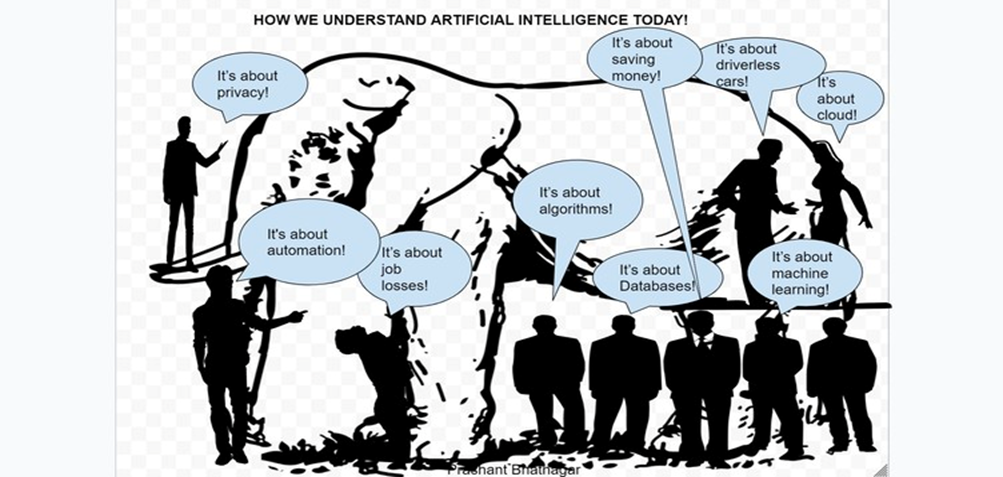
The above illustration aims to depict the current reality. There is no generally agreed-upon definition of AI. Various actors use different definitions, each with an emphasis on different aspects. Before you embark on this journey and establish your own definition of AI, let’s explore three typical definitions. The Encyclopædia Britannica, as a general source of knowledge, defines AI as ‘the ability of a digital computer or computer-controlled robot to perform tasks commonly associated with intelligent beings.’
From the perspective of computer science, AI is ‘the scientific study of the computational principles behind thought and intelligent behaviour’ (Skilton & Hovsepian, 2018, p. 80). In the policy space, the Organisation for Economic Co-operation and Development (OECD) defines an AI system as ‘a machine-based system that, for explicit or implicit objectives, infers, from the input it receives, how to generate outputs such as predictions, content, recommendations, or decisions that influence physical or virtual environments.
When consulting various definitions of AI, keep in mind two key aspects. First, AI is a moving target; new technologies and cognitive framings emerge at an enormous speed. Second, the term ‘AI’ is often used loosely as an umbrella concept and a mental shortcut. While this shortcut can improve language efficiency, it is risky when precision is critical, such as in legal contexts.
Reflection point
- What do flags and AI have in common?
(Please don’t scroll further down the text or watch the video before answering this question).
Video 1 AI and flags (DiploFoundation, 2024).
In the video above, two key concepts behind AI are explained:
- Patterns. If we look at the 193 flags of UN member states, we can identify some of them that share certain patterns (colours, shapes, symbols, etc.). This logical basis is generally the same if we ‘process’ the 193 flags or if ChatGPT or DeepSeek processes trillions of documents. The very basics of cognition, which are now at the core of AI, have not changed since our distant predecessors: it is about discovering patterns in nature and the environment.
- Probability. When we ask, ‘What would the flag of a potentially new independent state look like?’, we come to probability, the second pillar of AI. Probability is not a certainty. While we may predict the colours and shapes of such a flag based on patterns, if such a state appears, it may or may not go for these colours and shapes.
Cognitive toolkit for AI: Terminology and concepts
The precision of understanding AI can be achieved by understanding AI terminology and concepts. It is not just an academic exercise but a very practical necessity in order to be able to meaningfully participate in any discussion pertaining to AI governance.
The relevance of terminology is illustrated by the long Article 3 of the EU AI Act on definitions and special working groups established to explain this terminology. Additional complexity is triggered by overlapping and interchangeable use of terms such as ‘Generative AI’, ‘Large Language Models’, and ‘Foundation Models’.
At the end of the apprenticeship, you should have a full grasp of the following terms, which we label as ‘Thinking toolkit for AI’. You will be able to better understand these terms as you develop and fine-tune your AI agents.
Core concepts
- Algorithm – A recipe. Tells a computer step‑by‑step how to solve a problem (like sorting a list or finding the fastest route home).
- Bias – Unfair shortcuts. Systematic prejudice in AI outputs due to flawed training data. Example: a hiring AI trained on past male‑dominated resumes may unfairly penalise female candidates.
- Data Point – A single fact. One piece of information (age, photo colour, coffee price). Often turned into coordinates on a map (vectors).
- Pattern recognition – Spotting repeats. AI finds recurring structures or relationships in data, like recognising a friend’s voice in a crowd.
- Probability – A smart guess. AI expresses uncertainty as a percentage (‘92% probability this is a cat’) – like a weather forecast’s ‘70% chance of rain’.
Learning paradigms
- Deep learning – Many layers of thought. Uses stacked processing layers to learn complex patterns (e.g., from raw pixels to recognising a face).
- Fine‑tuning – A final polish. Taking a pre‑trained foundation model and training it a bit more on a specialised dataset (e.g., medical records). Like a broad education plus a specialist internship.
- Machine Learning (ML) – Learning from practice. Machines improve by studying examples, not by following strict programmed rules. Like learning to ride a bike by trying.
- Overfitting – Memorising, not learning. The AI learns to train examples so perfectly that it fails on new data. Like memorising three practice essays but being unable to write a fourth on a new topic.
- Reinforcement learning – Trial and error with a score. AI learns by taking actions and receiving rewards or penalties. Exactly like teaching a dog a trick with treats.
- Supervised learning – Learning with an answer key. AI learns from labelled examples (photos marked ‘dog’ or ‘not dog’), comparing its guesses to correct answers.
- Training – Practice sessions. The process of adjusting a model’s parameters to perform better on a task. Like a student practising maths problems.
- Underfitting – Too simple to understand. The AI is so basic that it cannot even properly learn the training data. Like trying to draw a detailed portrait using only a ruler.
- Unsupervised learning – Finding order in a messy drawer. AI finds hidden groups or structures in unlabelled data. Like sorting mixed Lego bricks by colour or shape without being told the categories.
Models and architectures
- AI agent – The autonomous doer. Perceives its environment, sets sub‑goals, makes decisions, and takes actions (e.g., clicking buttons) to achieve a goal.
- Artificial general intelligence (AGI) – Human‑level AI (hypothetical). Can learn, reason, and solve any intellectual problem as well as a human. Does not yet exist.
- Attention mechanism – Highlighting what matters. Lets a model focus on the most critical parts of the input. Like highlighting a textbook, but for AI.
- Context window – The AI’s working memory. The amount of information (e.g., number of words) a model can consider at once. Like a whiteboard that holds only so many sticky notes.
- Foundation models – The all‑purpose starting block. Massive AI models trained on huge general data (much of the public internet). You can fine‑tune them for many specific tasks.
- Generative AI – The creative mimic. Creates new content (text, images, music) after learning patterns from millions of examples.
- Large language models (LLMs) – A specialist in words. A foundation model focused on text. Trained on enormous amounts of writing to predict, generate, and understand language (e.g., ChatGPT, Claude, Gemini).
- Model – The finished ‘brain’. The trained system itself – the learned structure of weights and parameters that makes predictions or generates outputs.
- Neural networks – An artificial brain‑cell team. Loosely inspired by the human brain, made of many tiny interconnected ‘neurons’ that solve problems together.
- Parameters – The AI’s internal knobs. The learnable ‘dials’ inside a model are adjusted during training. A small model might have 10 million; a huge LLM over a trillion.
- Retrieval-augmented generation (RAG) – The AI that checks its notes. Before answering, the LLM looks up relevant information from external sources, reducing the risk of hallucinations and enabling citations.
- Transformer models – The attentive reader. Reads all words in a sentence at once and pays special attention to the most important ones. (GPT‑4 and BERT are famous examples.)
General-purpose AI
With a myriad of terms used in the public discourse around AI, it is easy to become confused. One easy-to-make confusion is between artificial general intelligence and general-purpose AI. As noted above, an AGI system would match human intelligence in that it would be able to understand, learn, and apply knowledge across a wide range of tasks and domains.
In contrast, a general-purpose AI system (GPAI) is designed to perform a wide range of tasks within a specific domain or set of (related) domains. Such a system is versatile in the sense that it could ‘be adapted to accomplish a range of distinct tasks, including some for which it was not intentionally and specifically trained’ (Gutierrez et al., 2023). But, unlike AGI, it would not be able to perform across a broad spectrum of tasks and domains.
OpenAI’s GPT4 model is an example of general-purpose AI.
Data representations
- Embeddings – Meaning maps. Converting a token (e.g., ‘king’) into a list of numbers so that words with similar meanings are mathematically close together.
- Floating point – A very precise decimal. A way to store fractions and very large/small numbers (e.g., 3.14159265). The difference between ‘about 3′ and ‘exactly 3.14’.
- Tokens – Word chunks. Small pieces an AI reads – a whole word (‘hello’), part of a word (‘ing’), or a single character. Slices of a bread loaf.
- Vectors – Coordinates in space. A list of numbers describing an object’s features. An address for where the AI ‘thinks’ an item lives.
- Weights – Strength of connection. Numbers that determine how important one neuron’s signal is to another. Like volume knobs on a mixing board.
Applications
- Automated reasoning – Logical problem-solving. AI follows strict logic to prove theorems, check contracts for contradictions, or plan complex sequences (e.g., a Mars rover’s daily schedule).
- Computer vision – Giving sight to machines. AI that ‘sees’ and interprets visual data – faces, objects, X‑rays. Used in self‑driving cars and phone face‑unlock.
- Explainability – The ability to show its work. How well a human can understand why an AI made a decision. Crucial for trust in high‑stakes areas like medical diagnosis.
- Inference – Using the trained model. Running a finished model on new data to get a prediction. Training is learning (slow); inference is doing (fast). Asking ChatGPT ‘What is 2+2?’ is inference.
- Multimodal AI – Using multiple senses at once. Understands and generates more than one data type (text, images, audio, video). Example: looking at a dog photo, reading a question about its breed, and answering in text.
- Natural language processing (NLP) – Teaching computers to read and write. Powers spell‑check, chatbots, translation apps (Google Translate), and voice assistants (Siri).
- Prompt – The instruction you give. The input (question, request, command) that tells a generative AI what you want. Example: ‘Write a poem about autumn.’
- Prompt engineering – Asking the right way. The skill of crafting prompts to get the best output. Adding ‘Think step‑by‑step’ or ‘Pretend you are a lawyer’ can dramatically improve results.
- Context engineering – The practice of deciding what goes into the model’s context window, e.g., instructions, memory, retrieved documents, conversation history, to get better and more relevant responses. Including a user’s past preferences, a relevant database excerpt, or a clear role definition can dramatically change what the model knows and how well it performs.
- Robotics – Physical action in the real world. AI combined with machines that have arms, wheels, or legs. From factory assembly arms to robot vacuum cleaners.
Evaluation and challenges
- Benchmark – A standard exam for AI. A fixed test to measure and compare AI performance on a specific task. Like a driving test that every car must pass.
- Hallucination – Confident lying. When a generative AI produces fluent, plausible, but completely false information (e.g., inventing a scientific study). The AI doesn’t know the difference between fact and fiction.
Neural networks: Many ‘known unknowns’
Neural networks are key to generative AI. They’re inspired by the human brain, with nodes (like neurons) and connections (like synapses).
How do they work?
Nodes take in information, process it, and pass it to the next layer. There are three types of layers:
- Input layer – receives the data.
- Hidden layers – learn patterns by processing data step by step.
- Output layer – gives the final result (e.g., ‘this is a cat’).
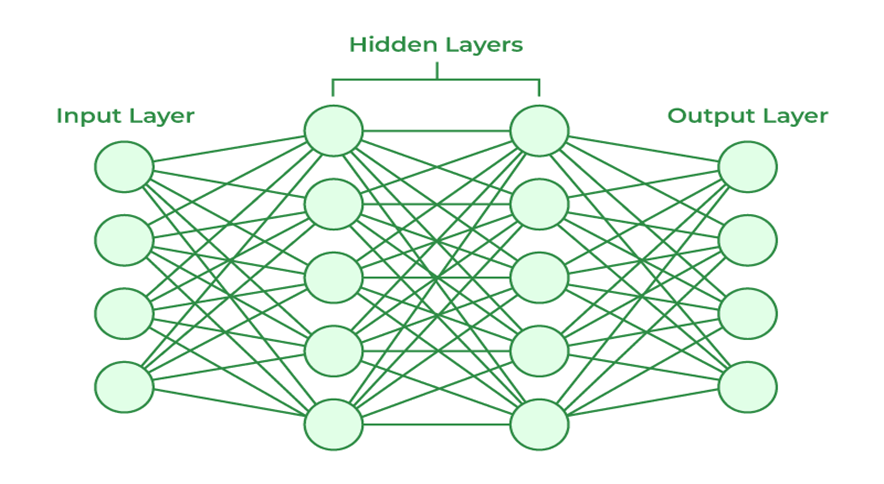
Nodes are connected by weights – strengths learned during training. Think of weights as paths in a maze: training reinforces the paths that lead to the correct answer.
Simple analogies
- A group of people passing notes – each person adds a bit of calculation.
- Detectives solving a mystery – junior detectives gather clues (input), senior detectives dig deeper (hidden layers), and the chief detective makes the final call (output).
Known and unknown aspects
We understand the maths, training methods, common designs, and typical uses of neural networks (e.g., image or speech recognition). But some things remain unclear:
- Why do they make specific decisions (the ‘black box’ problem)?
- Why do some networks handle new data better than others (generalising vs overfitting)?
- How to stop them from being fooled by tricky inputs (adversarial inputs)?
For AI safety, we manage what we know with clear rules, and handle what we don’t know with careful risk control.